

A vendor evaluation framework is a repeatable, weighted method for scoring vendors against pre-agreed criteria, scaled to the risk and value of the contract. The best approach for most procurement teams is a weighted scorecard that puts real weight on integration, total cost of ownership and vendor viability, not just price and features, and adjusts the depth of due diligence to how much is at stake.
Weighting matters because capability fit, integration, TCO, vendor viability and support all shape whether a vendor delivers long after the contract is signed. Lock your weights before demos, use a defined 1–5 scoring scale, and treat compliance minimums as pass/fail gates rather than scored line items.
Do this now:
- Write down requirements and weights before contacting a single vendor.
- Assemble a cross-functional scoring panel (technical, finance, security).
- Build a scorecard template and a 60 to 90 day pilot plan before shortlisting.
Key Takeaways
A vendor evaluation framework works because it replaces gut feel with a weighted, evidenced scorecard scaled to contract risk, backed by a timeboxed pilot and enforceable contract terms.
| Point | Details |
|---|---|
| Lock weights first | Agree criteria and weights in writing before any vendor demo or proposal arrives. |
| Score integration and TCO seriously | These two dimensions are routinely underweighted yet drive most long-term vendor problems. |
| Pilot on a timebox | Run a 60 to 90 day pilot with predefined KPIs and a clear go/no-go threshold. |
| Use Aithea and Heliolus AI | Aithea builds the scorecard and pilot plan, and Heliolus AI helps shortlist RegTech vendors by verified capability. |
Table of Contents
- Executive checklist for evaluating vendors today
- What is a vendor evaluation framework and why does it matter?
- When should you run a full vendor assessment?
- What criteria belong in a vendor evaluation scorecard?
- How do you build a weighted vendor scorecard?
- What are the steps in a vendor selection process?
- How do you design a pilot and a go/no-go decision?
- What does total cost of ownership actually include?
- How do you track vendor performance after selection?
- What extra criteria apply to AI and RegTech vendors?
- How do you keep vendor scoring free of bias?
- What actually breaks vendor evaluations in practice
- How Aithea supports your vendor evaluation from start to finish
- Sources
- FAQ
Executive checklist for evaluating vendors today
Before anything else, lock your requirements and weighting. Every hour spent adjusting weights after seeing a demo is an hour spent justifying a decision you have already made emotionally.
- Finalise requirements and criteria weights in writing, signed off by finance and the business owner, before any vendor briefing.
- Name your evaluation panel: a process owner, a technical subject-matter expert, someone from finance, and someone from security or legal.
- Draft a one-page timeline covering RFP issue, scoring, pilot and contract target dates.
- Shortlist no more than four vendors and commit to a timeboxed pilot with go/no-go KPIs agreed in advance.
Pro Tip: Print the scorecard and weights on one page and get every panel member to initial it before the first vendor call. It stops "we forgot the weighting" arguments six weeks later.
What is a vendor evaluation framework and why does it matter?
A vendor evaluation framework is a structured, weighted method for comparing suppliers against criteria your organisation agreed on before proposals arrived. It replaces gut feel with a documented, defensible score.
Three benefits stand out for procurement leaders:
- Defensible decisions. A signed scorecard and decision memo protect you when a losing bidder challenges the outcome or an auditor asks why a vendor was chosen.
- Lower total cost. Integration and TCO are routinely underweighted in informal evaluations, yet they materially determine long-term success far more than the headline licence fee.
- Better vendor behaviour. Vendors who know they are being scored on support responsiveness and SLA performance, not just price, tend to negotiate and deliver differently.
The mechanics borrow directly from established procurement practice: an RFP evaluation matrix, weighted criteria, and a scoring scale applied consistently across every bidder.
When should you run a full vendor assessment?
Not every purchase deserves the same scrutiny. A stationery contract and a core AML transaction-monitoring platform should never go through identical diligence.
Run a full assessment when the vendor touches regulated data, integrates deeply into core systems, or represents strategic annual spend. Three tiers work well in practice:
- Light: low-value, low-risk, easily replaced vendors. A short checklist and a reference call suffice.
- Medium: moderate spend or moderate integration. Full scorecard, two to three references, financial snapshot.
- Heavy: regulated data, high integration, high spend or reputational exposure. Full scorecard, independent scoring, pilot, financial due diligence and legal review of exit terms.
| Point | Details |
|---|---|
| Match effort to risk | Scale checks, not just paperwork, to contract value and regulatory exposure. |
| Light tier is fast | Reserve full scorecards and pilots for vendors with real integration or compliance exposure. |
| Heavy tier needs time | Budget extra weeks for financial due diligence and legal review on strategic contracts. |
What criteria belong in a vendor evaluation scorecard?
Your scorecard needs to cover technical fit alongside the commercial and risk dimensions that decide whether the relationship survives past year one.
Include these dimensions as separate scored rows:
- Capability and technical fit against your stated requirements
- Integration and interoperability with existing systems
- Total cost of ownership across implementation, licensing and support
- Vendor viability and financial stability
- Support quality and SLA terms
- Compliance, security and certification status
- Past performance and verifiable references
- Risk, expressed as likelihood multiplied by impact
- Data portability and contractual exit terms
Dr Ray Carter's widely used 10C model maps neatly onto this structure: Capacity, Competency, Consistency, Control, Cost, Commitment, Culture, Clean (a proxy for CSR and ethics), Communication and Cash (financial integrity). Each "C" becomes a scorecard row, and the model's real value is that it forces you to score financial health and cultural fit with the same rigour you apply to price.
A vendor's Cash position and Control processes tell you more about delivery risk over three years than their demo tells you about features today.
For evidence, request audited financials or a recent P&L, ISO or SOC 2 certificates, three verifiable client references, a live product demonstration with your own test data, and API documentation where integration matters. Aithea's analysis of qualitative supplier factors shows how culture and communication, the softer Cs, often predict delivery problems that a features checklist misses entirely.
How do you build a weighted vendor scorecard?
A working scorecard needs six columns: category, sub-criteria, weight, score, evidence, and evaluator notes. Skip any one of these and the scorecard collapses into an opinion poll with numbers attached.
- List categories and sub-criteria. Break "compliance" into certifications held, audit history and breach disclosure record, for instance.
- Assign weights before you see a single proposal. Weights should sum to 100% across all categories.
- Define the 1–5 scale in writing. A "3" for support might mean "responds within 24 hours, no dedicated account manager"; a "5" might mean "responds within 2 hours, named account manager, 24/7 escalation path". Written definitions reduce scorer variance far more than a bare numeric scale.
- Add an evidence field. Every score needs a citation: a document, a demo note, a reference call transcript.
- Include an evaluator notes field for outliers and dissent, which feeds your calibration session later.
Typical weight distributions for a mid-sized technology procurement run technical fit at 30 to 40%, price at 25 to 35%, vendor experience and references at 15 to 20%, and support or governance at 10 to 15%. For a compliance technology purchase, shift several points from price toward compliance and data portability, since a cheap tool that cannot prove its audit trail is not actually cheap.
Mandatory requirements, such as a specific certification or a data residency commitment, should sit outside the weighted score entirely and act as pass/fail gates. A vendor that fails a gate is removed from the shortlist regardless of how well it scores elsewhere.
What are the steps in a vendor selection process?
The process runs from requirements to contract in a fixed sequence, and skipping a step is usually where evaluations go wrong.
- Lock requirements and weighting. Deliverable: a signed requirements document with agreed criteria weights.
- Issue the RFI or RFP. Deliverable: a standard RFP evaluation matrix sent to every bidder so responses are comparable.
- Shortlist against pass/fail gates. Deliverable: a scored shortlist memo naming who advances and why.
- Score independently, then calibrate. Deliverable: individual scorecards from each evaluator, reconciled in a single calibration meeting.
- Run a pilot. Deliverable: a pilot report against predefined KPIs.
- Negotiate contract terms. Deliverable: a term sheet covering SLAs, exit terms and pricing.
- Award and document. Deliverable: a decision memo and notice of intent to award.
A few practical notes make this run smoothly:
- Involve finance and security early, not at contract review, or you will re-score late and lose momentum.
- Run the calibration session as a structured meeting with the scorecard on screen, not a free-form debate.
- Keep the IIBA's guidance on evidence verification in mind when independent scorers disagree by more than one point on the same criterion.
How do you design a pilot and a go/no-go decision?
A pilot should generate binary evidence, not a comfortable feeling. Treat it as a test with a pass mark agreed before it starts, not a trial run you judge on vibes afterwards.
Track three KPI groups during the pilot:
- Technical KPIs: integration uptime, latency, error rate.
- Business adoption KPIs: user adoption rate, task completion time versus the current process.
- Vendor behaviour KPIs: support response time, escalation handling, proactive communication.
| Result vs. claim | Decision |
|---|---|
| high claimed performance | Go, proceed to contract |
| moderate claimed performance | Conditional go, with a 30-day remediation window |
| low claimed performance | No-go, return to shortlist |
Timebox the pilot to 60 to 90 days, long enough to see a real usage pattern but short enough that neither side loses momentum. A pilot with no timebox tends to drift, and vendors know it.
What does total cost of ownership actually include?
Price on the invoice is rarely the real cost. Model the full picture before you sign anything.
Include these TCO line items:
- Implementation and configuration
- Integration work and middleware
- Training and change management
- Ongoing support and maintenance fees
- Downtime and business disruption costs during rollout
- Migration and eventual exit or switching costs
Contract levers reduce the risk that these costs blow up later. Negotiate SLAs with percentage-based penalties for missed uptime or response targets, tie payments to delivery milestones rather than a single upfront invoice, and secure a data portability clause specifying export formats and a maximum exit timeline. Scoring API quality and contract flexibility before signing predicts switching costs better than any feature checklist.
Your risk register should capture likelihood, impact, financial exposure and cybersecurity posture for each vendor, following domains like those UpGuard maps for vendor risk: financial stability, cybersecurity, business continuity and reputational standing. Any vendor that fails a cybersecurity or regulatory minimum should be disqualified outright, not merely marked down.
How do you track vendor performance after selection?
The criteria you scored at selection should reappear as contract KPIs; otherwise the evaluation was theatre.
Track these fields on a recurring vendor performance scorecard:
- SLA metrics against the contracted targets
- Support ticket volume and resolution time trend
- Roadmap delivery against what was promised at selection
- Renewal risk indicators and escalation frequency
| Period | Review cadence |
|---|---|
| Onboarding | Weekly |
| First quarter | Monthly |
| Steady state | Quarterly |
A vendor that scored well on "commitment" and "communication" during selection should keep proving it. Aithea's work on qualitative delivery factors shows these softer criteria often predict renewal problems long before an SLA breach does.
What extra criteria apply to AI and RegTech vendors?
AI and automation vendors need scorecard rows a standard technology evaluation does not cover. Data ownership terms, model explainability, and human-in-the-loop controls all belong in the weighted score, not as an afterthought during legal review.
Add these AI-specific criteria:
- Who owns the data used to train or fine-tune the model, and can it be exported
- Whether the vendor can explain a specific output or flagged alert on demand
- Whether a human reviewer can override or halt automated decisions
- API and data portability if the tool needs replacing later
For pilots, score output accuracy against a labelled test set, false positive rate, an explainability score based on how well the vendor can justify a given alert, and remediation effort per false positive.
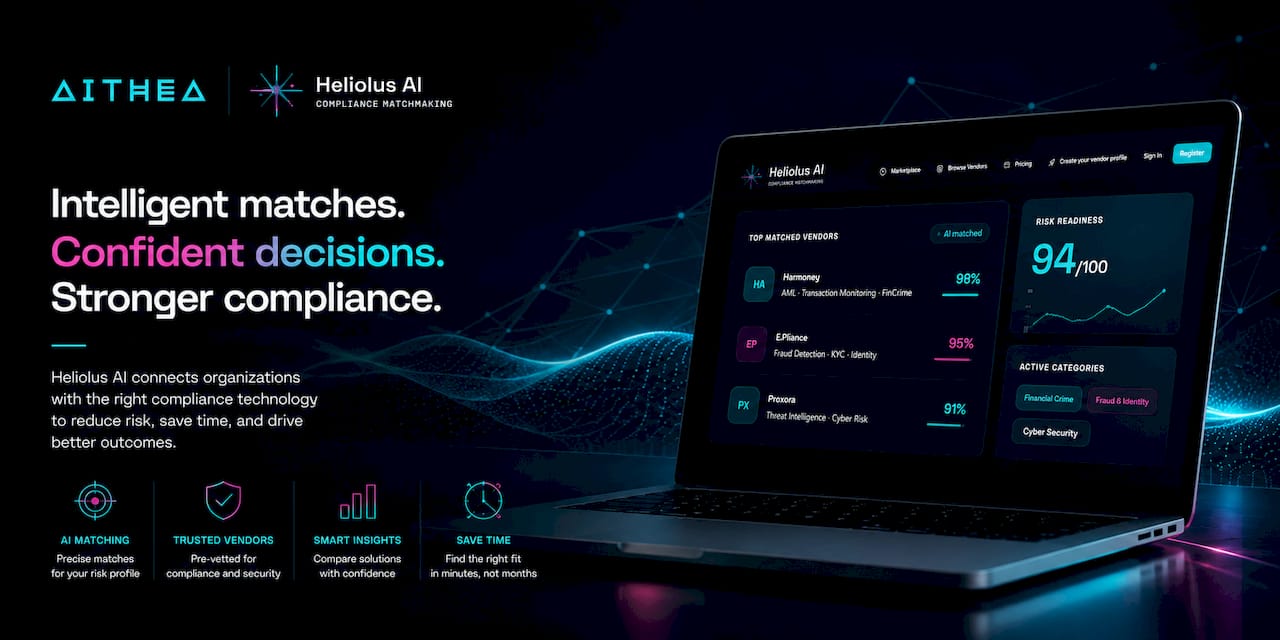
Across Europe, regulatory expectations around AI in financial crime compliance are moving faster than most procurement teams' internal policies. A directory such as Heliolus AI helps compliance teams map vendor capability against these emerging requirements before committing budget, rather than discovering gaps during a regulatory review.
Pro Tip: Ask every AI vendor to explain one specific false positive from their own demo data, live, on the call. If they cannot, their explainability claim is marketing, not a feature.
How do you keep vendor scoring free of bias?
Bias creeps in through informal shortcuts: scoring after a good demo, letting the loudest evaluator dominate calibration, or changing weights once a favourite emerges.
Build these controls into the process:
- Timestamp every scorecard and store evaluator justifications alongside the scores.
- Score independently first, then calibrate in a single structured meeting.
- Require written justification for any score more than one point from the panel average.
- Produce a decision memo and formal notice of intent to award before contract signature.
Pro Tip: Have every evaluator score the same question across all vendors in one sitting, rather than scoring vendor by vendor. It stops fatigue and favouritism creeping into the last scorecard on the pile.
What actually breaks vendor evaluations in practice
The single most common failure is not a weak vendor, it is a weak process: demo bias overriding the scorecard, and TCO calculated from the price sheet alone while integration and training costs get discovered eighteen months in.
Three habits fix most of this. Run calibration sessions as a structured walk through the scorecard, question by question, not a free discussion of "who did we like." Scope pilots around one or two decisive questions rather than a broad trial that never produces a clean answer. And bring finance into the room during weighting, not during contract review, because executive buy-in evaporates the moment someone asks why integration costs were not in the original business case.
A compliance team once shortlisted a transaction-monitoring vendor almost entirely on a polished demo, only to discover during implementation that the API could not export flagged cases in the format their case management system needed. A weighted scorecard with data portability as a scored line, not an afterthought, would have caught that in week one.
How Aithea supports your vendor evaluation from start to finish
Building a defensible scorecard from scratch, running an unbiased calibration session, and designing a pilot that produces a clean go or no-go answer all take time procurement teams rarely have spare during a live RFP. This is where Aithea's compliance technology matchmaking earns its place, rather than a generic consultancy retainer.
Aithea's engagements map directly onto the framework covered here:
- Requirements discovery: structured workshops to define and weight criteria before a single vendor is contacted.
- Scorecard build: a scorecard tailored to compliance technology, including the AI-specific rows on data ownership and explainability.
- Pilot design and governance: KPI definitions, remediation windows, and a decision memo template ready for sign-off.
For compliance teams comparing AML, sanctions or transaction-monitoring vendors specifically, the Heliolus AI directory lets you shortlist RegTech vendors against live capability data before you draft a single RFP question. Start by exploring the directory for your category, then book a scorecard workshop with Aithea to turn that shortlist into a weighted, defensible decision.
Sources
- Vendor evaluation framework: Choosing technology partners that last — peppereffect
- Vendor evaluation framework guide — tkxel
- Vendor evaluation template: Free download — Fairview
- RFP evaluation matrix scoring — SpecLens
- RFP Evaluation Matrix Template | Columbia Procurement
FAQ
What are the five key vendor evaluation criteria?
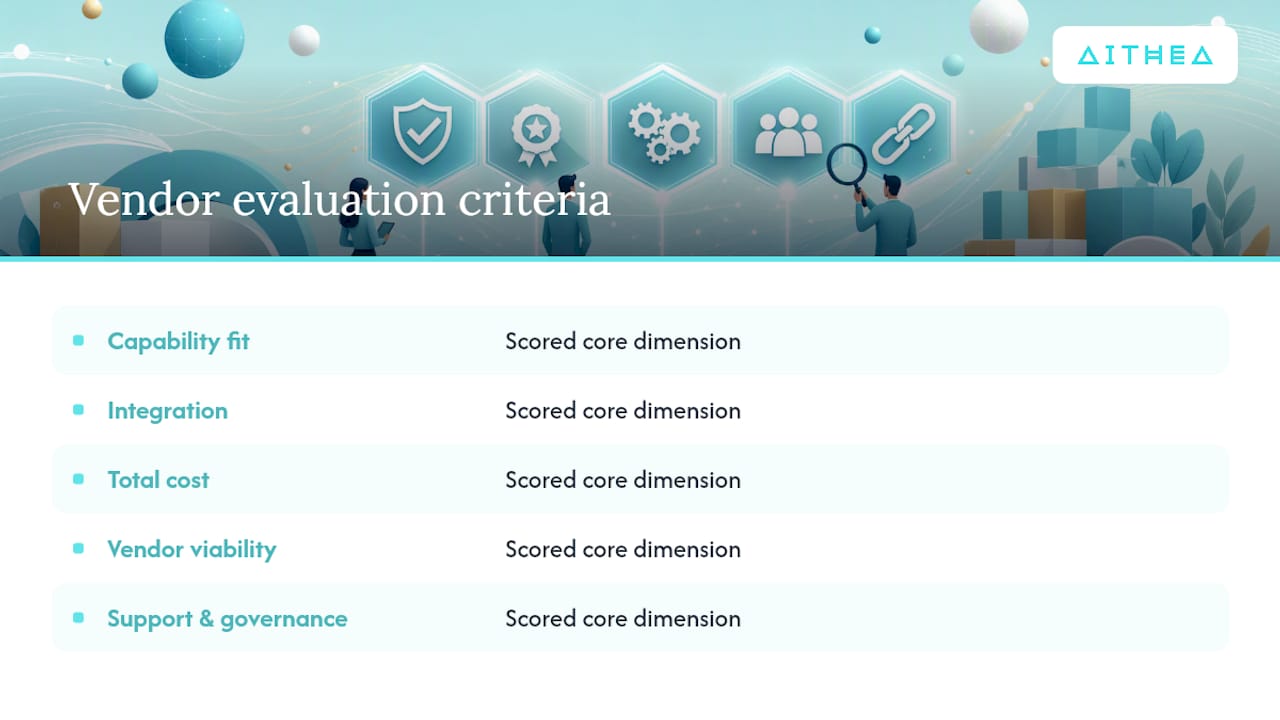
Most frameworks score capability fit, integration and interoperability, total cost of ownership, vendor viability, and support or governance as the five core dimensions, with compliance and risk added as pass/fail gates.
What are the 10 Cs of supplier evaluation?
Dr Ray Carter's 10C model scores Capacity, Competency, Consistency, Control, Cost, Commitment, Culture, Clean (CSR and ethics), Communication and Cash, giving procurement a fuller picture than price alone.
What is the best way to measure vendor performance after selection?
Track SLA metrics, support ticket trends and roadmap delivery weekly during onboarding, monthly through the first quarter, and quarterly afterwards, using the same criteria scored during selection.
How do you evaluate a vendor's performance during a pilot?
Score technical KPIs like uptime and latency, business KPIs like adoption rate, and vendor behaviour KPIs like support response time against predefined thresholds over a 60 to 90 day timebox.
How do you evaluate AI or RegTech vendors specifically?
Add data ownership, model explainability and human-in-the-loop controls to the standard scorecard, and use a directory such as Heliolus AI to compare vendor capability against evolving European regulatory expectations before shortlisting.