

Transaction monitoring rules are the automated logic that flags transactions for review against defined typologies of financial crime, built from a trigger, a threshold, a time window, a scope and an action. If you manage or supervise a monitoring programme, three things need doing now: confirm which transaction streams are actually covered and which sit outside the net; prioritise calibration effort on your highest-risk scenarios rather than spreading it evenly; and run any new or amended rule in shadow mode before it ever generates a live alert. Monitoring itself isn't optional. FATF's risk-based approach and the EU's Anti-Money Laundering Regulation both treat ongoing monitoring as a baseline supervisory expectation, not a discretionary control.
- Confirm coverage: map every payment rail, channel and product against your rule library and flag gaps.
- Prioritise: rank scenarios by typology risk and historical SAR/STR yield, then calibrate the top tier first.
- Shadow test: never promote a rule change to production without a trial run against live data first.
Key Takeaways
Defensible transaction monitoring rules combine precise scope, evidence-based calibration through shadow testing, and documented rationale that satisfies both FATF principles and EU AMLR obligations.
| Point | Details |
|---|---|
| Five components define a rule | Trigger, threshold, time window, scope and action must each be documented and justified. |
| Segment before you threshold | Baseline behaviour by customer segment and product to avoid one-size-fits-all thresholds. |
| Shadow test every change | Run candidate rules against live data for a full cycle before any production alert fires. |
| Combine scenarios with AND logic | Joining rules narrows alert populations to cases with convergent risk signals. |
| Data quality drives defensibility | Stale KYC fields and generic merchant codes undermine even well-calibrated rules. |
Table of Contents
- What is a transaction monitoring rule made of?
- Regulatory obligations behind transaction monitoring rules
- Common rule types and scenarios worth adapting
- Calibrating rules: shadow mode, back-testing and the metrics that matter
- From alert to filing: the investigation workflow
- Why data quality decides whether your rules actually work
- How AI and behavioural models are reshaping detection
- Ready to modernise your monitoring programme?
- Primary regulatory and guidance links to read next
- What the research actually supports
- Sources
- FAQ
What is a transaction monitoring rule made of?
A transaction monitoring rule is only as good as its five components, and most calibration failures trace back to one of them being poorly defined rather than the underlying logic being wrong.
- Trigger — the event class the rule watches for: an incoming wire, a card-not-present payment, a cash deposit, a rapid transfer between linked accounts. Get this wrong and the rule either misses the typology entirely or fires on the wrong population.
- Threshold — the numeric or behavioural line that separates normal activity from something worth a look. A €10,000 cash threshold means something different for a market trader than for a pensioner, which is why static, one-size thresholds tend to underperform segmented ones.
- Time window — the period over which activity is aggregated. A £9,000 deposit is unremarkable alone; three £3,000 deposits inside 48 hours across different branches tells a different story. Widening or narrowing the window changes what the rule actually detects, often more than adjusting the threshold does.
- Scope — the customer segment, product, channel or geography the rule applies to. A velocity rule tuned for retail current accounts will misfire badly if applied unchanged to correspondent banking flows.
- Action — what happens when the rule fires: an alert to a queue, a risk score adjustment, a payment hold, or automatic escalation to a senior investigator for high-severity typologies.
Pro Tip: When reviewing an existing rule you didn't build, don't start with the threshold. Start by asking what the time window and scope actually are in the underlying query, not what the documentation says they are. The two frequently disagree, and that gap is where false negatives hide.
Regulatory obligations behind transaction monitoring rules
Monitoring obligations aren't abstract. FATF's Recommendation 10 requires obliged entities to conduct ongoing due diligence and scrutinise transactions throughout the relationship, ensuring they're consistent with the institution's knowledge of the customer, their business and risk profile. That single principle underpins nearly every national AML framework in force today.
In Europe, the Anti-Money Laundering Regulation) sharpens this considerably. Article 26 mandates continuous monitoring of business relationships, not periodic snapshots, while Article 69 requires prompt reporting the moment suspicion arises. AMLA now coordinates supervisory consistency across EU member states, which matters if your institution operates across borders and has previously relied on divergent national interpretations.
Outside Europe, expectations converge on similar substance. FinCEN's Anti-Money Laundering Act and the OCC's BSA supervisory guidance both stress documented, tested monitoring controls in the US, while MAS in Singapore and HKMA in Hong Kong increasingly expect real-time or near-real-time monitoring for higher-risk entities. Practically, this means:
- Written calibration methodology, not just rule logic, needs to survive supervisory scrutiny.
- Testing frequency has to be evidenced, not asserted.
- Recordkeeping must show why a threshold was set, not only what it is.
An FCA enforcement decision against a payments firm illustrates the point starkly: supervisors increasingly penalise weak systems and controls even absent proven laundering, because the absence of defensible evidence is itself the failing.
Common rule types and scenarios worth adapting
Six scenario families cover most of what a monitoring programme needs, and each has a template logic you can adapt rather than build from scratch.
- Threshold rules flag single transactions above a fixed or risk-adjusted amount, such as a cash deposit over £8,000 for a retail customer whose profile shows typical monthly cash handling under £1,500.
- Velocity rules count transaction frequency within a window, for example more than five outbound transfers exceeding £2,000 within 24 hours from an account with no prior transfer history.
- Structuring rules detect deliberate sub-threshold splitting, such as four deposits of £2,400 across four branches in one week, aggregating just under a £10,000 reporting line.
- Peer-group deviation compares a customer against a statistically built baseline for similar customers, flagging when a small retail merchant's monthly turnover jumps from £15,000 to £95,000 without a corresponding business change.
- Rapid in-out flags funds that arrive and leave within a short window with little economic rationale, a classic mule-account signature, particularly where the outbound leg goes to a newly added payee.
- Geographic mismatch flags activity inconsistent with a customer's stated footprint, such as a domestic-only business suddenly receiving wires from three high-risk jurisdictions in the same month.
Sector context changes which of these matter most. Retail banking leans on structuring and threshold rules; fintech wallets lean harder on velocity and rapid in-out given lower onboarding friction; corporate payment platforms need geographic mismatch and peer deviation tuned to trade patterns rather than consumer norms.
| Scenario type | Trigger example | Typical time window |
|---|---|---|
| Threshold | Single cash deposit above segment limit | Single transaction |
| Velocity | Multiple transfers exceeding a count/value limit | 24 hours |
| Structuring | Multiple sub-threshold deposits, same customer/network | 5 to 7 days |
| Peer deviation | Turnover deviates from statistical baseline | Rolling 30 days |
| Rapid in-out | Inbound funds moved out with minimal dwell time | Under 24 hours |
| Geographic mismatch | Corridor inconsistent with declared profile | Per transaction or rolling window |
Combining logic with AND/OR conditions is where precision actually improves. A velocity rule OR'd loosely with a threshold rule tends to flood queues; the same logic joined with AND against a peer-deviation flag narrows the alert population to cases with genuine convergent risk signals, which is usually where the SAR-worthy activity actually sits.
Calibrating rules: shadow mode, back-testing and the metrics that matter
Moving a candidate rule from spreadsheet logic to live production without a proving ground is how programmes end up with either alert floods or dangerous blind spots. The sequence that works reliably follows four steps.
- Segment and baseline first. Build behavioural baselines by customer segment and product before setting any threshold. A single global threshold, applied across both a private banking book and a student current account portfolio, consistently over-alerts one segment and misses the other, which is the single most common calibration failure.
- Run shadow mode. Let the candidate rule generate would-be alerts against live data without surfacing them to investigators. Shadow testing across a full transaction cycle, ideally a representative seasonal window rather than a quiet fortnight, is what reveals realistic volumes and a credible false positive rate before the rule ever reaches production.
- Back-test and check overlap. Run the rule against historical data with known outcomes, and cross-check against existing rules to spot redundant alerts covering the same underlying typology from a different angle.
- Monitor performance metrics continuously. False positive rate, SAR conversion rate, raw alert volume and time-to-investigate should sit on a monthly dashboard, not an annual review.
Evidence-based calibration, using historical data to set segment-specific baselines rather than industry rules of thumb, is consistently what separates programmes with manageable alert volumes from those drowning in undifferentiated queues. Acceptance criteria for promoting a rule out of shadow mode should be agreed in advance: a target false positive ceiling, a minimum SAR conversion rate, and sign-off from both the model owner and second-line compliance.
From alert to filing: the investigation workflow
An alert firing is the start of a decision trail, not the end of one, and supervisors judge programmes as much on that trail as on the rule logic itself. The workflow that holds up under review runs through four stages: initial triage against the customer's known profile, full investigation gathering supporting transaction history and open-source checks, escalation to a senior investigator or MLRO for higher-severity cases, and a final decision to file a SAR/STR or close the alert with documented rationale.
What gets captured at each stage matters more than most teams assume:
- The specific data points that triggered the rule, not just the alert reference number.
- A written rationale for filing or not filing, referencing the customer's expected activity profile.
- Escalation criteria applied and who reviewed the decision.
- Management information showing volumes, ageing and outcomes by scenario type.
Filing timelines vary by jurisdiction and shouldn't be treated as interchangeable. Some regimes expect filing "promptly" with no fixed number of days once suspicion crystallises, as under the EU's Article 69, while others operate defined statutory windows. Check your own regulator's rules rather than assuming a global standard.
Pro Tip: Build your escalation criteria around convergence of signals rather than single-rule severity. An alert triggered by one high-scoring rule is often weaker evidence than a moderate alert corroborated by two independent scenario types firing on the same customer within days of each other.
Why data quality decides whether your rules actually work
Rules are only as sharp as the customer data feeding them, and this is where KYC/CDD and transaction monitoring are inseparable in practice. A rule tuned against an "expected transaction profile" that was never properly captured at onboarding, or never refreshed, will misfire in both directions: too many false positives for customers whose profile is stale and understated, too many missed typologies for customers whose real risk has shifted since onboarding.

Essential fields feeding effective rules include beneficial ownership data, PEP status, sanctions screening results, merchant category codes, and device or IP signals for digital channels. The most common data quality failures aren't exotic: free-text address fields that break geographic mismatch logic, merchant codes that default to a generic value at point of sale, and beneficial ownership records that were never updated after a corporate restructuring. Remediation is usually less about new technology and more about enforcing mandatory fields and periodic data refresh cycles tied to the customer risk rating.
How AI and behavioural models are reshaping detection
Machine learning and behavioural scenarios genuinely improve detection where typologies are diffuse and evolve quickly, such as mule network detection or emerging fraud-to-laundering patterns that don't fit a clean static rule. Static, deterministic rules remain essential for clear-cut typologies like structuring or sanctioned-jurisdiction exposure, where the logic is unambiguous and supervisors expect a demonstrable, explainable trigger. The direction of travel across the industry is a hybrid model: static rules catching known typologies, behavioural layers catching what rules alone would miss.
The governance overhead of adding ML is real and shouldn't be underestimated during procurement. Explainability, ongoing model monitoring, drift detection and a formal change control process all need to exist before a behavioural model goes anywhere near production alerting, particularly given how EU supervisors are converging on stricter documentation expectations under AMLR.
A practical vendor selection checklist should cover:
- Data integration depth across your actual payment rails, not just the vendor's reference architecture.
- Explainability sufficient to satisfy a supervisor asking "why did this alert fire?"
- Native shadow-mode support, not a bolt-on workaround.
- Operational SLAs for tuning turnaround and false positive triage support.
Compliance teams don't need more rules; they need rules that are defensible, and technology that makes defensibility a design feature rather than a documentation afterthought.
This is precisely the gap Aithea works in: helping compliance teams translate regulatory expectations into a technology specification a vendor can actually be held to, and running the RFP and vendor evaluation process so procurement decisions hold up as well as the rules themselves.
Ready to modernise your monitoring programme?
Rebuilding a rule library, adding a behavioural layer, or simply preparing a defensible RFP for new monitoring technology all demand the same thing: a clear bridge between what regulators expect and what vendors actually deliver. Aithea's AI-powered compliance consulting is built for exactly that gap, helping compliance officers and risk managers run technology procurement and vendor evaluation with the same rigour they apply to the rules themselves. If your programme is due a calibration review or a vendor refresh, get in touch before your next examination cycle catches the gap first.
Primary regulatory and guidance links to read next
- FATF — Recommendation 10 and the risk-based approach to ongoing monitoring.
- AMLA — EU supervisory coordination and alignment resources.
- FinCEN's Anti-Money Laundering Act guidance and the OCC's BSA examination resources for US expectations.
- MAS for Singapore's real-time monitoring expectations.
What the research actually supports
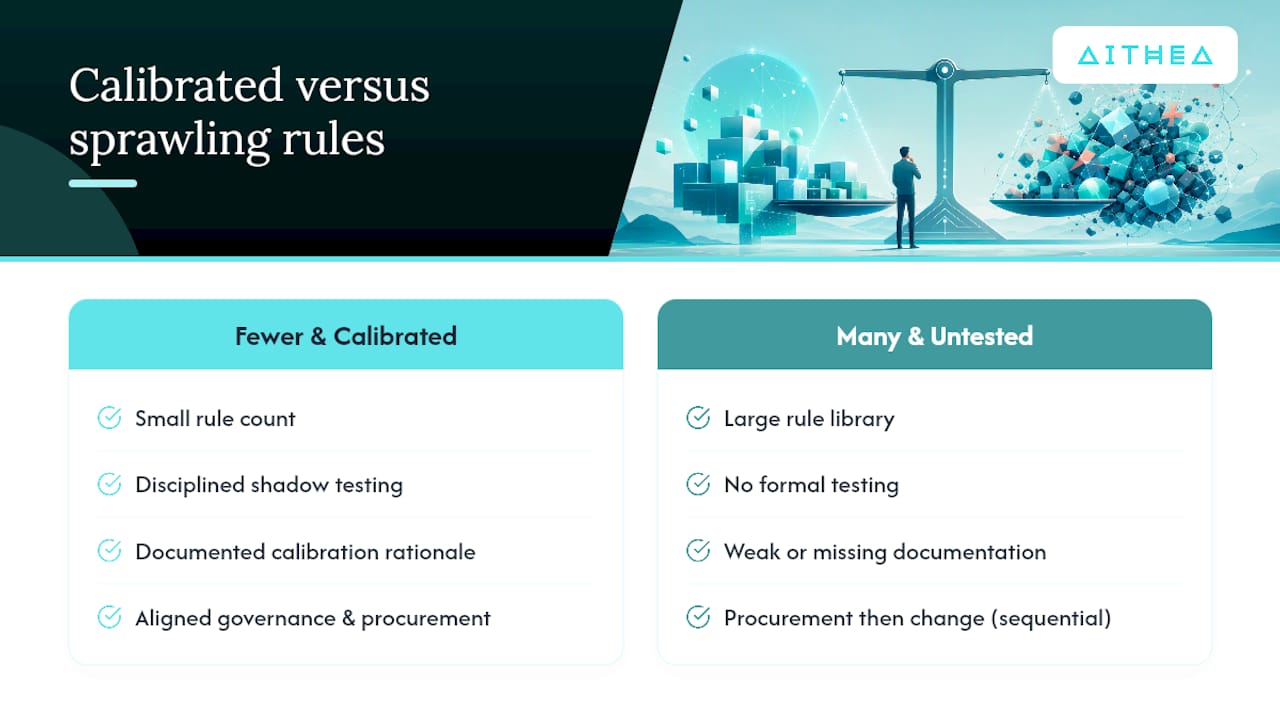
The conventional advice on transaction monitoring rules tends to fixate on rule count, more scenarios, more coverage, as if volume were the measure of a mature programme. It isn't. The evidence points the other way: programmes with fewer, well-segmented rules running through disciplined shadow testing consistently outperform sprawling libraries built by bolting on a new scenario every time an examiner asks an awkward question.
What's underrated is how much of a rule's defensibility comes from documentation of why a threshold sits where it does, not the threshold itself. Supervisors increasingly probe methodology, not just outcomes. That's a governance problem as much as an analytics one, and it's exactly where change management and technology procurement decisions need to be made together rather than sequentially.
If you take one thing from this: prioritise calibration evidence over rule expansion. A smaller rule set with a documented, tested methodology will survive an examination that a large, untested one won't.
This article is general information, not a substitute for advice from a qualified financial advisor. Consult a qualified financial professional about your own circumstances before acting on anything here.
Sources
FAQ
What are the new AML regulations for 2026?
The EU's Anti-Money Laundering Regulation and the establishment of AMLA continue to phase in, sharpening continuous monitoring duties under Article 26 and prompt reporting under Article 69 across EU member states.
What is L1, L2, and L3 in transaction monitoring?
These typically refer to escalation tiers: L1 is initial alert triage by a junior analyst, L2 is deeper investigation and evidence gathering, and L3 is senior or MLRO-level review for filing decisions on the highest-severity cases.
Is transaction monitoring required by law?
Yes. FATF's Recommendation 10 sets the global standard for ongoing monitoring, and the EU's AMLR, alongside national regimes overseen by bodies like FinCEN, the OCC, MAS and HKMA, translate that into binding legal obligations.
What is a red flag in transaction monitoring?
A red flag is any transaction pattern inconsistent with a customer's known profile, such as structuring, rapid in-out movement, or activity from an unexpected geographic corridor, that warrants investigation before it's cleared or escalated.