

FinTech builds the products customers touch: payment apps, lending platforms, robo-advisers. RegTech builds the compliance engines behind them, the systems that screen customers, monitor transactions and generate the reports regulators demand. Regulatory shifts across Europe in 2026, from the FCA's Consumer Duty to DORA's resilience testing, are turning RegTech from a back-office cost into a growth requirement. This article covers definitions, real examples, the regulatory backdrop, integration mechanics, AI governance risk and a practical checklist for choosing between them.
TL;DR:
- RegTech's core capabilities, like identity verification and transaction monitoring, are increasingly integrated into FinTech workflows to reduce false positives and accelerate onboarding.
- European regulatory changes in 2026, such as DORA and the FCA Consumer Duty, make RegTech essential for compliance operational resilience testing and timely reporting.
- Proper RegTech procurement requires thorough testing against real data, clear documentation, and understanding of update cadence, with red flags including opaque decision logic and hidden costs.
- AI governance in RegTech demands explainability, ongoing validation, and human oversight to mitigate model risk, bias, and false flag issues amid evolving standards.
- Shared data infrastructure and machine learning models across FinTech and RegTech highlight the necessity of close collaboration to prevent compliance gaps during scaling.
Table of Contents
- What is FinTech? Definition, users and core technologies
- What is RegTech? Definition, users and core capabilities
- RegTech vs FinTech: purpose, buyer and KPIs compared
- FinTech and RegTech in practice: real examples
- Why 2026's regulatory landscape makes RegTech strategic
- How RegTech integrates with FinTech in practice
- AI governance risk: model risk, explainability and mitigations
- How to choose RegTech: checklist, questions and red flags
- Aithea's practitioner view on procurement and AI governance
- Get practical help choosing and governing RegTech
- Sources
- FAQ
What is FinTech? Definition, users and core technologies
FinTech is any technology built to deliver financial products and services directly to consumers or businesses, bypassing or reinventing the traditional bank branch model. It spans payments, digital lending, wealth management, cryptocurrency exchanges, insurance platforms and neobanks that operate entirely through an app. The World Bank's analysis of fintech and financial inclusion frames this growth as a genuine shift in who gets access to financial services, not just a change in how existing customers are served.
The beneficiaries are broad. Consumers get faster payments and easier credit. Small and medium businesses get working-capital lending without a branch visit. Established banks license FinTech infrastructure to modernise their own front ends rather than build from scratch.
Underneath, a handful of technologies do the heavy lifting:
- APIs connect FinTech apps to banking cores, card networks and payment rails in near real time.
- Cloud infrastructure lets a five-person startup scale to a million users without owning a server.
- Analytics and machine learning drive credit scoring, fraud detection and personalised product recommendations.
- Blockchain and distributed ledgers underpin crypto-asset trading and some cross-border settlement products.
- Banking-as-a-Service (BaaS) arrangements let a FinTech plug into a licensed sponsor bank's infrastructure instead of holding its own banking licence.
That last point is where the trouble usually starts. A FinTech can launch fast on borrowed banking rails, but the compliance obligations, KYC, AML, consumer protection, don't disappear just because the licence is borrowed. As user numbers climb, so does regulatory exposure, and that is precisely the gap RegTech exists to close.
What is RegTech? Definition, users and core capabilities
RegTech is technology purpose-built to help firms meet regulatory obligations faster, cheaper and more consistently than manual processes allow. Where FinTech faces the customer, RegTech faces the regulator, automating identity checks, screening transactions against sanctions lists, monitoring for suspicious activity and generating the reports supervisors require.
It sits alongside a related but distinct category called SupTech, technology that regulators themselves used to supervise the market. RegTech is the tool the regulated firm buys; SupTech is the tool the regulator uses to watch the firms buying RegTech. The two increasingly talk to each other through shared data standards, but the buyer is different in each case.
Primary users of RegTech include:
- Compliance and risk teams at banks, running the largest and most complex screening and reporting operations.
- FinTechs scaling past their early growth stage, once manual review of every new customer becomes unsustainable.
- Corporates with cross-border trade exposure, screening counterparties against sanctions and export-control lists.
- Consultancies and auditors, who use RegTech outputs as evidence during regulatory reviews.
Typical capabilities, as Fintechly's breakdown of RegTech categories sets out, include identity verification, transaction monitoring, regulatory intelligence feeds that track rule changes, and reporting automation that assembles the filings supervisors expect on a fixed schedule. Most of it arrives as an API or a SaaS platform rather than installed software, because compliance rules change too often for anything else to keep pace. RegTech is sometimes described as a subset of FinTech, since both rely on similar underlying technology, but the buyer, the KPI and the regulatory relationship are different enough that treating them as one category obscures more than it reveals.
RegTech vs FinTech: purpose, buyer and KPIs compared
Put the two side by side and the contrast sharpens fast.
| Dimension | FinTech | RegTech |
|---|---|---|
| Primary purpose | Deliver a financial product or service | Automate compliance and regulatory reporting |
| Typical buyer | Product, growth or business teams | Compliance, risk and legal teams |
| Success metric | Customer acquisition, transaction volume, revenue | False-positive rate, audit readiness, time to file |
| Product design priority | User experience, speed, conversion | Accuracy, explainability, auditability |
| Regulatory focus | Meeting the rules that apply to the product | Building the tooling that proves the rules were met |
The overlap is real, and it's growing. Both categories draw on the same underlying data pipes, the same API architecture and, increasingly, the same machine learning models. A transaction-monitoring model built for RegTech often reuses the same behavioural data a FinTech's fraud engine already collects. That shared foundation is why the two functions need to collaborate rather than operate as separate silos, an internal handover between a product team and a compliance team is where gaps in coverage tend to open up.
SupTech deserves a brief mention here too. Regulators themselves are adopting machine-readable reporting standards and automated market surveillance, which means the RegTech a firm buys increasingly needs to speak the same structured-data language the regulator's own SupTech expects on the receiving end.
FinTech and RegTech in practice: real examples
Seeing the two in action side by side makes the distinction concrete.
FinTech examples:
- A mobile payments app processing peer-to-peer transfers in seconds.
- A Buy Now, Pay Later (BNPL) provider splitting a purchase into instalments at checkout.
- A neobank offering a current account with no physical branch.
- A robo-adviser building a low-cost investment portfolio from a short risk questionnaire.
- A crypto exchange letting retail customers trade digital assets.
RegTech examples:
- An identity-verification platform that confirms a new customer's passport and address in under a minute.
- A sanctions-screening tool that checks every counterparty against global watchlists in real time.
- A transaction-monitoring system that flags unusual payment patterns for investigation.
- A regulatory-reporting engine that auto-generates the filings a supervisor requires each quarter.
- A regulatory-intelligence feed that alerts a compliance team the moment a relevant rule changes.
Two short journeys show how they connect. During customer onboarding, a FinTech's app collects a new user's details, then hands off silently to a RegTech identity-verification API that checks the documents, runs a sanctions screen and returns a pass or fail before the user ever notices a delay. During transaction monitoring, every payment the FinTech processes streams into a RegTech engine that scores it against behavioural baselines, escalating only the small percentage that looks genuinely anomalous. Done well, this cuts false positives, speeds up onboarding and leaves an auditable trail a regulator can review without a single spreadsheet.
Why 2026's regulatory landscape makes RegTech strategic
Regulation across Europe has moved decisively toward treating certain FinTechs like banks. The EU's Digital Operational Resilience Act (DORA) requires financial entities, and the third-party technology providers they rely on, to prove they can withstand and recover from IT disruption, not just report on it after the fact. The UK's FCA Consumer Duty pushes firms to demonstrate good customer outcomes, not just technical rule compliance, and its scrutiny now extends to open banking, BNPL products, crypto-asset frameworks and AI-driven financial advice.
The compliance bar has moved. EY's Global Financial Services Regulatory Outlook points to growing fragmentation across jurisdictions, with new regimes for stablecoins, digital assets and AI use in finance adding to an already dense compliance map. Firms operating across multiple European markets increasingly need to design for variable requirements rather than a single rulebook.
The operational implications are concrete rather than abstract:
- Operational resilience testing is now a supervisory expectation, not a best-practice suggestion, under DORA.
- Reporting timelines have tightened, with some incident and outcome reporting expected within days rather than the annual cycle firms grew used to.
- Third-party oversight extends compliance responsibility to the vendors a FinTech relies on, including its RegTech suppliers.
- AI scrutiny is intensifying, with supervisors asking pointed questions about how automated decisions in lending, screening and advice are validated.
Under MiCA, crypto-asset service providers now face licensing and disclosure obligations that look far closer to traditional banking rules than the light-touch approach many crypto FinTechs were built around. For a FinTech that scaled fast on the assumption that compliance could stay manual a little longer, this regulatory tightening is the moment RegTech stops being optional infrastructure and becomes the difference between passing a supervisory review and failing one.
How RegTech integrates with FinTech in practice
Integration rarely happens at the strategy level. It happens at specific technical seams: a KYC API called during onboarding, a streaming feed of transaction data pushed into a monitoring engine, a reporting endpoint that assembles filings on a fixed schedule. Get these seams wrong and the compliance system either misses activity it should catch or drowns the team in false alerts.
Procurement should follow a disciplined path rather than a vendor demo and a signature:
- Confirm RFP readiness: does the vendor have clear documentation on coverage, data requirements and update cadence?
- Insist on data mapping before commitment, so both sides know exactly what fields flow where.
- Run parallel testing against live production data in a protected sandbox before full cutover, checking coverage and false-positive rates rather than trusting a vendor's own benchmark.
- Set SLAs covering uptime, incident response time and escalation paths, not just monthly reporting.
Pro Tip: Ask any RegTech vendor to run their system against a slice of your last quarter's real transaction data before you sign anything. A demo environment tells you almost nothing about your actual false-positive rate.
Operationally, expect ongoing monitoring, defined escalation routes when a model flags something serious, and an audit trail detailed enough to satisfy a regulator asking "show me why this transaction was cleared" six months after the fact.
AI governance risk: model risk, explainability and mitigations
RegTech's shift toward AI and machine learning has sharpened a governance problem that didn't exist when compliance rules ran on static logic. A model that flags a transaction as suspicious needs to explain why, in language a regulator, an auditor and eventually a customer can follow. Without consistent AI-specific financial regulation across Europe, firms are left applying existing frameworks like MiFID II and DORA to AI use, which means the governance burden falls largely on the firm rather than on a ready-made rulebook, as Stanford Law's analysis of AI and financial regulation sets out.
A model that can't explain its own decision is a liability dressed up as efficiency. Regulators are increasingly unwilling to accept "the algorithm flagged it" as an answer on its own.
Three risk areas deserve particular attention: model risk from AI that drifts as underlying data changes without anyone noticing; data quality and bias, where poor training data produces systematically unfair or inaccurate flags, especially in AML and KYC screening; and false-flagging, where an overly cautious model buries genuine risk signals under a flood of noise.
Mitigations that hold up under scrutiny:
- Maintain model documentation covering training data, validation results and known limitations.
- Run ongoing validation, not a one-off check at launch, to catch drift before it causes harm.
- Keep a human-in-the-loop for any escalation with material consequences for a customer.
- Build a defined incident response process for when a model gets something wrong.
How to choose RegTech: checklist, questions and red flags
Selecting RegTech is less about the flashiest demo and more about verifiable coverage. Work through this in order:
- Coverage first. Confirm the tool actually screens against the jurisdictions and rule sets your business operates under, not a generic global list.
- Explainability second. Ask for a sample decision log and check whether a non-technical compliance officer could follow the reasoning.
- Data lineage. Understand exactly where the vendor's underlying data comes from and how often it refreshes.
- Regulatory update cadence. Ask how quickly the vendor incorporates new sanctions lists or rule changes, and get this in writing.
- Deployment mode. Decide whether API, SaaS or on-premise fits your existing stack and data residency requirements.
- Scalability and cost shape. Check whether pricing scales predictably with transaction volume or spikes unpredictably at growth milestones.
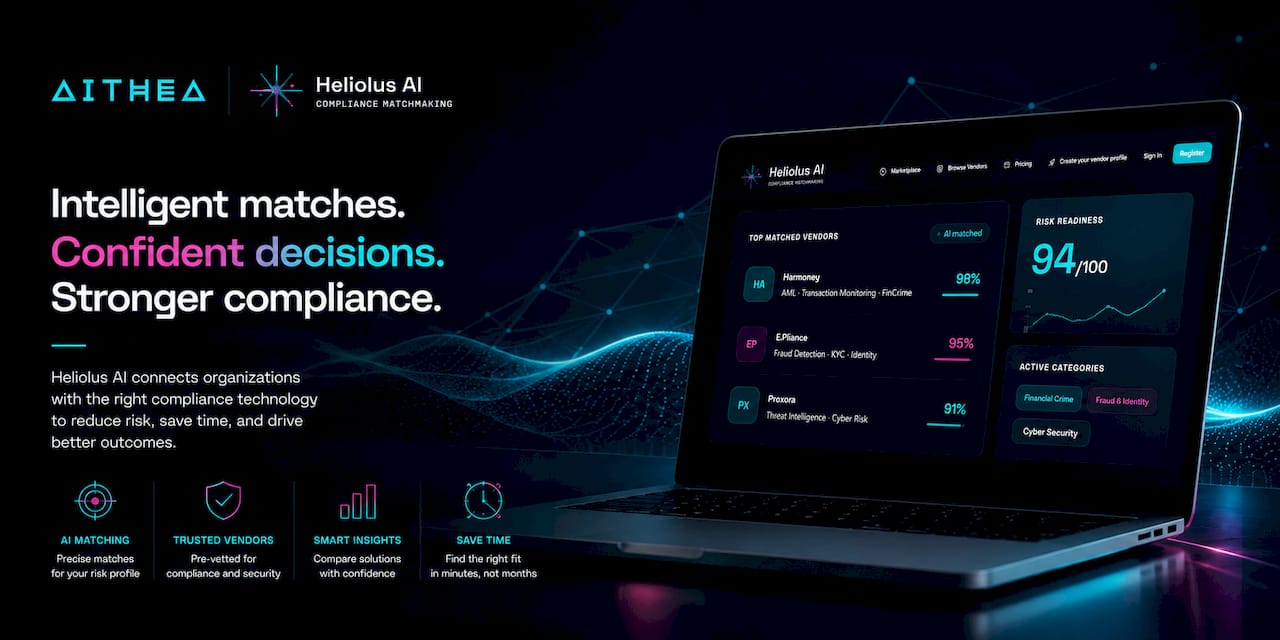
When interviewing vendors, ask for proof points from a comparable firm, request a live test against your own anonymised data, and press on what happens when a false positive rate spikes unexpectedly. A tool like Aithea's Heliolus navigator can help structure that comparison across multiple vendors at once rather than evaluating each in isolation.
Red flags that should stop a deal before it starts: a vendor who can't explain their model's decisions in plain language, no clear data lineage, a pricing model that hides costs until volume scales, or a refusal to run a sandbox test against your real data.
Aithea's practitioner view on procurement and AI governance
Vendor selection is where most compliance technology projects quietly go wrong, long before anyone notices a coverage gap. We work at the intersection of regulation, technology and AI, helping compliance officers and business leaders run structured, evidence-based procurement rather than decisions driven by the best sales pitch in the room.
Our approach to AI governance in vendor validation starts from a simple principle: a model a compliance team can't explain to a regulator is a model that shouldn't be running unsupervised. That means testing vendor claims against real data, checking explainability before checking price, and treating RFP support as a structured discipline rather than an afterthought. Aithea's education and technology-matching services exist precisely because most compliance teams are asked to evaluate technology they were never trained to interrogate properly.
— Aneta
Get practical help choosing and governing RegTech
If the checklist above raised more questions than it answered, that's the point where a structured evaluation earns its cost. We help compliance officers and business leaders run the procurement process properly, matching vendor capability against regulatory reality rather than a marketing deck, and building the AI governance documentation supervisors now expect to see.

Aithea's core compliance and risk consulting services cover exactly the ground this article walks through: vendor matching, RFP readiness, data mapping support and AI governance review, built for compliance teams who need a defensible answer when a regulator asks how a decision was made. For firms handling cross-border exposure, the sanctions and financial crime frontline work shows how this plays out in practice. If your team is facing a RegTech procurement decision in the next few months, consider speaking to specialist consultants before locking in a vendor whose explainability you haven't tested yet.
Sources
The FCA Consumer Duty sets out the UK's outcomes-based supervisory standard. EY's Global Financial Services Regulatory Outlook tracks 2026 regulatory fragmentation. The World Bank's fintech and financial inclusion research frames global adoption trends. Stanford Law's review of AI and financial regulation covers AI governance gaps. For security-adjacent compliance planning, ISMS Calculator's ISO 27001 fintech roadmap is a useful practical companion.
- Global financial services regulatory outlook 2026 (EY)
- Fintech and the future of finance (World Bank)
- AI meets financial regulation — Stanford Law
FAQ
What Are the Four Types of FinTech?
FinTech is usually grouped into payments, lending, wealth and investment management, and insurance technology, with digital-asset platforms and neobanks often treated as a fifth, fast-growing category.
Is JP Morgan Considered a FinTech?
Not typically. JP Morgan is a traditional bank that has built substantial in-house financial technology, but the term FinTech is generally reserved for firms whose core business model is technology-first financial services delivery, not incumbent banks with digital arms.
Can You Give an Example of RegTech?
A sanctions-screening tool that checks every new customer and counterparty against global watchlists in real time is a clear RegTech example, as is an automated regulatory-reporting engine that assembles quarterly filings without manual spreadsheet work.
Is Deloitte a FinTech?
No. Deloitte is a professional services and consultancy firm that advises FinTechs and RegTechs on regulation, technology and risk, but it doesn't build customer-facing financial products itself, which is what defines a FinTech.
How Does RegTech Support FinTech Growth?
RegTech automates the identity checks, screening and reporting a FinTech would otherwise handle manually, letting it scale its customer base without a proportional increase in compliance headcount or regulatory risk.