

The regtech market map is a functional taxonomy and snapshot of the suppliers, funding signals, and use cases that compliance teams need to move from a blank spreadsheet to a credible vendor shortlist. This UK edition covers the six primary RegTech families, draws on The Global State of RegTech 2026 for taxonomy and market sizing, and is designed for compliance officers, procurement leads, and risk managers who need to match capability to obligation quickly.
Who should use this map:
- UK compliance teams preparing an RFP or technology selection programme
- Procurement and risk managers evaluating vendor fit against FCA, AML, and Economic Crime Act obligations
- RegTech vendors seeking to understand where they sit in the broader ecosystem
What this edition shows:
- Six functional families spanning identity and onboarding through to AI governance
- Coverage of 200+ companies tracked across recent market maps, with funding signals drawn from CB Insights, Crunchbase, and public filings
- UK-specific regulatory drivers and a procurement checklist you can use immediately
Download the full visual map: Contact the Aithea team to request the interactive version with vendor profiles and funding data.
Key takeaways
The regtech market map is most valuable when it is used as an obligation-first filter, not a vendor directory, with procurement structured around integration fit, model governance, and operational metrics.
| Point | Details |
|---|---|
| Start with taxonomy | Map your regulatory obligations to the six functional families before approaching any vendor. |
| Apply the procurement checklist | Prioritise integration model, data hygiene, supervisory connectivity, and model governance in every RFP. |
| UK regulatory drivers are specific | Economic Crime Act, FCA PS21/3, and PRA SS1/23 create pass/fail criteria that generic vendor scorecards miss. |
| Measure PoC by operational metrics | False positive reduction and time to report matter more than model accuracy benchmarks. |
| Aithea for matchmaking | Aithea's Heliolus navigator maps obligations to vendor capabilities, producing a scored shortlist before the RFP stage. |
Table of Contents
- What does the 2026 regtech market map actually show?
- How the six RegTech categories map to your compliance obligations
- Why the UK is a distinctive RegTech buyer market in 2026
- How to use the market map to shortlist vendors and run procurement
- How this map was built: methodology and inclusion filters
- Leading RegTech companies and notable startups by category
- How does the UK RegTech market compare globally?
- What challenges do RegTech vendors and adopters actually face?
- What does the future of RegTech look like beyond 2026?
- Which technologies are reshaping the RegTech sector right now?
- Why maps matter more than vendor lists: an editorial perspective
- Aithea turns your market map into a procurement outcome
- Sources
- FAQ
What does the 2026 regtech market map actually show?
The CB Insights RegTech market map established the multi-category approach that most maps now follow: identify 100+ private companies, group them by functional capability, and filter by equity funding and a clear compliance use case. The LegalTech market map released in 2025 extended that approach, tracking 200+ early-stage companies with combined funding signals and team counts, illustrating rapid startup formation across the sector. McKinsey estimates the total provider population at around 1,000 firms, with financial crime and cybersecurity segments expected to outpace others in growth.
| Metric | Coverage note |
|---|---|
| Companies tracked | 200+ across six functional families |
| Regional spread | UK / EMEA primary; US and APAC secondary |
| Funding filter | Equity funding since 2015 or equivalent threshold |
| Primary data sources | CB Insights, Crunchbase, public filings, regulatory registers |
| Update cadence | Reviewed quarterly; major refresh annually |
| Exclusions | Pure IT infrastructure, non-compliance SaaS, pre-seed without compliance use case |
The map groups vendors along two axes: functional family (what the tool does) and buyer tier (retail bank, corporate, fintech, insurer). Financial crime compliance and regulatory reporting attract the largest vendor populations. AI governance and resilience is the fastest-growing emerging family, reflecting both FCA expectations and the EU AI Act's reach into UK-adjacent supply chains.
How the six RegTech categories map to your compliance obligations
The Global State of RegTech 2026 clusters solutions into five to six primary domains. The compliance tech taxonomy below follows that framework, cross-referenced with the Planet Compliance category list used by practitioner directories.
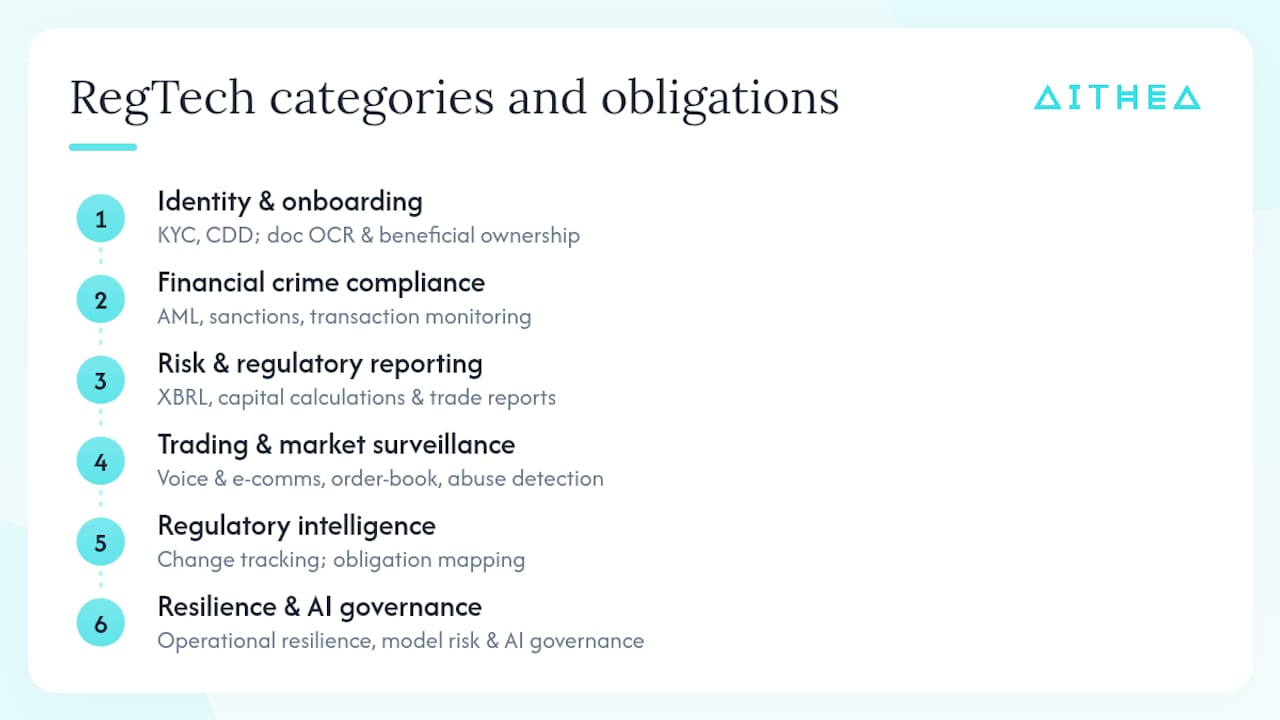
1. Identity and onboarding (KYC/CDD) Covers customer due diligence, biometric verification, document OCR, and beneficial ownership mapping. Typical use cases: automated KYC at account opening, ongoing CDD refresh, PEP and sanctions screening at onboarding. UK obligations addressed: Money Laundering Regulations 2017, FCA SYSC requirements, Economic Crime Act customer verification provisions.
2. Financial crime compliance (AML/sanctions/fraud) The largest family by vendor count. Includes transaction monitoring, sanctions screening, adverse media, and fraud detection. Use cases: real-time payment screening against OFSI and OFAC lists, SAR generation, typology-based alert tuning. UK obligations: Proceeds of Crime Act 2002, Terrorism Act 2000, OFSI sanctions regime, Economic Crime (Transparency and Enforcement) Act 2022.
3. Risk and regulatory reporting Covers XBRL tagging, regulatory capital calculations, trade and transaction reporting, and supervisory data submission. Use cases: automated COREP/FINREP filing, MiFIR transaction reporting, EMIR trade reporting. UK obligations: PRA reporting standards, FCA transaction reporting under UK MiFIR, Bank of England data collections.
4. Trading and market conduct surveillance Communications surveillance, order book monitoring, best execution analytics, and market abuse detection. Use cases: voice and e-comms surveillance, spoofing and layering detection, best execution reporting. UK obligations: UK MAR, FCA COBS rules, SM&CR accountability mapping.
5. Regulatory intelligence and change management Horizon scanning, regulatory change tracking, obligation mapping, and policy workflow. Use cases: automated alerts on FCA Handbook changes, obligation-to-control mapping, board reporting on regulatory change. Increasingly AI-driven, with large language models parsing consultation papers and mapping changes to internal policy libraries.
6. Resilience, security, and AI governance Operational resilience testing, cyber risk management, model risk governance, and AI explainability tooling. Use cases: DORA-aligned resilience testing (relevant for UK firms with EU operations), model validation audit trails, AI bias monitoring. UK obligations: FCA PS21/3 operational resilience, PRA model risk management SS1/23.
Suppliers range from pure-play specialists to integrated platforms, and buyers must weigh depth against breadth. A specialist AML engine may outperform a platform's bundled module on detection accuracy, but the platform wins on integration cost.
Why the UK is a distinctive RegTech buyer market in 2026
UK regulatory change, the Economic Crime Act, and FCA guidance on operational resilience are driving demand for real-time data pipelines, stronger vendor due diligence, and demonstrable model governance. This is not a gradual shift; it is a structural change in what supervisors expect to see.
"Regulatory objectives such as financial stability and investor protection are increasingly supported by automated data exchange between regulated entities and supervisors." The ADB suptech analysis frames this as a systemic integration challenge, not a point-solution problem — and UK buyers face exactly the same dynamic.
The FCA's data strategy and its push toward machine-readable reporting mean vendors that support XBRL, ISO 20022 subsets, or direct supervisory APIs carry a measurable implementation advantage. Firms that buy a reporting tool without checking its supervisory connectivity are buying a problem, not a solution. Separately, the Economic Crime Act's UWO and register provisions have created new CDD and beneficial ownership obligations that sit squarely in the identity and onboarding family, accelerating demand for automated corporate structure mapping.
The 2026 Global State of RegTech report also notes a role change for compliance teams: risk and compliance functions are shifting from enforcement to strategic advisory, and digital fluency is now a core competency. That shift has a direct procurement implication. Buying a tool without a parallel reskilling programme is one of the most reliable routes to shelfware in financial crime compliance.
For operational teams, the practical implications are three: first, data architecture must be clean enough to feed automated reporting and monitoring tools; second, integration points with supervisors (FCA Connect, Bank of England BEEDS, HMRC) need to be mapped before vendor selection, not after; third, vendor SLAs must include resilience commitments aligned to FCA PS21/3 thresholds.
How to use the market map to shortlist vendors and run procurement
Use the map to filter by functional fit, buyer tier, and integration model first. Then run a staged procurement process that moves from shortlist to proof of concept before any contractual commitment.
Procurement checklist (in priority order):
- Functional fit: Does the vendor's capability map to your specific regulatory obligation, not just the general category?
- Integration model: What APIs, data formats (XBRL, ISO 20022, REST), and connector libraries does the vendor support?
- Data hygiene requirements: What data quality standards does the tool require, and does your current data estate meet them?
- Regulatory reporting compatibility: Can the tool produce outputs accepted by FCA, PRA, or Bank of England systems directly?
- Model governance: For AI/ML tools, does the vendor provide explainability outputs, audit logs, and model update governance documentation?
- Vendor resilience: What are the vendor's RTO/RPO commitments, and do they align with your FCA PS21/3 obligations?
- Exit risk and roadmap: What is the vendor's funding position, and is there a credible product roadmap beyond the current release?
- Training and change management: Does the vendor offer onboarding support, and is there a microlearning or training programme for your compliance team?
RFP questions to paste into bids:
- What data formats do you ingest and output, and which supervisory APIs do you connect to natively?
- How do you document model changes, and what is your model validation process?
- What audit log capabilities do you provide for regulatory examination purposes?
- How do you handle false positive tuning, and what operational metrics do you report?
- What is your incident response SLA, and how do you notify clients of material system changes?
| Procurement phase | Typical duration | Key output |
|---|---|---|
| Discovery and mapping | 3–4 weeks | Longlist of 8 vendors per category |
| RFP and scoring | 4–6 weeks | Shortlist of 2–3 vendors |
| Proof of concept | 6–8 weeks | Operational metrics vs. baseline |
| Integration and parallel run | 8 weeks | Validated data flows and reporting outputs |
| Go-live and review | 4 weeks | Sign-off against success criteria |
Pro Tip: *Design your PoC to measure operational metrics — false positive reduction, time to close cases, time to report — rather than model accuracy alone.
The Heliolus AI selection navigator from Aithea automates much of this mapping, matching vendor capabilities to your specific obligation set before the RFP stage.

How this map was built: methodology and inclusion filters
The map combines public databases, funding records, and curated industry inputs. Inclusion requires equity funding since 2015 (or a demonstrable equivalent commercial threshold) and a clear, primary compliance use case. General IT infrastructure, pure cybersecurity without a compliance workflow, and pre-seed companies without a live product are excluded.
| Data source | Role in the map | Coverage note |
|---|---|---|
| CB Insights | Primary company database and funding signals | 100+ companies; multi-category map precedent |
| Crunchbase | Funding rounds, investor data, team size | Cross-referenced with CB Insights for accuracy |
| Public filings and regulatory registers | FCA register, Companies House, OFSI lists | UK-specific compliance verification |
| Industry reports | Global State of RegTech 2026, McKinsey, ADB | Taxonomy validation and market sizing |
| Planet Compliance directory | Category naming conventions and cross-checks | Practitioner-oriented taxonomy reference |
The map is reviewed quarterly for new entrants and funding events, with a full refresh annually. Readers can suggest additions by contacting the Aithea team with a company name, category, and funding evidence. Companies that change their primary use case or exit the compliance market are removed at the next quarterly review.
The Global State of RegTech 2026 provides the conservative total addressable market estimate used for sizing commentary, based on financial institutions with 50 or more employees. That filter is intentional: it excludes the long tail of micro-firms that rarely procure dedicated RegTech, giving a more realistic picture of the addressable buyer population.
Leading RegTech companies and notable startups by category
The vendor population is large and varied. Rather than an exhaustive list, the profiles below highlight the types of players that dominate each category and the characteristics that distinguish them.
Identity and onboarding: This category is led by firms with deep document verification and biometric capability. Onfido (now part of Entrust), Jumio, and Veriff are widely deployed at UK banks and fintechs for automated KYC. Passfort (acquired by Moody's) brought workflow orchestration to CDD, a model now replicated by several newer entrants focused on corporate onboarding and UBO mapping.
Financial crime compliance: The most contested category. NICE Actimize and Nasdaq Surveillance anchor the enterprise end. Mid-market buyers increasingly look at cloud-native AML platforms that offer pre-built typology libraries and faster tuning cycles. Behavox has built a strong position in communications surveillance. Several UK-founded startups are targeting the SME and fintech segment with API-first transaction monitoring.
Regulatory reporting: Axiom SL (now part of SS&C) and Regnology serve the large bank segment. A new generation of cloud-native reporting tools is targeting the mid-tier, with native XBRL and ISO 20022 support becoming a baseline expectation rather than a differentiator.
Trading and market conduct: NICE Actimize, Nasdaq Surveillance, and b-next cover the enterprise segment. Smaller specialists focus on specific asset classes or communication channels, particularly as FCA expectations around e-comms surveillance have expanded.
Regulatory intelligence: Corlytics, Clausematch, and Ascent RegTech are established names. The category is being reshaped by large language models: several startups now offer AI-driven obligation extraction that can parse FCA consultation papers and map changes to internal policy libraries within hours rather than weeks.
AI governance and resilience: The newest and fastest-growing category. Vendors here include model risk management platforms, AI explainability tools, and operational resilience testing specialists. Many are early-stage, which means buyers should apply the exit-risk question from the procurement checklist with particular care.
How does the UK RegTech market compare globally?
The UK holds a strong position in the global regtech ecosystem, but the competitive dynamics differ meaningfully by region.
United States: The largest RegTech market by vendor count and funding volume. Regulatory fragmentation across federal and state regimes has driven demand for multi-jurisdictional compliance platforms. FinCEN's AML Act 2020 reforms accelerated investment in beneficial ownership and transaction monitoring. US-headquartered vendors dominate the enterprise segment globally, though UK and EU buyers often require local data residency and supervisory connectivity that US-built platforms do not offer out of the box.
European Union: The EU AI Act, DORA, and the AML Authority (AMLA) are reshaping procurement priorities. DORA's operational resilience requirements, effective from January 2025, have created immediate demand for ICT risk management and third-party oversight tools. AMLA's planned centralised supervision of high-risk obliged entities will likely standardise AML data formats across the bloc, creating an opportunity for vendors with machine-readable reporting capability.
Asia-Pacific: The ADB suptech analysis highlights that RegTech adoption in Asia is driven as much by supervisory technology (suptech) investment as by private-sector demand. Singapore's MAS and Hong Kong's HKMA have both run structured RegTech adoption programmes, creating a more curated vendor environment than the open-market dynamics seen in the UK and US. Growth is strong in AML and digital identity, particularly in markets with large unbanked populations moving into formal financial services.
UK position: Post-Brexit, the UK has maintained its own regulatory trajectory, which creates both a challenge and an opportunity. Vendors must maintain UK-specific supervisory connectivity and regulatory mapping, but the FCA's Innovation Hub and the GFIN network have kept the UK attractive for RegTech startups. The UK remains the primary European hub for financial crime compliance technology, with a concentration of AML, sanctions, and fraud vendors that is unmatched on the continent.
What challenges do RegTech vendors and adopters actually face?
The gap between a vendor's demo and a live deployment is where most RegTech projects run into difficulty. Three challenges dominate.
Data quality. Most AML and KYC tools require clean, structured customer and transaction data to function at the accuracy levels shown in vendor benchmarks. UK financial institutions, particularly those that have grown through acquisition, often carry fragmented data estates that need remediation before any tool can deliver its promised performance. Buying the tool before fixing the data is the single most common cause of failed RegTech implementations.
Integration complexity. Regulatory reporting tools that cannot connect to FCA Connect, Bank of England BEEDS, or HMRC systems natively require custom middleware, which adds cost, implementation time, and a new point of failure. Vendors that support automation in compliance reporting through standard APIs reduce this risk materially.
Vendor consolidation risk. The VC-driven RegTech market has seen significant consolidation. Buyers who selected a specialist startup in 2020 may now find that vendor has been acquired, rebranded, or had its product roadmap redirected. Qualifying exit risk and product roadmap continuity is not optional; it belongs in every RFP.
For vendors, the primary challenge is sales cycle length. Compliance technology procurement at a regulated institution involves legal, IT security, data governance, and compliance sign-off, often sequentially. Average sales cycles of 9–18 months are common at tier-one banks, which creates cash flow pressure for early-stage vendors and explains why many pivot to the mid-market or fintech segment.
What does the future of RegTech look like beyond 2026?
Three regulatory themes will shape procurement decisions over the next three to five years.
Machine-readable reporting is moving from aspiration to expectation. The FCA's data strategy and the Bank of England's transformation programme both point toward more automated supervisory data exchange. Vendors that support XBRL, ISO 20022 subsets, or direct supervisory APIs will have a structural advantage as this shift accelerates.
AI governance as a compliance obligation. The EU AI Act's risk-based framework applies to AI systems used in credit scoring, fraud detection, and AML, many of which are deployed by UK firms with EU operations. The FCA's own AI principles and the PRA's model risk management supervisory statement SS1/23 are already creating demand for explainability, audit trails, and model governance tooling. This is not a future concern; it is a current procurement requirement.
Financial crime convergence. The boundary between AML, sanctions, fraud, and cyber is dissolving. The Economic Crime Act's provisions, combined with OFSI's expanded enforcement powers and the National Economic Crime Centre's coordination role, are pushing firms toward integrated financial crime platforms rather than point solutions. Vendors that can demonstrate cross-typology detection and a unified case management workflow are better positioned for the next procurement cycle.
Which technologies are reshaping the RegTech sector right now?
AI and machine learning are the most consequential technology shift in RegTech since cloud computing. In AML, ML models are replacing rules-based transaction monitoring, reducing false positive rates and improving detection of novel typologies. In regulatory intelligence, large language models are parsing consultation papers and mapping regulatory changes to internal obligations at a speed no human team can match. The operational implication is significant: compliance teams need model governance skills, not just compliance skills.
Blockchain and distributed ledger technology have found a narrower but genuine use case in trade finance compliance and cross-border payment transparency. Shared KYC utilities built on permissioned ledgers allow multiple institutions to access a common verified identity record, reducing duplication and improving data quality. The R3 Corda network and similar platforms have demonstrated this at scale, though adoption remains concentrated in trade finance and correspondent banking.
Natural language processing is transforming regulatory change management. Tools that can ingest FCA Handbook updates, parse obligation language, and map changes to internal policy controls are moving from prototype to production. The practical benefit is a faster, more auditable response to regulatory change, which matters when the FCA's enforcement timeline does not pause for manual policy reviews.
Agentic AI, where AI systems execute multi-step compliance workflows autonomously, is the next frontier. Early deployments are handling SAR drafting, alert triage, and regulatory query responses. The governance challenge is substantial: agentic systems require clear escalation rules, human-in-the-loop checkpoints, and audit trails that satisfy both internal model risk management and external supervisory scrutiny.
Why maps matter more than vendor lists: an editorial perspective
The most common mistake compliance teams make when evaluating RegTech is starting with a vendor list rather than an obligation map. A list of 50 AML vendors tells you nothing about which three are relevant to your specific transaction monitoring gap, your data architecture, and your FCA reporting obligations. A market map, used correctly, forces the conversation onto functional fit and integration requirements before any vendor gets a meeting.
What strikes me most about the 2026 market is the speed at which AI governance has moved from a theoretical concern to a procurement line item. Two years ago, model explainability was a nice-to-have in an RFP. Now, with PRA SS1/23 and FCA AI principles in force, it is a pass/fail criterion at tier-one banks. Compliance teams that have not updated their vendor evaluation criteria to reflect this are carrying unquantified model risk.
The other shift worth naming is the role of training. The Global State of RegTech 2026 is clear that digital fluency is now a core competency for compliance functions, not a bonus. Procurement that does not include a parallel reskilling plan is incomplete. A tool without a trained team is an expensive liability.
Maps move conversations from features to obligations and integration plans. That is their practical value, and it is why Aithea builds its technology matchmaking around obligation mapping first, vendor capability second.
Aithea turns your market map into a procurement outcome
Knowing the market map is step one. Converting it into a signed contract with the right vendor, at the right price, with a working integration, is where most compliance teams need support.

Aithea's AI-powered compliance technology matchmaking starts from your obligation set, not a vendor brochure. The Heliolus selection navigator maps your specific regulatory requirements to vendor capabilities across all six RegTech families, producing a scored shortlist before you write a single RFP question. For teams that need hands-on support, Aithea's consulting engagements cover the full procurement cycle: RFP design, vendor scoring, PoC design with operational metrics, and integration governance. Microlearning programmes for compliance teams run in parallel, so your people are ready when the tool goes live.
If you want a tailored shortlist built from your obligations, contact the Aithea team and request a matchmaking session.
Sources
- The Global State of RegTech 2026
- Building regulatory and supervisory technology ecosystems: for Asia's financial stability and sustainable development
- RegTech market map (CB Insights)
- RegTech Market Map (LegalTech)
- What is RegTech? (McKinsey)
- The main RegTech categories - Planet Compliance
This article is general information, not a substitute for advice from a qualified financial advisor. Consult a qualified financial professional about your own circumstances before acting on anything here.
FAQ
What is a RegTech market map?
A RegTech market map is a structured taxonomy of regulatory technology vendors, grouped by functional capability and filtered by funding and compliance use case, designed to help compliance teams shortlist suppliers efficiently.
How many RegTech companies are active in 2026?
McKinsey estimates the provider population at around 1,000 firms globally, with recent market maps tracking 200+ early-stage companies across the six primary functional families.
Which RegTech category is growing fastest in the UK?
Financial crime compliance (AML and sanctions) and AI governance are the two fastest-growing categories, driven by Economic Crime Act obligations, FCA model risk guidance, and OFSI enforcement activity.
How should I use a market map during procurement?
Filter first by functional family and buyer tier, then apply the procurement checklist covering integration model, data hygiene, supervisory connectivity, and model governance before issuing an RFP.
How can Aithea help with RegTech procurement?
Aithea's Heliolus navigator maps your regulatory obligations to vendor capabilities across all six RegTech families, producing a scored shortlist. Consulting engagements then support RFP design, PoC governance, and compliance team training through to go-live.