

A proof of value confirms whether a technology delivers measurable business impact in your environment; a pilot confirms whether that same technology can run inside live workflows with real users. A proof of concept, the step before both, only answers whether the thing works at all. Choosing the wrong one wastes months. Skip a PoV and demand a pilot instead, and you risk deploying something nobody has proven is worth the spend.
TL;DR:
- A proof of concept answers whether a technology can technically work within a sandbox environment and typically takes three weeks or less.
- A proof of value evaluates if the technology is worth the investment through measurable KPIs over four to eight weeks using production or near-production data.
- A pilot tests operational readiness by deploying a near-complete solution to real users for six weeks to a quarter, assessing adoption, stability, and workflow integration.
- Skip a proof of value and directly run a pilot only if there are no strategic or financial doubts about the tool's worth, and success criteria are already clear.
- Ensuring clear ownership, defined KPIs, and production-ready data before moving from PoV to pilot significantly increases the chances of scaling successfully.
Table of Contents
- Proof of value vs pilot: what each term actually means
- How do I know whether I need a PoV or a pilot?
- How do you set measurable KPIs for a PoV or pilot?
- Why do so many pilots stall before scaling?
- What does "production ready" actually require?
- Designing PoVs for regulated, AI driven compliance environments
- Where does a PoV fit versus a pilot in a real compliance deal?
- What are the real risks and benefits of a PoV versus a pilot?
- How do you move from PoV to pilot without losing momentum?
- What does each phase actually cost?
- What innovation managers get wrong about this decision
- Get hands-on support designing your PoV or pilot
- Sources
- FAQ
Proof of value vs pilot: what each term actually means
The confusion around "proof of value vs pilot" usually comes from treating them as interchangeable stages of the same test. They are not. Each answers a different question, involves different people, and produces a different kind of evidence.
A proof of concept (PoC) answers "can this work?" It is a narrow, technical exercise, usually run by engineers or solution architects against a sandbox environment, and it rarely touches production data. Expect it to run one to three weeks.
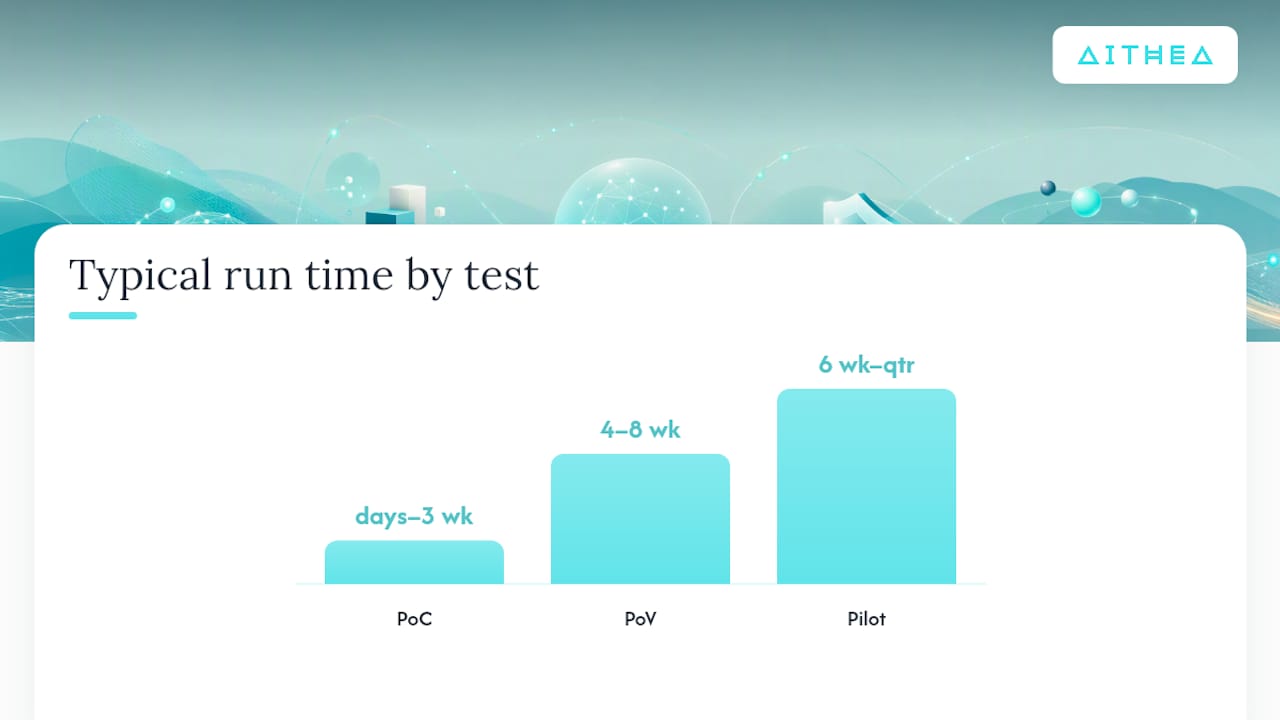
A proof of value (PoV) answers "is this worth it?" It is cross-functional by design, pulling in the business owner, the technical lead and often procurement, because the output is a business case with numbers attached. A PoV is typically time-boxed to 4–8 weeks and should run against production or production-grade data, not a curated demo set.
A pilot answers "can this operate in our real workflows?" It is the closest thing to production without being production. A pilot deploys a near-complete solution to a limited group of real users, testing feasibility, stability, and whether people actually adopt it, over anywhere from six weeks to a full quarter.
- PoC: technical feasibility, engineering-led, days to three weeks, output is a working demo.
- PoV: business case, cross-functional, 4 to 8 weeks, output is quantified ROI evidence.
- Pilot: operational readiness, ops and change-management led, six weeks to a quarter, output is a go/no-go for scaling.
How do I know whether I need a PoV or a pilot?
Start by locating the doubt. If nobody on the buying committee questions whether the tool works or whether it will pay off, but everyone is nervous about rollout, you need a pilot, not another round of value testing.
- Ask where the scepticism sits. Technical doubt points to a PoC. Financial or strategic doubt ("will this actually move the needle on false positives, or investigation time?") points to a PoV. Operational doubt ("will our analysts actually use it, will it survive contact with our case management system?") points to a pilot.
- Check whether success criteria already exist. If your team can't name three measurable outcomes the technology must hit, run a PoV first. Pilots without a prior PoV tend to measure adoption while quietly ignoring whether the thing was ever worth adopting.
- Confirm data readiness. A PoV run on clean, synthetic data proves very little. If your data pipeline isn't ready to feed something close to production data, fix that before scheduling either exercise.
- Look at procurement pressure. Vendors sometimes push straight to a pilot because it looks like commitment. If the commercial case hasn't been proven, that pressure is a sign to insist on a PoV first.
Get this sequencing wrong and momentum stalls fast: a pilot launched without proven value drifts into "pilot purgatory", generating adoption data nobody asked for while the actual ROI question stays unanswered. Guidance from FlowLab on distinguishing technical feasibility from business value makes the same point in a different procurement context, which tells you this isn't a compliance-specific quirk.
How do you set measurable KPIs for a PoV or pilot?
Pick three to five outcomes before any technical work starts, not after. Vague ambitions like "improve efficiency" produce vague results that nobody can defend to an economic buyer later. Instead, define outcomes that a spreadsheet can settle: reduction in false-positive alerts, hours saved per case, percentage of transactions correctly escalated, or time-to-decision on a sanctions hit.
- Set a baseline for each metric using your current process before the PoV or pilot begins.
- Agree the data sources and refresh frequency needed to measure each KPI, and confirm they're actually accessible.
- Name three sign-off roles up front: a Value Owner who owns the business case, a technical champion who owns feasibility, and an economic buyer who owns the budget decision.
- Document what "pass" looks like numerically, not descriptively, before the test starts.
Cross-functional coordination and explicit success criteria agreed before technical work begins separate PoVs that convert into scaled deployments from ones that quietly die. Structured programmes with defined scope, timelines and mutual commitments convert far more consistently than open-ended trials with no fixed endpoint.
Pro Tip: Write your KPI thresholds down and get the economic buyer to initial them before the PoV starts. A verbal "we'll know it when we see it" agreement evaporates the moment results come back mixed.
Why do so many pilots stall before scaling?
Most pilots don't fail on technology. They fail on ownership, data, and change management, in roughly that order.
- Split ownership kills momentum. Name a Value Owner responsible for the business case and a separate Run Owner responsible for keeping the system alive operationally. Without both roles named explicitly, projects frequently stall the moment the evaluation phase ends and nobody feels accountable for what happens next.
- Synthetic data hides the real risk. Testing against clean, curated data is a common pitfall; representative production data surfaces integration and quality issues within the first month rather than after go-live.
- Missing production artefacts leave pilots orphaned. A pilot that scales without a runbook, monitoring, or defined SLOs isn't ready, whatever the demo looked like.
- Change management gets bolted on too late. Identify early adopters and build their feedback loop into the pilot plan from day one, not as an afterthought once adoption numbers disappoint.
What does "production ready" actually require?
Passing a pilot on paper and surviving contact with production are different things. Practitioners increasingly talk about a minimal "production spine": a short list of artefacts that must exist before you let more users near the system, regardless of how well the pilot performed.
- Named owners with a clear escalation path when something breaks at 2am.
- A draft SLO or SLA, even an imperfect one, plus basic monitoring and an incident response plan.
- Data governance and access control that match your existing compliance standards, not a temporary exception.
- A written runbook, and a measurement plan for the rollout itself, not just the pilot phase.
This isn't bureaucracy for its own sake. Organisations regularly fall into what one analysis calls the "pilot graveyard", where proofs of value technically succeed but quietly die because nobody defined the production path on day one. Done correctly, structured PoC and pilot programmes can convert 60 to 80% of engagements into closed deals, largely because that structure removes the ambiguity that otherwise kills momentum after go-live.
Designing PoVs for regulated, AI driven compliance environments
PoVs should be designed around measurable regulatory fit as much as technical performance, because a compliance tool that scores well on speed but poorly on auditability under European AI and data protection rules isn't a real win. Operational evaluation has to account for explainability, model governance, and how the tool behaves under the EU's evolving AI and financial crime rules. Procurement artefacts matter here: structured RFP inputs and a defensible vendor-scoring method turn a subjective "we liked the demo" into evidence a board can act on.
Where does a PoV fit versus a pilot in a real compliance deal?
Picture a transaction monitoring tool that claims to cut false positives by a meaningful margin. The technology clearly works elsewhere; that's not in question. What's in question is whether it works on your alert volumes, your typologies, your data quality. That is a PoV scenario: run it against six months of historical, real alerts and measure the false-positive reduction directly.
Now picture a case management upgrade meant to replace a tool your investigators use daily. Nobody doubts it will reduce clicks per case. The open question is whether investigators will actually adopt it, whether it integrates with your existing sanctions screening feed, and whether it holds up under real caseload pressure. That's a pilot: roll it out to one team for six to eight weeks and watch adoption, not ROI.
A sanctions screening replacement often needs both, in sequence. Run a PoV first to prove the match-rate and false-positive numbers beat your incumbent on real data. Only once that business case is proven should you move to a pilot with a live team, testing whether the workflow, escalation paths, and analyst experience hold up. Skipping the PoV means you might pilot something that works operationally but never actually improves your detection rate, which is an expensive way to learn a tool wasn't worth buying.
What are the real risks and benefits of a PoV versus a pilot?
A PoV's main benefit is that it kills bad decisions cheaply. Four to eight weeks and a modest budget can save you from a six-figure annual contract for a tool that doesn't actually move your metrics. Its main risk is scope creep: without firm KPIs agreed up front, a PoV can drift into an unpaid extended demo that never reaches a decision.
A pilot's main benefit is operational truth. It's the only stage that reveals whether your team will actually use the thing, whether it survives your existing tech stack, and whether support processes hold up under real volume. Its main risk is cost and exposure: a pilot touches real workflows and sometimes real customer data, so a failed pilot can carry reputational or regulatory consequences a PoV never would.
Run them in the wrong order and the risks compound. A pilot launched before value is proven risks a scaling decision built on adoption metrics alone, ignoring whether the tool ever delivered the ROI it was bought for. A PoV run without production data risks the opposite: a beautiful business case that collapses the moment real data hits the pipeline, because synthetic data validation is a well documented failure mode.
How do you move from PoV to pilot without losing momentum?
Treat the PoV's sign-off as a formal gate, not a soft handoff. The Value Owner who approved the business case needs to explicitly hand accountability to a Run Owner before pilot planning starts, otherwise the pilot inherits nobody's urgency.
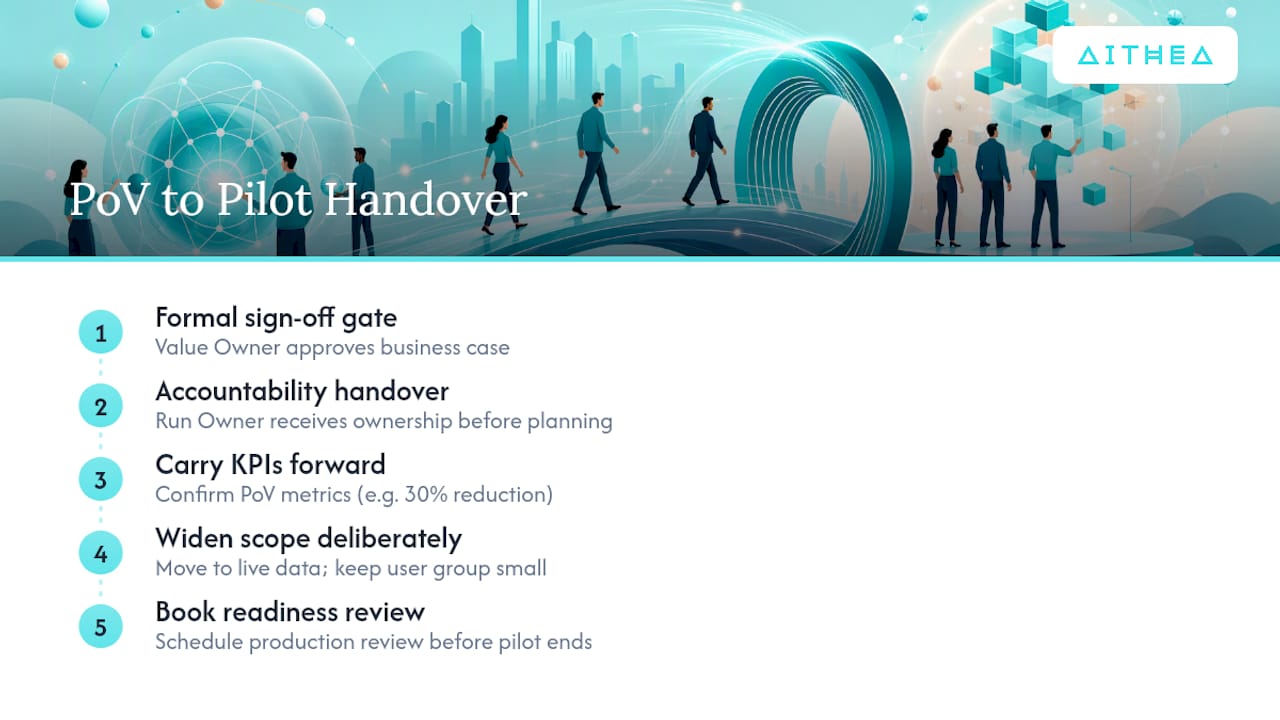
Carry the KPIs forward rather than rewriting them. If the PoV proved a 30% reduction in investigation time on historical data, the pilot's job is to confirm that number holds under live conditions with real users, not to invent new success measures from scratch. Changing the yardstick between stages is one of the fastest ways to lose executive confidence.
Widen the data and user base deliberately, not all at once. Move from the PoV's historical data set to live production data, and from a small technical evaluation team to a real operational team, but keep the pilot's user group deliberately small at first. Expanding both data scope and user headcount simultaneously makes it hard to diagnose whether a failure is a data problem or an adoption problem.
Finally, book the production-readiness review before the pilot ends, not after. Waiting until a pilot's final week to ask about monitoring, runbooks, and escalation paths guarantees a delay. Build that review into the pilot plan from the start so a positive result can move straight to scaling.
What does each phase actually cost?
PoC and PoV budgets should be modest and predictable: a few weeks of internal time from a technical lead and a business owner, plus whatever the vendor charges for a sandboxed engagement. Because a PoV is typically time-boxed to 4–8 weeks, the cost ceiling is naturally contained, and any vendor asking for a substantial fee or a long-term commitment before proving value should raise questions.
Pilots cost considerably more, and that's by design. You're now paying for integration work, possibly a temporary licence at production scale, training time for the pilot team, and internal effort from IT and compliance to support a live deployment. Budget for change management here too: the pilot's success depends on adoption, and adoption needs training time, communication, and a feedback channel that someone actually monitors, all of which cost real hours even if no line item says so.
The mistake worth avoiding is under-budgeting the pilot because the PoV came in cheap. A pilot that touches live workflows and real data carries operational risk a PoV never does, and skimping on the production-readiness checklist to save budget is exactly how pilots end up stalled indefinitely rather than scaled or killed cleanly.
What innovation managers get wrong about this decision
The conventional advice treats proof of value and pilot as a formality to get through on the way to a purchase order, and that's precisely where most compliance technology projects go wrong. Vendors have every incentive to rush you toward a pilot, because a pilot feels like commitment even when the value case was never actually proven.
What the evidence here actually supports is less comfortable: most of the failure happens not during either test, but in the gap between them, where ownership goes undefined and success criteria quietly get reinterpreted. Named owners and pre-agreed KPIs sound like paperwork until you watch a project stall for exactly that reason.
If you take one thing from this, prioritise the KPI conversation over the technology conversation. A compliance team that can name three measurable outcomes and a Value Owner before evaluating any vendor will make a better decision than one that picks the flashiest demo and figures out the metrics later. Regulation and AI evaluation only raise the stakes on getting that sequencing right.
— Aneta
Get hands-on support designing your PoV or pilot
Aithea exists precisely for the gap most compliance teams struggle with: turning "we should test this vendor" into a structured, defensible PoV or pilot with named owners, agreed KPIs, and procurement artifacts that a board will actually sign off on.

Rather than leaving your team to reverse-engineer success criteria mid-evaluation, Aithea helps you define the measurable outcomes, data requirements and sign-off structure before a vendor conversation even starts, and brings RFP and vendor-scoring tools purpose-built for compliance technology selection to the table. If your organisation is weighing a PoV or pilot for AI-driven compliance technology and wants that groundwork done properly, get in touch with Aithea to discuss how a structured evaluation could look for your team.
Sources
The pilot project guide from Monday.com covers operational rollout mechanics in detail. Isotropic Solutions' AI PoV guide is the sharpest reference on time-boxing and production data for AI use cases specifically.
- POC & Pilot Programs: Proving Value Before the Sale - 2026 Guide
- What is a pilot project? A complete guide for managers
- What Is an AI Proof-of-Value Engagement? A Guide for Enterprise Buyers — Isotropic Solutions
- Proof-of-concept (PoC) vs proof-of-value (PoV): what do they mean for your business — Tenable blog
- POV vs POC: guide for SaaS teams (2026) - Guideflow Blog
FAQ
What is the difference between a PoC and a pilot?
A PoC tests narrow technical feasibility in a sandbox, usually in under three weeks, while a pilot tests a near-complete solution with real users in live workflows over six weeks to a quarter to assess adoption and operability.
What comes first, PoC or pilot?
A PoC comes first when technical feasibility is genuinely in doubt; when the technology's core capability is already proven elsewhere, teams typically skip straight to a PoV or pilot instead.
What is the difference between a PoC and a PoV?
A PoC answers "can it work technically?", while a PoV answers "is it worth it financially?" using measurable KPIs on production or production-grade data, typically over 4 to 8 weeks.
What are the differences between a PoC, an MVP and a pilot?
A PoC proves technical feasibility in isolation, an MVP is a stripped-down but usable product built for early customer feedback, and a pilot deploys a near-complete solution to real users to test operational readiness before full-scale rollout.
Should a PoV always happen before a pilot?
In most regulated technology decisions, yes: a PoV proves the business case is real before you invest the greater cost and operational exposure of a pilot, though a straightforward workflow tool with an already-proven ROI can sometimes move directly to a pilot.