

A proof of concept answers one question: can it work? A proof of value answers a different one: is it worth doing? Confusing the two wastes months of procurement time and burns stakeholder goodwill you will need later.
Run the diagnostic before you run anything else. If the doubt in the room is technical, whether the AI model can actually read the documents, whether the integration will talk to your case management system, run a proof of concept (PoC). If the doubt is financial or strategic, whether this reduces false positives enough to justify the licence fee, run a proof of value (PoV).
Immediate next steps:
- Name one technical lead and one executive sponsor before you start either exercise
- Write a single sentence defining scope: what you are testing, and what "success" means numerically
- Set a fixed end date; an open-ended pilot is not a pilot, it is a delay
Key Takeaways
A proof of concept tests whether a solution functions technically, while a proof of value tests whether it justifies the spend through measurable business outcomes.
| Point | Details |
|---|---|
| Ask the diagnostic question first | Technical doubt calls for a PoC; financial or value doubt calls for a PoV. |
| Fix the timeline before starting | A few weeks with a hard end date keeps a PoV from becoming an unpaid trial. |
| Secure the full committee | A PoV needs an executive sponsor, technical lead, and business owner signed on early. |
| Track two layers of metrics | Pair a technical threshold with a business metric like cost avoided or hours saved. |
| Aithea supports regulated PoV design | Aithea helps compliance teams build PoV criteria around explainability, data access, and measurable compliance KPIs. |
Table of Contents
- Proof of concept vs proof of value: the core definitions
- How PoC and PoV differ in practice
- When should you run a PoC and when should you run a PoV?
- How to design a proof of value that actually produces a decision
- Common mistakes that derail PoC and PoV projects
- A quick checklist for choosing and running your evaluation
- Why compliance and AI projects change the PoV design
- What the evaluation debate gets wrong
- Get help scoping a proof of value that survives procurement
- Sources
- FAQ
Proof of concept vs proof of value: the core definitions
A proof of concept is a demonstration built to show that an idea is technically feasible. It is deliberately narrow: one use case, one dataset, one pass/fail threshold. It answers "can it work?" with a technical report, not a budget justification.
A proof of value is a structured pilot that measures whether a solution delivers business outcomes worth paying for. It runs longer, involves more people, and ends in a business case rather than a technical write-up.
- PoC example (non-technical): a logistics firm tests whether a routing algorithm can process live GPS feeds without crashing. Pass or fail.
- PoV example (compliance): a bank pilots an AI screening tool against six months of historic alerts to measure the drop in false positives and the hours of analyst time saved, then builds a business case around those figures.
The distinction matters more in regulated sectors, where a technically brilliant tool that nobody can explain to a regulator is worth nothing.
How PoC and PoV differ in practice
- Core question and output. A PoC produces a technical report answering "does it function?" A PoV produces a business case answering "does it pay off?"
- Who signs off. PoCs are usually approved by a technical lead alone. PoVs need the full buying committee, meaning an executive sponsor, a business owner, and a technical lead, because the decision that follows is a spending decision.
- Timeline and resourcing. PoCs can run in days with one or two engineers. PoVs typically need two to six weeks, real (or realistic) data, and input from finance or operations.
- Sequencing. Where a technology is genuinely novel, a short PoC often precedes the PoV, confirming it functions before you spend weeks measuring whether it is worth the spend. Running both back to back is normal; skipping the PoV and going straight to procurement is not.
When should you run a PoC and when should you run a PoV?
The diagnostic question is always the same: where does the buyer's doubt actually sit? Ask that first, because the answer determines everything downstream, from who attends the kickoff meeting to what the final report looks like.
Run a PoC when the technology is genuinely unproven for your environment, an unusual integration, an untested data format, a novel model architecture, and the sponsor's objection is "will this even function here?"
Run a PoV when the technology is established but the objection is financial: "will this save enough to justify the licence?" or "can we prove ROI to the board?" Most mid-market and enterprise software decisions sit in this category, because feasibility is rarely the real obstacle once a vendor has other live customers.
- Vendor evaluation: the vendor already has reference clients running the same core function. Skip the PoC, run a PoV.
- Internal innovation project: nobody has built this before internally. Run a short PoC first.
- Regulated procurement: technical fit and regulatory defensibility both matter. Run a brief PoC to confirm integration, then a full PoV to build the compliance business case.
Pro Tip: If your evaluation has run past six weeks with no fixed end date, you are not running a PoV. You are running an unpaid consulting engagement for the vendor. Set the clock before you start, not after.
How to design a proof of value that actually produces a decision
A PoV without structure just becomes a longer, vaguer PoC. Five elements separate a PoV that produces a decision from one that produces excuses:
- A business-framed objective. Not "test the AI model" but "reduce false positive alerts by a stated margin within the pilot window."
- Success criteria with two layers. A technical metric (accuracy, latency) and a business metric (hours saved, cost avoided).
- Named stakeholders, including an executive sponsor who can actually approve spend afterwards.
- A fixed timeline. Two weeks is a workable cadence for a focused enterprise PoV; four weeks suits more complex, multi-system pilots.
- A results template agreed in advance, so the closing conversation is about the numbers, not about redefining what success meant.
Two-week plan: Week one, configure against a historic dataset and set baselines. Week two, run live comparisons and draft the business case.
Four-week plan: Weeks one to two mirror the above; weeks three to four add stakeholder review cycles and a second data cut to confirm results hold.
For compliance and AI projects specifically, track: analyst time saved per week, change in false positive rate, percentage of regulatory obligations covered, and direct cost avoided through reduced manual review.
Common mistakes that derail PoC and PoV projects
Most failed evaluations trace back to a handful of avoidable errors, and the most expensive one is running the wrong exercise entirely, a technical PoC when the real objection was always about cost.
- Running a PoC when the sponsor's actual doubt is financial, not technical
- Starting without agreed success criteria, or without an executive sponsor who can act on the result
- Letting scope creep turn a two-week PoV into a three-month unpaid trial
- Measuring only technical thresholds and never connecting them to a business outcome
Left unchecked, these produce what one industry analysis calls a "museum of prototypes": working demos nobody ever adopts.
A quick checklist for choosing and running your evaluation
- Diagnostic answered: technical doubt → PoC; value doubt → PoV
- Stakeholders secured: executive sponsor, technical lead, business owner
- Success criteria set: one technical threshold, one business metric
- Timeline fixed, with a named next step if targets are met
Why compliance and AI projects change the PoV design
Compliance technology cannot be judged on accuracy alone. A model that improves detection but cannot explain its reasoning to a regulator has not proven its value, only its cleverness.
AITHEA frames PoV success criteria around three layers: measurable compliance KPIs, explainability the reviewer can defend to a regulator, and data access that respects privacy constraints from day one. Where production data cannot be used, simulated datasets have to carry enough realism to make the results credible during model validation and change management.
What the evaluation debate gets wrong
The conventional advice treats PoC and PoV as interchangeable steps in a generic "pilot" process. That framing is where most procurement cycles lose months. A PoC proves nothing about value, and a PoV run without technical guardrails proves nothing about feasibility. Treating them as one blurred activity is how you end up with a working demo and no budget approval six months later.
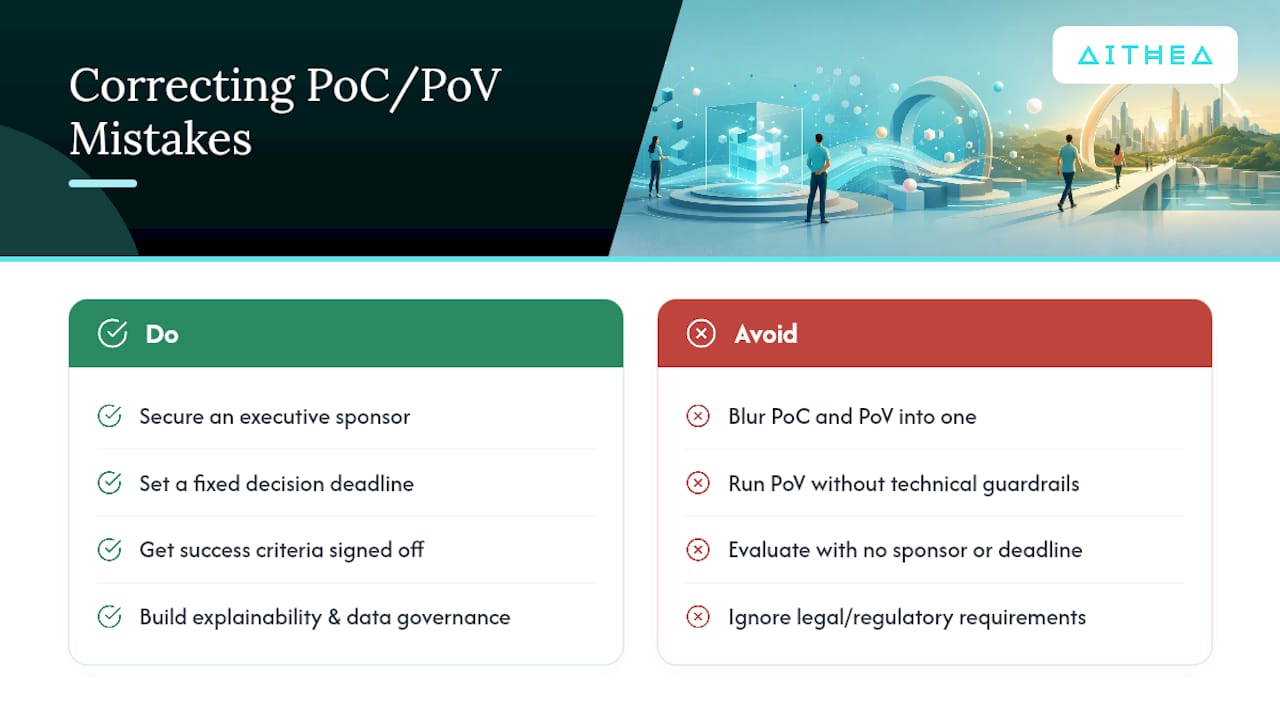
The bigger gap is stakeholder discipline, not methodology. Teams write success criteria that sound rigorous but were never signed off by the person who controls the cheque book. In regulated environments this is worse: a PoV that ignores explainability and data governance from the outset will need to be rerun once legal or the regulator asks the obvious question.
Prioritise the executive sponsor and the fixed timeline before you prioritise the technology itself. A brilliant tool evaluated with no sponsor and no deadline dies quietly. A modest tool evaluated with both produces a decision, win or lose, and that is the actual point of running a PoV at all.
— Aneta
Get help scoping a proof of value that survives procurement
Designing a PoV that holds up under regulatory scrutiny takes more than a spreadsheet of KPIs, it takes someone who has scoped compliance technology evaluations before and knows where regulators, data access, and vendor claims tend to collide. Aithea works alongside compliance teams on exactly this: technology matchmaking, PoV design, and procurement support for financial crime and regulatory technology decisions.

If you are weighing up a new sanctions screening or AML tool and need the diagnostic run properly rather than guessed at, start with a scoped readiness conversation. Get in touch with Aithea to talk through a pilot workshop before you commit budget to the wrong evaluation.
Sources
- Proof of value vs proof of concept: Why the difference matters in presales | Modern Presales
- POV vs POC: guide for SaaS teams (2026) - Guideflow Blog
- proof of concept | Definition from Cambridge Dictionary
- Proof of Concept (PoC) Versus Proof of Value (PoV) | Tenable blog
FAQ
What is the difference between proof of concept and proof of value?
A proof of concept tests technical feasibility, whether something can function. A proof of value tests business impact, whether it delivers enough measurable benefit to justify buying it.
What comes first, PoC or MVP?
A proof of concept typically comes first, confirming an idea is technically workable before resources go into building a minimum viable product (MVP) for real users.
How is an MVP different from a PoC?
A PoC proves feasibility internally and is often thrown away; an MVP is a stripped-down but real, usable product released to actual users to gather feedback.
What is the difference between a PoC and a PoV?
The same distinction applies: a PoC answers whether a solution works technically, while a PoV answers whether it works financially, producing a business case rather than a technical report. Aithea's PoV frameworks for compliance projects build both answers into one evaluation.