

The most costly procurement pitfalls in RegTech are not vendor failures. They are internal. EBA's analysis of RegTech in the EU financial sector identified data quality, legacy integration, lengthy procurement cycles, skills gaps and limited awareness of available solutions as the dominant barriers. Here are the ten pitfalls that most frequently derail UK procurement teams, each with a mitigation you can act on today.
- Data quality and readiness. Vendors cannot fix your data. Conduct a data-quality audit before issuing an RFP.
- Legacy integration. Assume your core systems will not connect cleanly. Require API documentation and sandbox access at shortlist stage.
- Procurement delays. Internal approval cycles routinely extend timelines by months. Appoint a senior sponsor with delegated authority before the process starts.
- Vendor immaturity. Marketing claims are not evidence. Require SOC 2 or ISO 27001 certification, audit logs and reproducible demo data.
- Unclear ROI. Vendors overestimate how persuasive ROI projections are; institutions care more about security and integration. Define your own success metrics before evaluating any solution.
- Skills gaps. Technology works; adoption does not. Build a training and change-management plan into the procurement scope from day one.
- Weak contracting and exit risk. Absent exit-assistance clauses are the most expensive long-term mistake. Require specific data-export formats and a defined transition period in every contract.
- GDPR and cybersecurity exposure. Unclear controller/processor roles create regulatory liability. Confirm ICO-compliant data-processing agreements before any pilot begins.
- Hidden total cost of ownership. License fees are rarely the largest cost. Budget separately for integration, testing, training, ongoing support and eventual migration.
- Change management failure. Procurement ends at go-live; value does not start until adoption does. Mandate a change-management workstream with named ownership.
Regulatory signposts for UK teams: the FCA's outsourcing and third-party risk guidance, the PRA's supervisory statement SS2/21 on operational resilience, the ICO's guidance on controllers and processors, and the EBA's supervisory analysis of RegTech benefits and risks together form the baseline governance framework every UK procurement team should attach to its RFP.
Key takeaways
The most costly RegTech procurement pitfalls are internal and contractual, not vendor failures, and most are preventable with structured governance applied before the RFP goes out.
| Point | Details |
|---|---|
| Audit before you procure | Conduct a data-quality and integration-readiness audit before issuing any RFP. |
| Require auditable vendor evidence | Request SOC 2/ISO 27001 certification, model validation reports and reproducible demos, not marketing claims. |
| Budget for the full lifecycle | License fees are rarely the largest cost; budget separately for integration, testing, training and exit. |
| Negotiate exit clauses before signing | Require specific data-export formats, a defined transition period and termination-for-cause provisions in every contract. |
| Attach regulator guidance to your RFP | Reference FCA, PRA, ICO and EBA guidance in procurement documents; vendors who cannot respond to it self-select out. |
| Use Aithea's structured approach | Aithea's Heliolus navigator and procurement playbooks give compliance teams an evidence-based vendor selection and pilot management framework. |
Table of Contents
- Why buying RegTech differs from generic IT procurement
- Data protection, privacy and cybersecurity pitfalls
- Integration with legacy systems: why it derails more projects than anything else
- How to assess vendor maturity and avoid weak due diligence
- Procurement costs, timelines and the budget mistakes that compound
- Organisation readiness: skills, training and change-management pitfalls
- Contracting pitfalls: what weak SLAs and absent exit clauses actually cost you
- A practitioner's procurement checklist: RFP, pilot and KPI templates
- Where to look: FCA, PRA, ICO and EBA guidance for UK RegTech procurement
- Aithea's approach to RegTech procurement: from vendor selection to pilot management
- A procurement lesson worth carrying forward
- Sources
- FAQ
Why buying RegTech differs from generic IT procurement
RegTech procurement must be treated as a compliance function that happens to involve technology. That distinction changes almost every sourcing decision.
A standard IT procurement optimises for cost, functionality and delivery speed. RegTech procurement must also satisfy auditability, explainability, model governance and regulatory evidence requirements. The FCA and PRA expect firms to demonstrate that outsourced or third-party technology does not create gaps in their regulatory obligations. That means the contract, the due-diligence file and the ongoing oversight framework are as important as the software itself.
The EBA's supervisory interest, summarised in its press release on RegTech benefits, challenges and risks, reflects a consistent theme: regulators want to see that firms understand what their RegTech solutions are doing, can explain the outputs, and can switch providers without losing regulatory continuity. That is a materially different bar from a standard IT vendor assessment.
AI and machine-learning features raise the stakes further. When a solution uses ML for transaction monitoring, name screening or risk scoring, procurement must assess model governance: how the model was trained, how drift is detected, how outputs are explained to compliance staff, and who is accountable when the model produces a false negative. These are not IT questions. They sit squarely in the compliance function, and procurement teams that treat them as technical footnotes tend to discover the gap during a regulatory review rather than a vendor demo. Linking AI governance to operational practice from the outset, as explored in Aithea's analysis of agentic AI in compliance, is no longer optional for firms deploying automated decision-making in regulated workflows.
Regulatory baseline for UK teams: FCA outsourcing guidance (FG16/5), PRA SS2/21 on operational resilience, ICO guidance on data processors, and the EBA's RegTech analysis together define the minimum governance framework. Attach all four to your procurement governance document before the RFP goes out.
Data protection, privacy and cybersecurity pitfalls
Data protection and cybersecurity failures in RegTech procurement most often stem from two sources: unclear controller/processor roles and inadequate data-exportability provisions. Both are avoidable with a short pre-procurement checklist.
Before any vendor conversation, confirm:
- Whether your organisation is the data controller and the vendor is the processor, or whether a joint-controller arrangement applies. The ICO's guidance on controllers and processors sets out the obligations each role carries under UK GDPR.
- That a UK GDPR-compliant data-processing agreement (DPA) will be in place before any personal data is shared, including in pilots.
- Encryption standards for data in transit and at rest, and whether pseudonymisation is applied to sensitive fields.
- Data localisation: where data will be stored and processed, and whether any cross-border transfers require a transfer risk assessment under UK GDPR.
- The vendor's incident-response and breach-notification obligations, and how they align with your 72-hour ICO reporting window.
- Audit rights over the vendor's data-processing activities, not just a contractual assertion that they comply.
The FCA's operational resilience framework and the PRA's expectations for third-party risk both require firms to demonstrate that data governance does not degrade when a function is supported by an external provider. A vendor's ISO 27001 certification is a useful signal, but it does not substitute for a firm-specific DPA and a tested incident-response protocol. For a deeper look at how cybersecurity and AI intersect in financial crime compliance, the risks extend well beyond the procurement phase.
Pro Tip: Structure pilot datasets using synthetic or fully anonymised records that mirror your production data schema. This lets you test the solution's real capability, including data-mapping accuracy and model performance, without exposing live personal data to a vendor who has not yet passed your full due-diligence process.
Integration with legacy systems: why it derails more projects than anything else
Poor integration planning is the single largest cause of delayed value realisation in RegTech deployments. Industry surveys confirm that a significant portion of financial institutions and vendors identify legacy integration as one of the most serious barriers to adoption, though they often disagree on where exactly the friction sits.
The friction points are predictable once you know where to look:
- Data format mismatches. Vendors build against canonical data models that rarely match your core banking or case-management schemas. Require a data-mapping workshop before contract signature, not after.
- API availability and versioning. Confirm whether the vendor's API is REST or SOAP, its versioning policy, and whether your internal systems can consume it without middleware. Assume middleware will be needed and budget for it.
- Batch versus streaming architecture. Many legacy compliance systems process data in overnight batches. If the RegTech solution is designed for real-time streaming, the mismatch will require architectural decisions that add months to the timeline.
- Vendor assumptions about your environment. Vendors frequently assume a cleaner, more standardised data environment than exists. Require the vendor to document their assumptions in writing and confirm which assumptions your environment does not meet.
- Integration sandboxes. Insist on access to a vendor-hosted integration sandbox before the pilot begins. Testing against a live environment for the first time during a pilot is a common and avoidable mistake.
- End-to-end test cases. Define test cases that cover the full data journey from your source systems through the RegTech solution to your reporting or case-management output. Sign off the data-mapping document before any test begins.
- Performance and rollback tests. Test under realistic load conditions and confirm that a rollback to your previous process is possible within a defined window if the integration fails.
Complex RegTech implementations typically run over a period of about one to one and a half years from requirements to production. The phases where compression is genuinely safe are requirements drafting (with experienced support) and vendor shortlisting (with a focused RFP). The phases where compression creates risk are integration testing and user-acceptance testing. Cutting those short is where most post-go-live incidents originate.
How to assess vendor maturity and avoid weak due diligence
Ask for demonstrable, auditable evidence rather than marketing claims. That single rule eliminates most vendor-maturity pitfalls.
Industry analysis shows that institutions prioritise security at 41% in vendor selection, yet vendors tend to overweight ROI and regulatory expertise in their pitches. The gap means vendors will show you what they think you want to see. Your due-diligence process must be structured to surface what you actually need to know.
Vendor evidence to request at shortlist stage:
- Peer case studies from institutions of comparable size and regulatory profile, with named contacts for reference calls.
- Audit logs and uptime history for the past 12 months, including incident reports and resolution timelines.
- SOC 2 Type II or ISO 27001 certification, with the scope statement confirmed as covering the specific service you are procuring.
- Model validation reports for any AI or ML components, including training data provenance, drift-monitoring methodology and explainability documentation.
- Reproducible demo data: the vendor should be able to run their solution against a dataset you provide, not only against their curated demo environment.
- Subcontractor and fourth-party mapping: who processes your data beyond the primary vendor?
- Financial stability indicators: audited accounts, funding runway for early-stage vendors, and evidence of contractual continuity provisions.
- Data portability: in what format can you extract your data, and what does the vendor charge for extraction?
Where a RegTech solution amounts to outsourcing of a material function, the EBA's outsourcing guidance sets out the due-diligence activities regulators expect. UK firms should map those expectations against FCA and PRA requirements, which include pre-engagement assessment, ongoing monitoring and documented exit planning. Treating due diligence as a one-time procurement gate rather than an ongoing oversight obligation is itself a procurement pitfall.
Persistent barriers in 2026: Industry commentary confirms that legacy integration, unclear ROI, change management and skills gaps remain the dominant adoption barriers, with vendors and buyers frequently diagnosing different root causes. Translating vendor capabilities into your institution's own success metrics is more reliable than accepting vendor-supplied ROI projections.
Procurement costs, timelines and the budget mistakes that compound
Procurement teams consistently underestimate implementation and lifecycle costs. License fees are visible; integration, testing, training, ongoing support and exit costs are not, and they routinely exceed the license cost over a three-year horizon.
Typical cost components to budget separately:
- License or subscription fees (per user, per transaction, or platform-based)
- Integration costs: API development, middleware, data mapping, and internal engineering time
- Testing: end-to-end test design, UAT facilitation, performance testing, and remediation cycles
- Training: initial onboarding, regulatory-context training, and ongoing model-explainability sessions
- Ongoing support: vendor SLA tiers, internal support staffing, and change-request handling
- Exit and migration: data extraction, transition-period support, and re-procurement costs
RFx drafting guidance recommends embedding measurable technical definitions, governance controls and total-cost-of-ownership requirements directly into procurement documents. An RFP that asks only for license pricing will receive responses that obscure the true cost.
Procurement phase timeline (realistic estimates):
| Phase | Realistic duration |
|---|---|
| Requirements definition | 4–8 weeks |
| RFP drafting and issue | 2–4 weeks |
| Vendor response and evaluation | 4–6 weeks |
| Proof of concept / pilot | 8–12 weeks |
| Contract negotiation | 4–8 weeks |
| Integration and implementation | 16 weeks |
| User acceptance testing | 4–6 weeks |
| Controlled roll-out and steady state | 4–8 weeks |
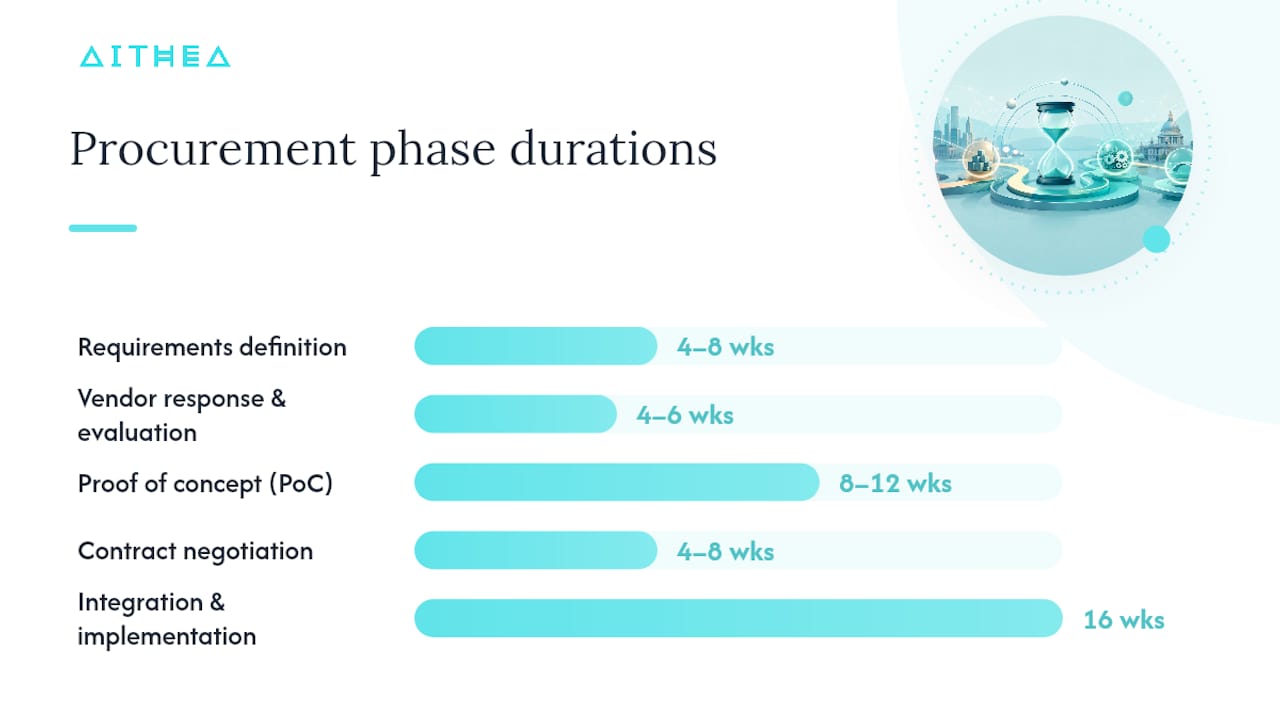
The total from requirements to production for a complex RegTech integration typically runs 12–18 months. Procurement tips that reduce wasted time: keep RFPs focused on measurable asks rather than exhaustive questionnaires, and avoid imposing more than roughly 40 hours of response burden on vendors. Overlong RFPs cause high-quality suppliers to deprioritise your process, leaving you with responses from vendors who have the capacity to answer them rather than the capability to deliver.
Organisation readiness: skills, training and change-management pitfalls
Poor skills and change management prevent adoption even when the technology works. This is not a soft risk. It is the most common reason RegTech projects deliver below their business case.
The roles that must be named and accountable before procurement concludes:
- Procurement sponsor. A senior leader with delegated authority to make decisions and resolve escalations. Without this role, procurement stalls at every approval gate.
- Compliance owner. The person accountable for the regulatory outcome the technology is meant to support. They define success criteria and sign off acceptance testing.
- Data engineer or data lead. Responsible for data-quality remediation, mapping and ongoing data governance. This role is frequently absent and frequently the cause of integration failure.
- Vendor programme manager. The vendor-side counterpart who owns delivery. Confirm this person's seniority and availability before contract signature.
- Test lead. Owns the end-to-end test plan, UAT facilitation and defect management. Should be independent of the implementation team.
- Security reviewer. Reviews the vendor's security posture, DPA compliance and incident-response provisions. Should be involved before the pilot, not after.
Training checklist to mandate in the procurement scope:
- Initial onboarding: system navigation, workflow configuration and alert management
- Regulatory context: why the tool exists, what obligation it addresses, and how outputs connect to regulatory reporting
- Model explainability: for AI/ML components, how to interpret outputs, understand confidence scores and escalate anomalies
- Incident response playbooks: what to do when the system produces unexpected results or goes offline
- Continuous learning: a schedule for refresher training as the model or regulatory environment evolves
When to recruit versus when to use vendor-managed services: if your organisation lacks a data engineer with compliance-domain knowledge, a vendor-managed or consultant-supported implementation is often faster and lower risk than recruiting during the procurement cycle. Build that decision into the business case, not as an afterthought after the contract is signed.
Contracting pitfalls: what weak SLAs and absent exit clauses actually cost you
Weak exit and SLA terms are the most costly long-term procurement mistakes in RegTech. They are also the most negotiable before signature and the least recoverable after it.
Procurement best practice is clear: require specific data-export formats, defined exit assistance, and termination-for-cause provisions for repeated SLA failure. Token service credits that amount to a fraction of a month's license fee do not reflect the compliance impact of a monitoring system being unavailable during a peak transaction period.
Contract clause checklist:
- Data export format: specify the exact schema and file format in which your data will be returned, not just a commitment to "provide data on request."
- Exit assistance: define the transition period (typically 3–6 months), the vendor's obligations during that period, and the technical cooperation required for migration.
- Termination for cause: include the right to terminate without penalty if the vendor fails to meet defined SLA thresholds for a specified consecutive period.
- Audit rights: the right to audit the vendor's data-processing activities, security controls and subcontractor arrangements, not merely to receive a certification copy.
- Subcontractor transparency: require notification and approval rights for any change in subcontractors who process your data.
- IP ownership: confirm that any configuration, rule sets or models built on your data remain your intellectual property.
- SLA remedies that match compliance impact: a transaction-monitoring system offline for four hours during business hours carries a different compliance risk than a reporting tool offline overnight. SLA tiers and remedies should reflect that difference.
Exit plan template items to require before signing:
- Transition period length and transitional SLAs
- Data export schedule and format confirmation
- Technical cooperation commitments from the vendor's engineering team
- Documentation handover: system configuration, rule sets, model parameters and integration specifications
- Knowledge transfer sessions for your internal team or replacement vendor
A practitioner's procurement checklist: RFP, pilot and KPI templates
Follow a staged procurement plan: requirements, focused RFP, proof of concept, pilot, controlled roll-out. Require evidence at each gate before proceeding to the next.
- Governance gate. Confirm sponsor, compliance owner, data lead, security reviewer and test lead are named. Attach the regulatory framework (FCA, PRA, ICO, EBA) to the governance document.
- Requirements definition. Document functional requirements, data requirements, integration constraints, regulatory obligations and success criteria before any vendor contact.
- RFP structure. Mandatory sections: solution overview, data export schema, audit rights, SLA definitions and remedies, change-control process, pricing structure and total cost of ownership, subcontractor mapping, exit assistance provisions. Embed measurable technical definitions and governance controls rather than open-ended questions.
- Vendor shortlisting. Score responses against your pre-defined criteria. Request reproducible demos against your own (anonymised) data. Conduct reference calls with named peers.
- Proof of concept design. Define the dataset (synthetic or anonymised), the test scenarios, the success criteria and the governance of pilot data before the PoC begins.
- Pilot KPI agreement. Agree KPIs with the vendor in writing before the pilot starts. Disputed KPIs after a pilot are a common and avoidable source of procurement delay.
- Contract negotiation. Use the clause checklist above. Do not proceed to implementation until exit, audit rights and SLA remedies are agreed.
- Integration and UAT. Run end-to-end test cases, performance tests and rollback tests. Sign off data-mapping documentation before go-live.
- Controlled roll-out. Limit initial deployment to a defined scope. Confirm monitoring, escalation and incident-response processes are live before expanding.
- Post-go-live vendor management. Schedule quarterly performance reviews against agreed KPIs. Maintain the due-diligence file and update it when the vendor changes subcontractors, ownership or material product features.
Sample pilot KPIs and target thresholds:
| KPI | Suggested target threshold |
|---|---|
| Alert accuracy (true positive rate) | ≥85% against agreed test dataset |
| False positive rate | ≤15% against agreed test dataset |
| System uptime during pilot | high availability during business hours |
| Alert latency (time to generate) | monitoring latency consistent with real-time requirements |
| Data-mapping accuracy | all defined fields correctly mapped |
| Incident response time (P1) | ≤4 hours to vendor acknowledgement |
Pro Tip: Run a blinded pilot scoring process: have your compliance owner and test lead score vendor outputs against the agreed KPIs without knowing which vendor produced which result. This removes familiarity bias from the evaluation and produces a defensible, auditable selection rationale.
Where to look: FCA, PRA, ICO and EBA guidance for UK RegTech procurement
Consult FCA and PRA guidance on outsourcing and operational resilience, the ICO on data processing, and the EBA's analysis for market context and due-diligence benchmarks.
Practical mapping for UK procurement teams:
- FCA (FG16/5 and operational resilience policy): expects firms to assess third-party providers before engagement, maintain oversight during the relationship, and demonstrate that outsourcing does not create regulatory gaps. Audit rights and exit planning are explicit expectations.
- PRA (SS2/21): sets out operational resilience requirements including impact tolerances for important business services. A RegTech solution supporting a critical compliance function must be assessed against those tolerances.
- ICO: governs data-processing obligations under UK GDPR. Controller/processor status, DPAs, transfer risk assessments and breach-notification timelines are all procurement-stage decisions, not post-implementation ones.
- EBA: while the EBA's remit is EU-wide, its analysis of RegTech in the financial sector remains the most comprehensive supervisory treatment of RegTech due diligence, outsourcing mapping and vendor-selection criteria available. UK firms use it as a benchmark even post-Brexit.
Concrete next step: compile a regulatory evidence pack before your RFP goes out. It should contain: the applicable FCA/PRA guidance references, your ICO data-processing assessment, your outsourcing register entry for the proposed solution, and the EBA due-diligence checklist mapped to your vendor-assessment questions. Attach this pack to the RFP as an annex. Vendors who cannot respond to it are telling you something important.
The EBA's supervisory summary of RegTech benefits and risks is a useful single-page reference for briefing senior stakeholders on why RegTech procurement requires compliance-led governance rather than standard IT sourcing.
Aithea's approach to RegTech procurement: from vendor selection to pilot management
Procurement teams that have navigated the pitfalls above know the process is resource-intensive. Mapping regulatory obligations, structuring an RFP, running a blinded pilot and negotiating exit clauses all require domain knowledge that most internal teams are building in real time, often while managing live compliance programmes.

Aithea provides AI-driven vendor selection, procurement playbooks and pilot management specifically for compliance programmes in financial crime, trade and regulatory compliance. The Heliolus AI compliance technology selection navigator gives procurement and compliance teams a structured, evidence-based framework for shortlisting and evaluating RegTech vendors, without the months of unstructured market scanning that typically precede a focused RFP. Core service capabilities include vendor selection and market mapping, RFP design with measurable technical asks, pilot orchestration and blinded scoring, contract and exit clause review, and compliance training for teams adopting new technology.
If your organisation is at the requirements stage, the shortlisting stage, or mid-pilot and questioning whether the evaluation is defensible, get in touch with the Aithea team to discuss how a structured procurement engagement can reduce timeline risk and produce a selection rationale your regulators can audit.
A procurement lesson worth carrying forward
One lesson that changes how experienced teams run RegTech procurements: the most avoidable mistakes are not discovered during vendor evaluation. They surface six to twelve months after go-live, when the exit clause that was never negotiated becomes relevant, or when the model that was never explained to compliance staff produces an alert pattern no one can interpret.
Consider a scenario that recurs across UK financial institutions: a compliance team selects a transaction-monitoring solution after a thorough RFP process. The vendor's demo is compelling, the security certification is in order, and the pilot produces acceptable false-positive rates. Eighteen months later, the vendor is acquired. The new parent entity changes the data-processing subcontractors. The firm has no contractual notification right and no audit right over the new subcontractor chain. The ICO data-processing agreement references an entity that no longer exists in the same form. Re-negotiating from a position of operational dependency is expensive and slow.
The corrective governance change is straightforward: subcontractor transparency and change-notification rights belong in every RegTech contract, not as boilerplate but as specific, enforceable clauses with defined remedies. The checklist in the contracting section above covers this. So does the vendor selection and due-diligence guidance that procurement teams should attach to their governance documents from the outset.
AI adds a further dimension. When a monitoring model is updated by the vendor post-go-live, without a contractual requirement for model-change notification and re-validation, the firm may be running a materially different model than the one it approved. Model governance provisions, including the right to be notified of material model changes and to require re-validation before deployment, are now a standard expectation in compliance-led procurement.
Sources
Before finalising your RFP or governance document, review these sources. Each addresses a specific procurement risk.
- EBA analysis of RegTech in the EU financial sector
- Vendor selection, due diligence, and implementation (RegTech chapter)
- FIs and vendors agree legacy systems are the issue but diverge sharply on where the friction sits
- What are the biggest barriers to third-party RegTech adoption?
- Risk, Compliance & Regulatory Technology (RegTech) RFx Drafting | Financial Services and Fintech
Attach the EBA analysis, the relevant FCA/PRA guidance references and your ICO data-processing assessment to every RFP you issue. Vendors who engage seriously with that material are demonstrating the regulatory literacy your procurement process should be selecting for.
FAQ
What are the most common procurement pitfalls in RegTech?
The most common pitfalls are data-quality gaps, legacy integration failures, unclear controller/processor roles under UK GDPR, weak exit and SLA clauses, and underestimated total cost of ownership. The EBA's analysis identifies data quality, interoperability and lengthy procurement cycles as the dominant internal barriers.
How long does a typical RegTech implementation take?
Complex RegTech implementations typically run 12–18 months from requirements definition to production, covering integration, testing, user acceptance and controlled roll-out. Compressing integration testing or UAT is where most post-go-live incidents originate.
What due diligence should I require from a RegTech vendor?
Request SOC 2 Type II or ISO 27001 certification, audit logs and uptime history, model validation reports for any AI/ML components, subcontractor mapping, financial stability evidence and a reproducible demo against your own anonymised data. Where the solution amounts to outsourcing, apply the EBA's outsourcing due-diligence framework mapped to FCA and PRA expectations.
What exit clauses must every RegTech contract include?
Every contract should specify the exact data-export format, a defined transition period of 3–6 months, termination-for-cause rights for repeated SLA failure, audit rights over subcontractors, and a documentation handover covering system configuration, rule sets and integration specifications.
How can Aithea help with RegTech procurement?
Aithea provides AI-driven vendor selection, RFP design, pilot orchestration and contract review for compliance programmes. The Heliolus AI selection navigator gives procurement teams a structured, evidence-based framework for shortlisting and evaluating RegTech vendors.