

The single priority for 2026 is building a mapped compliance data layer around one or two high-value use cases, not buying another point solution. Get the taxonomy right first: link every regulatory obligation to its control and evidence trail. Firms that do this see faster audit response, lower manual effort, and a credible path to DORA and EU AI Act readiness, with frameworks built specifically for that sequencing.
TL;DR:
- Building a mapped compliance data layer around key use cases is essential, with emphasis on proper taxonomy linking obligations to controls before adopting tools.
- Prioritizing automation in regulatory change management and evidence generation delivers quick gains, while data mapping remains the strategic foundation.
- A phased roadmap with clear assessment, pilot, and scaling gates reduces rework and ensures compliance system integration, especially with legacy system constraints.
- DORA and the EU AI Act now impose strict vendor documentation and resilience requirements, making vendor due diligence a core part of risk management.
- Modern compliance tech stacks should favor hybrid architectures with strong data lineage, avoiding disconnected niche tools that hinder auditability.
Table of Contents
- Top priorities: what to modernize compliance technology first
- How do you build a roadmap to modernize compliance technology?
- What does DORA require from compliance technology vendors?
- Which architecture choices actually work for compliance technology stack modernisation?
- Change management, timelines and cost: what should you budget for?
- Case studies: what modernisation looks like across industries
- Why do legacy systems block modernisation, and how do you work around them?
- What data privacy and security steps matter most during modernisation?
- How do you keep compliance technology current after go-live?
- Why now: the near-term landscape for compliance teams
- How Aithea helps you deliver this roadmap
- Sources
- FAQ
Top priorities: what to modernize compliance technology first
Not every gap deserves equal budget. Triage matters more than ambition when you're trying to modernize compliance technology under regulatory pressure and finite headcount.
- Data layer and taxonomy — map every obligation to a control and a data source before buying anything. Skip this and every subsequent tool sits on sand.
- Regulatory change management — automate horizon scanning and impact assessment first; it touches every other process and delivers visible time savings fast.
- AML transaction monitoring — tune or replace rules-based engines that generate excessive false positives; this is usually the biggest cost centre in the stack.
- KYC and onboarding — modernise identity verification and ongoing due diligence, particularly where manual review still dominates.
- Case management and evidence generation — the layer that proves to supervisors that everything upstream actually works.
Quick wins sit at the top of that list: change management tooling and evidence automation show results within a quarter. The data layer is the strategic investment. Get that wrong and every "quick win" above it becomes another disconnected tool feeding the same fragmented reporting problem firms were trying to escape in the first place.
How do you build a roadmap to modernize compliance technology?
A credible roadmap moves through five gates, each with its own deliverable and exit criteria. Skipping a gate to save time almost always costs more later in rework.
- Assess. Build an obligation-to-control inventory and taxonomy. This is the single most skipped step, and the one insight repeatedly linked to modernisation succeeding when obligations are mapped to controls once, with lineage maintained to digital evidence.
- Prioritise. Score gaps by regulatory exposure and manual effort saved. Pick one or two pilots, not five. A narrow, well-instrumented pilot beats a broad one every time.
- Pilot. Set measurable success criteria upfront: false positive reduction, time-to-evidence, hours saved per week. Build in human sign-off gates from day one rather than retrofitting governance after the fact.
- Procure. Issue RFPs that require vendors to demonstrate live, auditable behaviour, not static demo decks. Ask for evidence of resilience testing, data lineage, and exit planning.
- Scale and decommission. Roll the pilot into production, then formally retire the legacy tool it replaced. Institutions that skip decommissioning end up running both systems indefinitely, doubling licence costs and audit surface area.
Pro Tip: Write your pilot's exit criteria before you write its success criteria. Knowing exactly what "stop and walk away" looks like protects you from sunk-cost pressure six months in.
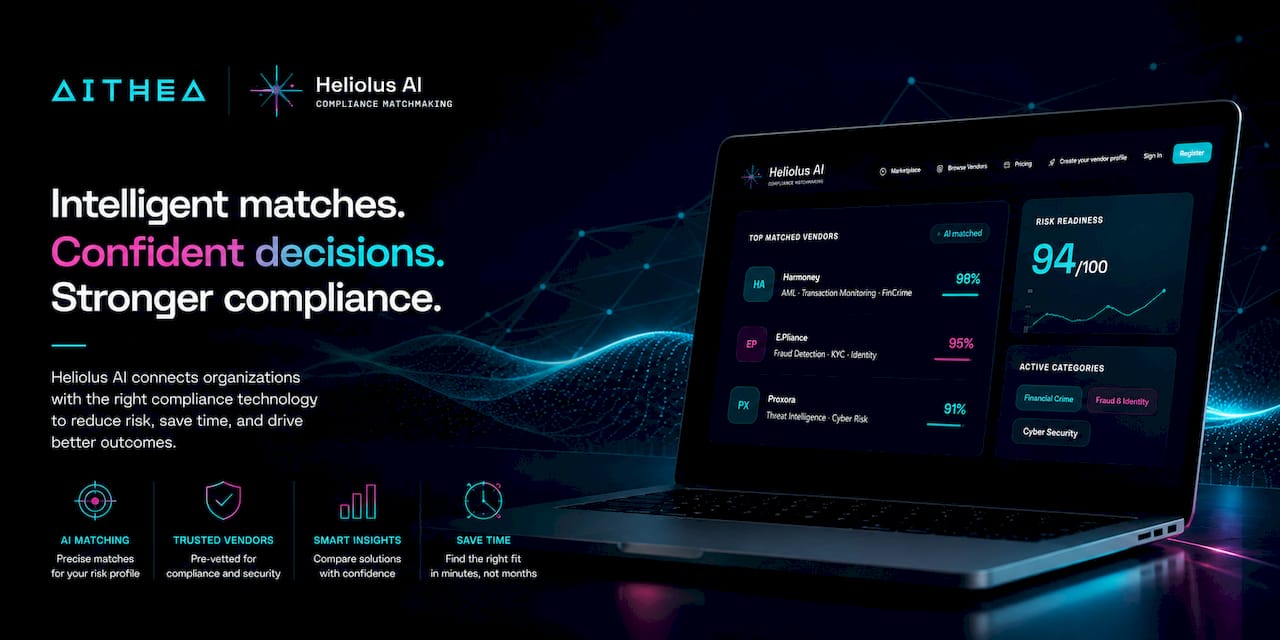
Aithea's technology selection navigator is built for exactly this gate structure, helping teams move from assessment to a shortlist without re-inventing the RFP checklist each time.
What does DORA require from compliance technology vendors?
DORA became applicable on 17 January 2025 and treats most RegTech vendors as ICT third-party providers subject to contractual, testing, and incident-reporting obligations. Buyers, not just vendors, carry the compliance burden here.
Under DORA, firms must document concentration risk and build exit strategies for critical ICT third parties that are actually tested, not just written into a contract and filed away. The EU AI Act adds a second layer: it became fully applicable for many provisions on 2 August 2026, and AI systems used for AML or credit scoring can fall under its high-risk category, triggering conformity assessments and mandatory human oversight.
Model risk governance deserves the same rigour. Treat any AML scoring system as a model subject to validation, documentation and ongoing governance expectations, echoing the discipline long applied under frameworks like SR 11-7 in the United States.
Your RFPs and contracts should include:
- Audit rights covering both the vendor's operations and its own subcontractors
- Documented, tested exit assistance provisions, not just a termination clause
- A concentration risk assessment showing how dependent you'd become on this single vendor
- Service resilience commitments with defined incident reporting timelines
Global regulatory fines in financial services reached $4.6 billion in 2024, and 71% of firms now plan to increase RegTech spending in response. That figure alone should reframe vendor due diligence as risk management, not procurement paperwork.
Which architecture choices actually work for compliance technology stack modernisation?
The most common mistake is what practitioners call the archipelago effect: replacing spreadsheets with a dozen unconnected niche tools instead of one coherent data layer. Each tool solves its own narrow problem while making the overall picture harder to audit.
A single compliance data layer, with obligations mapped once to controls and evidence, avoids that trap. It doesn't mean one monolithic platform does everything. A hybrid approach that pairs a platform layer for shared data and workflow with specialist modules for material use cases like sanctions screening is the pragmatic choice for most mid-sized institutions.
Where does agentic AI actually earn its place in this stack? Three production use cases stand out:
- Regulatory change prioritisation, where AI ranks incoming rule changes by relevance and urgency
- Retrieval-augmented question answering against policy documents, always with human review before any answer reaches a decision
- Automated evidence generation for audit and reporting packages
Early trials of regulatory "coworker" agents reported reductions of 80 to 90% in wasted effort on prioritisation tasks. That is a genuine productivity shift, but the same source is clear: never deploy a bare large language model for regulatory Q&A without retrieval and human review built in.
| Architecture decision | Best fit | Governance requirement |
|---|---|---|
| Single platform, full suite | Smaller firms, limited IT resource | Vendor concentration risk assessment |
| Hybrid platform plus specialist modules | Mid-sized institutions with material AML/KYC volume | Integration audit logging, provenance tracking |
| API-first, best-of-breed | Complex, multi-jurisdiction firms | Strong data lineage and exit planning per vendor |
Aithea's agentic AI guidance covers where autonomous execution is appropriate and where a human must stay in the loop.
Change management, timelines and cost: what should you budget for?
Realistic timelines matter more than optimistic ones. Assessment and taxonomy work typically runs eight to twelve weeks. A well-scoped pilot takes three to six months to reach a go/no-go decision. Full production rollout, including decommissioning the legacy tool, often adds another two to three quarters.
- Hire or upskill a data engineer who understands regulatory taxonomy, not just data pipelines
- Name a model risk owner accountable for validating any AI-driven scoring or classification
- Assign a product manager to own the roadmap between compliance, IT and procurement
- Keep subject-matter experts embedded in pilot design, not consulted after the fact
Quantify return on investment through three lenses: direct cost reduction in manual review hours, fines avoided through faster detection, and time saved on regulatory monitoring. The most common pitfall remains over-buying capability nobody maps to an obligation, followed closely by skipping the taxonomy step entirely and discovering the gap during a pilot review.
Pro Tip: Present ROI to the board in avoided-cost terms first, efficiency-gain terms second. Boards respond faster to "this prevents a repeat of last year's finding" than to "this saves forty hours a month."
Case studies: what modernisation looks like across industries
A European retail bank piloting compliance-as-code for transaction reporting saw the clearest signal yet that this approach scales. Digital Regulatory Reporting pilots run in partnership with UK regulators showed reporting cost reductions of up to 80% for participating firms, achieved by converting regulatory rules into machine-readable code rather than manually interpreting guidance each reporting cycle.
In trade compliance, firms handling sanctions screening across multiple jurisdictions have replaced static rules engines with AI-assisted triage that ranks alerts by genuine risk rather than flooding analysts with false positives. The operational effect compounds: fewer false positives means faster true-positive investigation, which means the evidence trail supervisors ask for is already assembled rather than reconstructed under deadline pressure.
Insurance compliance teams tackling AML monitoring have followed a similar path, layering agentic AI onto regulatory change management so that new guidance gets triaged and routed to the right policy owner within hours instead of weeks. The common thread across every credible case is sequencing: taxonomy and data mapping came first, the AI layer came second, and human sign-off stayed built into every workflow rather than bolted on after a near-miss.
What separates the initiatives that stall from the ones that scale isn't the sophistication of the technology. It's whether the firm mapped its obligations before it bought anything, and whether it picked one narrow, measurable pilot instead of trying to modernise everything simultaneously.
Why do legacy systems block modernisation, and how do you work around them?
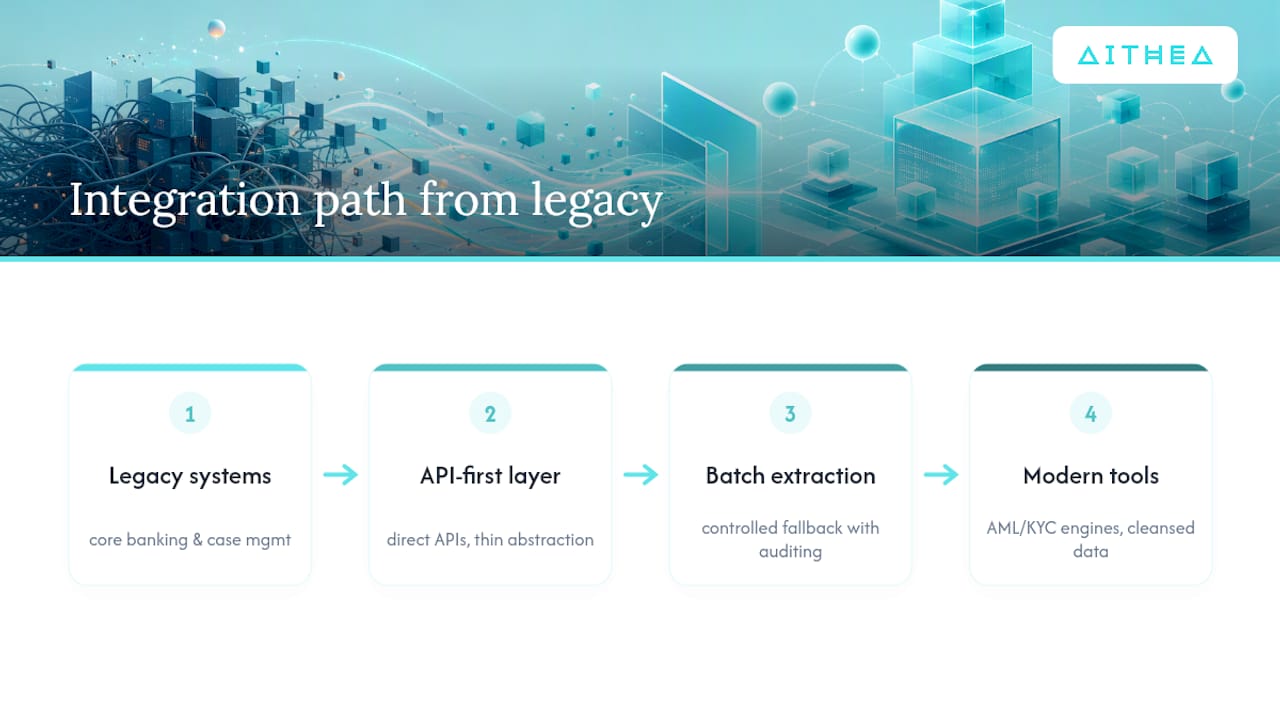
Legacy core banking and case management systems rarely expose clean APIs, which means every new tool needs a bespoke integration layer just to see the data it needs. That integration debt is often the real reason modernisation projects run over budget, not the new technology itself.
The practical workaround starts with an API-first integration pattern wherever the legacy system allows it, even if that means building a thin abstraction layer rather than waiting for a vendor's next major release. Where true API access isn't available, controlled batch extraction with strict audit logging is the fallback, not a permanent solution.
Data quality is the second blocker. Legacy systems accumulate decades of inconsistent entity naming, duplicate records and undocumented workarounds. Feeding that directly into a new AML or KYC engine without a cleansing and reconciliation step guarantees the new tool inherits the old system's mess, just with a better dashboard on top.
The third blocker is organisational, not technical: teams that have run the legacy system for years often hold undocumented knowledge about its quirks. Losing that knowledge during a rushed cutover creates gaps no amount of good architecture can fix retroactively. Build a parallel-run period into every migration plan, long enough to catch discrepancies before the legacy system is switched off, and keep the people who know its history involved until decommissioning is complete.
What data privacy and security steps matter most during modernisation?
Migrating compliance data, especially KYC and transaction records, means handling some of the most sensitive personal and financial data an organisation holds. Every modernisation project needs a data protection impact assessment before migration starts, not after a vendor is already onboarded.
Encryption in transit and at rest is table stakes; the harder question is access control granularity. New platforms should support role-based access mapped to actual job function, not a blanket "compliance team" permission that gives every analyst visibility into every case file. Audit logging needs to capture who accessed what data and when, both for internal governance and because DORA's incident reporting obligations assume you can reconstruct exactly what happened during a breach.
Vendor security posture belongs in the same due diligence process covered under DORA's third-party provider rules. Ask specifically how a prospective vendor segregates client data, what its breach notification timeline commits to, and whether its own subcontractors meet the same standard you're holding it to. A vendor that can't answer those questions clearly during procurement won't suddenly become transparent after the contract is signed.
Data retention policy is the detail teams forget most often. Regulatory evidence often needs to be retained for years, but personal data minimisation principles push the other way. Build retention rules into the new architecture from day one, tied to specific obligations rather than a blanket "keep everything indefinitely" default that creates its own privacy risk.
How do you keep compliance technology current after go-live?
Modernisation isn't a project with an end date. Regulatory change doesn't stop once a new platform goes live, and neither should the governance processes built around it.
Set a recurring review cadence, quarterly at minimum, to reassess whether the obligation-to-control mapping still reflects current regulation. New guidance under the EU AI Act or updates to DORA's technical standards can shift what "compliant" looks like without any code changing on your side.
Model performance drifts, particularly with AI-driven scoring tools. A monitoring routine that tracks false positive rates, alert volumes and model accuracy over time catches drift before it becomes a supervisory finding. Treat this the same way model risk governance frameworks require ongoing validation, not a one-time sign-off at deployment.
Vendor relationships need the same continuous attention as the technology itself. Annual reassessment of concentration risk, resilience testing results and contractual terms keeps DORA obligations current rather than treating the original due diligence as a box ticked once. Build a feedback loop from front-line users, the analysts and investigators actually working the tools daily, back into a product backlog. They spot friction and false positives long before a formal audit does, and that feedback is often the cheapest source of continuous improvement a compliance team has.
Why now: the near-term landscape for compliance teams
Compliance is shifting from a back-office cost centre to a function that directly shapes which vendors an institution can even do business with. DORA has made vendor resilience a procurement criterion, not an afterthought, and that reprices every existing vendor relationship whether firms like it or not.
The practical implication for leaders this year: audit your top three vendor contracts against DORA's exit and concentration risk requirements now, before a supervisor asks you to. Pair that with one modest agentic AI pilot, scoped narrowly enough to govern properly. Waiting for full regulatory clarity before acting is itself the riskier choice.
— Aneta
How Aithea helps you deliver this roadmap
There are practical alternatives to running procurement and pilot governance entirely in-house, without outside benchmarking against what vendors are actually delivering elsewhere. Rather than starting your RFP from a blank page, some services map support directly onto each stage of the roadmap above: assessment support to build your obligation-to-control taxonomy, RFP and due diligence guidance for procurement, governance frameworks for pilot sign-off, and microlearning content to upskill compliance teams alongside the technology itself.

The Heliolus navigator helps teams shortlist AI compliance vendors against criteria that actually matter, resilience, auditability, integration fit, rather than marketing claims alone. Aithea's agentic AI guidance sets out where autonomous execution is safe and where human sign-off stays mandatory under the EU AI Act. If your next step is scoping a vendor shortlist or pressure-testing a pilot's governance model, get in touch with Aithea before your next procurement cycle starts.
This article is general information, not a substitute for advice from a qualified financial advisor. Consult a qualified financial professional about your own circumstances before acting on anything here.
Sources
- AI in RegTech: The 2026 Tooling and Evaluation Guide | Finrep Blog
- CUBE turns regulatory overload into an AI advantage | Fintech Global
FAQ
How can compliance be improved with technology?
Start by mapping every regulatory obligation to a control and data source, then automate the highest-volume manual process, usually AML monitoring or regulatory change tracking, before adding further tools.
What are the latest technology trends in compliance?
Agentic AI for regulatory change prioritisation and evidence generation, compliance-as-code for reporting, and DORA-driven vendor resilience requirements are reshaping procurement decisions in 2026.
Is there a future in compliance as a career?
Yes. Compliance is shifting from a back-office control function to a role that shapes technology procurement and vendor strategy, which raises rather than reduces its strategic importance.
What is the best compliance software?
There is no single best platform; the right choice depends on your obligation mapping and risk exposure. Tools like Aithea's Heliolus navigator help teams shortlist options against their specific requirements rather than generic vendor rankings.
How long does it take to modernize compliance technology?
Assessment and taxonomy work typically takes eight to twelve weeks, a pilot runs three to six months, and full production rollout with legacy decommissioning adds another two to three quarters.