

Know Your Customer (KYC) is a risk-based framework that requires organisations to verify who their customers are and to monitor them for financial crime risk. The precise obligations differ by jurisdiction, but bodies including FinCEN, the UK's HMRC-aligned guidance and FATF converge on one instruction: verify identity, then document why the level of checking applied fits the risk. Consultancies work with compliance teams turning that instruction into a working, auditable process.
TL;DR:
- Customer identification typically involves verifying government-issued IDs and proof of address for individuals or registration details for companies.
- Risk-based approaches tailor the level of scrutiny, applying standard, simplified, or enhanced due diligence depending on factors like customer type, country, and transaction patterns.
- Verification increasingly relies on electronic methods such as OCR, facial biometrics, and database checks, but challenges remain with deepfakes and biased biometric systems.
- Continuous monitoring and periodic reviews are essential, especially if customer risk profiles shift due to transaction activity or changes in regulations or sanctions.
- Relying on external expertise can help adapt KYC processes to evolving technology, regulation, and risk landscapes, especially when internal capacity or knowledge gaps arise.
Table of Contents
- Core components: CIP, CDD and EDD explained
- When KYC is required: timing, triggers and legal obligations
- Documents and verification methods, including eKYC and biometrics
- Risk-based approach and ongoing monitoring
- Jurisdictional differences and key international standards
- Technology and AI in KYC: operational use cases, limits and governance
- Where compliance teams actually get KYC wrong
- When it's worth bringing in outside expertise
- Sources
- FAQ
Core components: CIP, CDD and EDD explained
KYC isn't one check. It's three layered processes that work together across the life of a customer relationship, from the moment they sign up to the day they close their account.
The customer identification program (CIP) is the entry gate. It confirms a person or entity is who they claim to be, typically using a government-issued photo ID, a national identity number, and proof of address such as a recent utility bill or bank statement. For companies, that means verifying registration details and identifying who actually owns or controls the entity behind the paperwork.
Customer due diligence (CDD) goes further than identity. It asks what the customer does, why they need the product, and where their money is likely to come from and go. The FinCEN CDD Rule requires covered US financial institutions to identify and verify both customers and beneficial owners, understand the nature of the relationship, and monitor it on an ongoing basis. UK guidance mirrors this closely, requiring firms to assess the purpose and intended nature of a business relationship before it goes live.
Enhanced due diligence (EDD) kicks in when the standard picture isn't enough. It applies to politically exposed persons, customers linked to high-risk jurisdictions, complex ownership structures, or unusual transaction patterns. EDD typically adds:
- Deeper source-of-funds and source-of-wealth checks
- Senior management sign-off before onboarding
- More frequent transaction reviews once the account is live
- Independent verification of adverse media or litigation history
Picture the lifecycle as a funnel: CIP confirms identity at the door, CDD builds the risk picture behind it, and EDD narrows in on the accounts that need closer watching once they're inside. Monitoring never really stops. A customer who looked low risk at onboarding can shift categories the moment their transaction behaviour changes.
When KYC is required: timing, triggers and legal obligations
Most regimes require KYC at account opening, but the obligation doesn't end there. Occasional or one-off transactions above a set threshold, common in payments and money transfer services, can trigger the same identification duties even without a formal account relationship.
Firms also need to re-check identity or escalate to EDD when:
- A customer's risk profile changes, such as a new beneficial owner or a shift to a higher-risk country
- Transaction behaviour looks inconsistent with the stated purpose of the account
- A periodic review falls due, particularly for higher-risk customers reviewed annually or more often
- Sanctions or PEP status changes are flagged through screening updates
The consequences of getting this wrong are not abstract. Regulators can levy fines, impose remediation orders, or in serious cases pursue criminal liability, and firms are generally expected to retain records for a set number of years after the relationship ends. Exact thresholds and retention periods vary by jurisdiction and sector, so the working rule is simple: always check the primary statute or your regulator's current guidance rather than relying on a generic summary, including this one.
Documents and verification methods, including eKYC and biometrics
Verifying a customer used to mean a photocopier and a filing cabinet. It increasingly means a phone camera and a facial scan. Both approaches remain valid, and most firms now run a hybrid of the two.
- Documentary evidence. Passports, national ID cards, and driving licences remain the backbone of identity verification, paired with proof of address such as a utility bill, tenancy agreement, or bank statement no older than three months.
- Database and registry checks. Firms cross-reference national ID registries, company registration databases, and credit bureau records to confirm the paperwork matches official records rather than a convincing forgery.
- Sanctions, PEP, and adverse media screening. Every customer is checked against sanctions lists and politically exposed persons databases, with adverse media screening flagging reputational or criminal history that formal databases might miss.
- Electronic KYC (eKYC). Optical character recognition (OCR) extracts data from scanned documents, near-field communication (NFC) reads the chip embedded in modern passports and ID cards, and facial biometrics with liveness detection confirm the person presenting the document is physically present and matches the photo.
Operational workflows built around these steps, document checks, sanctions and PEP screening, adverse media, and risk scoring, have become the default architecture for firms trying to onboard at scale without opening the door to synthetic identity fraud. eKYC speeds up onboarding dramatically, but it isn't free of trade-offs: liveness checks can be defeated by increasingly sophisticated deepfakes, and a badly tuned biometric system can lock out legitimate customers with darker skin tones or older ID photos more often than it should. Getting the balance right between friction and fraud resistance is now as much a design question as a compliance one, and it's worth reviewing how operational ID verification workflows are actually built before choosing a vendor.
Risk-based approach and ongoing monitoring
Not every customer needs the same depth of scrutiny, and regulators don't expect it. FinCEN's own guidance confirms that firms aren't required to run every possible check on every customer; they're required to apply a level of diligence that's appropriate to the risk and defensible on paper.
Risk is driven by a combination of factors:
- Customer type: an individual retail client carries different risk to a shell company with layered ownership
- Product: a basic savings account poses less risk than a cross-border correspondent banking relationship
- Transaction pattern: cash-intensive businesses and rapid fund movement both raise the risk score
- Geography: exposure to jurisdictions with weak AML controls pushes a customer toward enhanced measures
At the low-risk end, simplified due diligence applies lighter checks for customers such as regulated public bodies or listed companies. At the high-risk end, EDD demands the deeper checks outlined earlier. Between those two poles sits standard CDD, which covers the majority of everyday relationships.
Ongoing monitoring is where the risk-based approach earns its keep. Transaction monitoring systems flag activity that deviates from a customer's expected behaviour, triggering a review rather than an automatic block. Periodic reviews, more frequent for higher-risk customers, catch the cases where risk has quietly increased since onboarding. UK guidance is explicit that firms must be able to demonstrate why their chosen level of diligence fits the risk, not just that a check was performed.
Pro Tip: Don't just log that a check happened. Write down why that specific level of diligence was chosen for that specific risk rating. Regulators read policies, not just checklists, and a documented rationale survives an audit far better than a tick-box record does.
Jurisdictional differences and key international standards
KYC obligations share a common backbone but differ in detail from one regulator to the next, and treating one country's rulebook as universal is one of the most common mistakes compliance teams make.
- The FinCEN CDD Rule requires covered US financial institutions to identify and verify customers and beneficial owners, and to conduct ongoing monitoring for suspicious activity.
- The UK Money Laundering Regulations, supported by HMRC-aligned guidance, require verification of customers and beneficial owners, an assessment of the purpose of the relationship, and enhanced measures where risk is higher.
- The EU is consolidating supervision through its new Anti-Money Laundering Authority (AMLA), aiming to harmonise enforcement across member states rather than leaving it entirely to national regulators.
Sitting above all of these is the FATF, the international standard-setter whose recommendations shape how most national laws are drafted, even though FATF itself has no direct enforcement power. National regulators translate FATF's principles into binding local law, which is why the practical advice never changes: check the primary statute or your own regulator's guidance for the jurisdiction you actually operate in, rather than assuming one country's rule applies everywhere.
Technology and AI in KYC: operational use cases, limits and governance
KYC has quietly become a technology problem as much as a legal one. Document checks, sanctions screening, and adverse media reviews that once took a case handler hours can now run in seconds, and that shift is reshaping how compliance teams are structured.
AI and automation are proving useful in several concrete places:
- Document verification: OCR and machine learning models catch forged or altered documents faster than manual review
- Sanctions and PEP screening: fuzzy matching algorithms reduce the volume of false positives that used to swamp analysts
- Adverse media monitoring: natural language processing surfaces relevant negative news while filtering out name-matching noise
- Risk scoring: models continuously reweight a customer's risk profile as new transaction data arrives
Automation genuinely cuts false positives and speeds onboarding, but it shifts the compliance burden rather than removing it. Governance now has to cover explainability (can you show a regulator why a model flagged or cleared a customer?), independent model validation, and rigorous vendor due diligence before any tool goes near production data. Change management matters just as much: procurement decisions, staff training, policy updates, and audit trail design all need to move in step with the technology, not trail behind it. Aithea works with compliance teams on exactly this handoff, from technology matchmaking to structured vendor evaluation, because a well-chosen tool with poor governance around it creates new regulatory exposure rather than closing old gaps.
Where compliance teams actually get KYC wrong
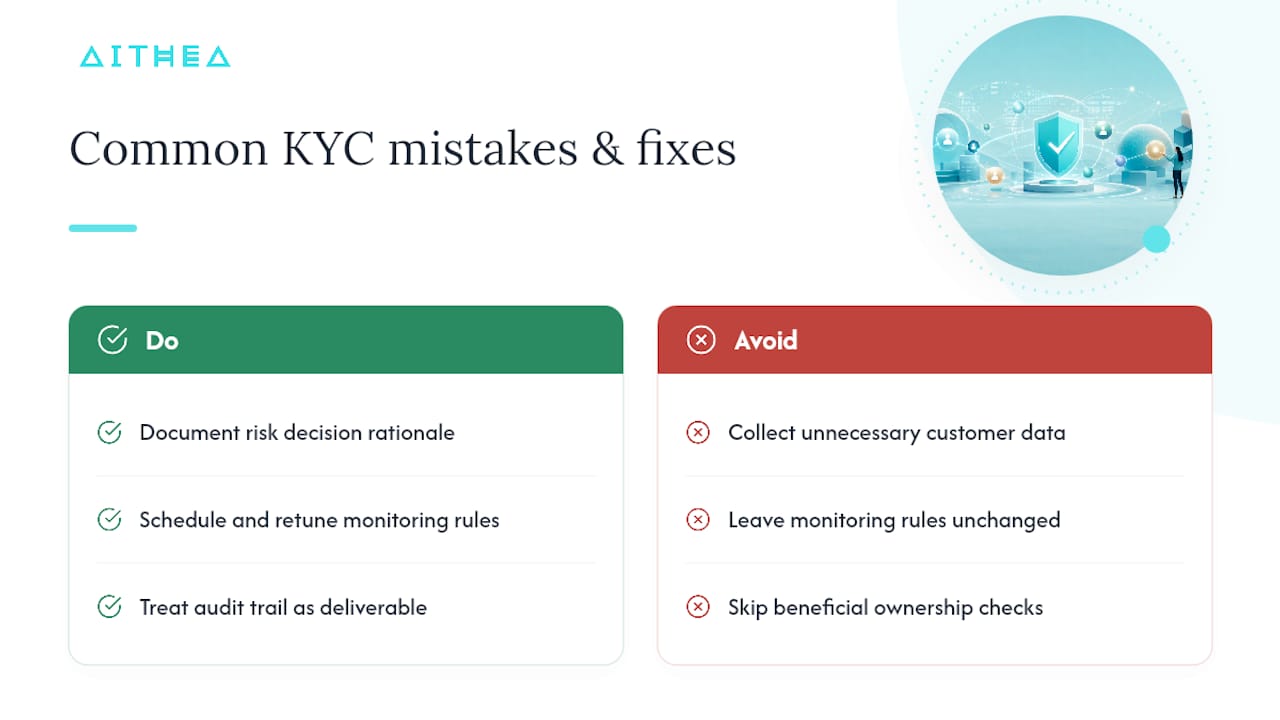
The failures I see repeated most often aren't exotic. Firms collect far more customer data than their risk assessment actually justifies, which slows onboarding without improving detection. Transaction monitoring rules get set once at go-live and never retuned, so they drift out of step with real customer behaviour within a year. Beneficial ownership checks get skipped on complex corporate structures because unpicking them is genuinely hard work.
The fix is unglamorous: write down the rationale for every risk decision as you make it, retune monitoring rules on a schedule, and treat a defensible audit trail as the actual deliverable, not the paperwork left over after the real work is done.
— Aneta
When it's worth bringing in outside expertise
Building and maintaining a defensible KYC programme in house takes ongoing legal tracking, vendor evaluation, and technology decisions that most compliance teams juggle alongside everything else on their desk. Some consultancies specialise in matching compliance teams to the right AI-driven verification, screening, and monitoring technology, then support the RFP and procurement process so the final choice fits the risk profile rather than a vendor's sales pitch.

That advisory work covers technology matchmaking for document verification and sanctions screening tools, structured support through vendor RFPs, and education for compliance teams who need to understand what a tool can and can't do before they sign a contract. It's worth bringing in that kind of outside support when your risk profile is changing faster than your current stack can handle, when a regulator has flagged gaps in your monitoring, or when you're evaluating AI vendors for the first time and want an informed second opinion. If any of that sounds familiar, get in touch with Aithea to talk through what a properly governed KYC technology stack should look like for your organisation.
Sources
FAQ
Is KYC a legal requirement in the UK?
Yes. UK Money Laundering Regulations require regulated firms to carry out customer due diligence, including identity verification and beneficial ownership checks, before establishing a business relationship.
What are the five steps of KYC?
Most frameworks follow customer identification, customer due diligence, risk assessment, ongoing monitoring, and enhanced due diligence for higher-risk cases, though exact staging varies by regulator and firm.
What is meant by Know Your Customer?
Know Your Customer means verifying a customer's identity and understanding their business relationship well enough to assess and monitor their financial crime risk on an ongoing basis.
What is a KYC process?
A KYC process is the practical sequence a firm follows to identify a customer, verify supporting documents, screen against sanctions and PEP lists, and monitor their activity for as long as the relationship lasts. Technology matchmaking tools help firms choose the right systems to run that process at scale without losing the audit trail regulators expect.