

Financial crime compliance is the framework of policies, controls and technology a regulated business uses to prevent, detect and report money laundering, sanctions breaches and fraud. Its purpose sits on three pillars: anti-money laundering (AML) and know-your-customer (KYC) checks, sanctions screening, and fraud detection, all backed by senior management oversight. None of it holds together without technology that connects regulatory obligation to daily operational practice.
TL;DR:
- Up-to-date customer risk profiling and ongoing monitoring are crucial, with regulators expecting frequent updates beyond initial onboarding.
- Effective governance requires clear documentation, regular oversight by senior management, and testing with records like risk assessments and suspicious activity logs.
- Automated AI tools reduce false positives and improve pattern detection, but need explainability, integration, and staff training for regulatory compliance.
- Fraud risk management should prioritize preventive controls and continuous metrics tracking, with external validation to ensure effectiveness.
- Vendor procurement must be driven by defined requirements and measurable benchmarks, avoiding hype by embedding explainability and SLAs into selection criteria.
Table of Contents
- What are the core components of financial crime compliance?
- Who is accountable for governance in financial crime compliance?
- What regulations shape financial crime compliance across Europe?
- How is AI changing financial crime compliance technology?
- What does effective fraud risk management look like?
- How should compliance teams train staff and build a speak-up culture?
- What's a practical 30/90/180-day implementation plan?
- What challenges will shape financial crime compliance next?
- How should firms respond to a compliance breach?
- How does financial crime compliance fit into enterprise risk management?
- What can real compliance failures teach us?
- Why procurement discipline matters more than the AI hype cycle
- Get hands-on support for your financial crime compliance technology decisions
- Sources
- FAQ
What are the core components of financial crime compliance?
A functioning programme rests on four interlocking parts, each with its own operational demands.
Customer due diligence starts with a risk-based Customer Identification Program, then moves into ongoing monitoring as the relationship matures. Regulators expect firms to update beneficial ownership records and re-score risk as customer behaviour changes, not just at onboarding. Suspicious Activity Reports should follow detection promptly. Industry guidance commonly points to a 30-day filing window once a suspicious pattern is confirmed.
Money laundering typically moves through three stages. Criminals place illicit funds into the financial system, layer them through transactions to obscure origin, then integrate them back into legitimate-looking assets. Understanding this three-stage typology helps analysts recognise why certain transaction patterns trigger alerts even when no single transaction looks unusual.
Core building blocks include:
- Sanctions screening: matching customers and transactions against watchlists, with escalation workflows for potential hits
- Transaction monitoring: rule-based or model-driven alerting on unusual account activity
- Fraud detection: identifying account takeover, first-party fraud and payment fraud patterns
- Case management: documenting investigation steps and disposition decisions
Transaction monitoring systems are notorious for high false positive rates. Analysts routinely spend more time clearing noise than investigating genuine risk.
Who is accountable for governance in financial crime compliance?
Accountability sits at multiple levels, and regulators expect to see it documented, not assumed.
- The board sets risk appetite and approves the overarching FCC policy framework, reviewing it at least annually.
- Senior management owns implementation and must be able to demonstrate active oversight, not just sign-off. FFIEC guidance is explicit that effective programmes need a named senior manager driving risk-based maintenance of customer profiles.
- The AML Compliance Officer or MLRO runs day-to-day operations, acts as the point of contact for regulators and files SARs.
- Independent testing (internal audit or an external reviewer) checks the programme works as designed, typically on an annual cycle, with findings tracked through formal remediation plans.
Practical governance artefacts include a written risk assessment, an escalation matrix, training records, and a suspicious activity log. Auditors will ask for all four during any examination, and gaps in record keeping are one of the most common findings in enforcement actions.
What regulations shape financial crime compliance across Europe?
The regulatory map is fragmented but converging. The Financial Action Task Force sets the global standard that most national frameworks are built on, covering the 40 Recommendations that shape risk-based AML expectations worldwide.
Within the EU, the Authority for Anti-Money Laundering and Countering the Financing of Terrorism (AMLA) is now coordinating national supervisors to close the inconsistency that has long let weak links persist across member states. This is arguably the most significant EU institutional shift in FCC in a decade, and firms operating across multiple EU jurisdictions should expect supervisory convergence rather than a patchwork of local interpretations going forward.
For US-facing obligations, FinCEN remains the primary source on SAR filing, beneficial ownership information reporting and Bank Secrecy Act duties. National regulators still diverge on thresholds, timelines and reporting formats.
Key sources to track:
- FATF Recommendations and mutual evaluation reports
- AMLA guidance and technical standards as they roll out across the EU
- FinCEN advisories for US-exposed entities
- Your home regulator's own rulebook, which usually layers additional local requirements on top
Always check the primary regulator source before acting on secondary commentary. Rules shift, and blog summaries age quickly.
How is AI changing financial crime compliance technology?
Technology has moved from a back-office support function to the operational core of compliance. Screening engines, entity resolution tools, transaction monitoring platforms and case management systems now need to talk to each other, not sit in silos.
AI's biggest contribution is pattern detection at a scale humans cannot match, and a meaningful cut in false positive volume when models are tuned well. That benefit comes with a governance cost: model decisions need traceability, and regulators increasingly ask firms to explain why an AI system cleared or escalated a case, not just what it decided.
A working vendor-evaluation checklist should cover:
- Data inputs: what data the tool needs, and whether your systems can supply it cleanly
- Integration: how the tool connects to existing screening and case management infrastructure
- Explainability: whether decisions can be reconstructed for an auditor or regulator
- Procurement readiness: sample data schemas, performance SLAs on screening latency, and false positive targets built into the RFP itself, since comparisons between vendors are unreliable without these
Practitioner guidance backs pairing automation with analyst review rather than replacing it outright, because sophisticated typologies adapt faster than static rules can be retrained. Post-deployment, plan for staff retraining, defined SLAs for alert handling, and ongoing model monitoring, not a one-off go-live.
Pro Tip: Build your false positive target and explainability requirement into the RFP before you approach vendors, not after. Retrofitting these requirements once a contract is signed is far harder than negotiating them upfront.
What does effective fraud risk management look like?
A defensible fraud risk assessment follows a repeatable sequence: identify the fraud schemes relevant to your business lines, score each by likelihood and impact, then prioritise controls against the highest-scoring risks first. Skipping straight to control deployment without this step is how firms end up over-controlling low-risk areas while leaving genuine exposure thin.
Preventive controls (segregation of duties, access restrictions, pre-transaction screening) stop fraud before it happens. Detective controls (transaction monitoring, reconciliation reviews, anomaly detection) catch it after the fact. Both matter, but the evidence increasingly favours investing upfront.
GAO evaluations show preventive antifraud activity frequently delivers stronger returns than reactive recovery efforts, and recommend building deterrence savings into ROI calculations from the outset.
Practical metrics worth tracking:
- Number of frauds prevented versus detected after loss
- Average time from alert to disposition
- False positive rate trend over time
- Estimated deterrence value against control cost
Third-party validation, whether internal audit or an external programme review, adds credibility that self-reported metrics rarely achieve.
How should compliance teams train staff and build a speak-up culture?
Training needs to be role-based. A frontline teller needs different red-flag knowledge than a transaction monitoring analyst or a senior manager signing off the annual risk assessment. Refresher training on at least an annual cycle is standard practice, with targeted updates whenever typologies or regulations shift materially.
Recognised industry certificates, such as those offered through the International Compliance Association (ICA), give structure to role progression and signal competence to regulators during examinations.
Culture matters as much as curriculum:
- Protected, well-publicised whistleblowing channels
- Visible ethical leadership from senior management, not just policy statements
- Incentive structures that don't quietly reward looking the other way
Behavioural and emotional-intelligence training measurably improves detection of red flags that automated systems miss entirely. Measure impact through post-training assessment scores and, more tellingly, through the volume and quality of internal escalations over time.
What's a practical 30/90/180-day implementation plan?
Start with a diagnostic: where are the gaps between current controls and regulatory expectation, and who owns each gap?
- Days 1 to 30: complete a current-state control mapping, assign named owners, fix any glaring policy gaps.
- Days 31 to 90: tune monitoring rules, integrate outstanding data sources, run initial staff training.
- Days 91 to 180: complete independent testing, formalise governance checkpoints, embed metrics reporting into board packs.
Call in external support when internal capacity or specialist knowledge (model validation, complex vendor procurement) is genuinely lacking, not as a default first move.
Pro Tip: Treat the 30-day mark as a hard checkpoint, not a soft target. Firms that let quick wins slip into month three rarely catch up on the 90-day integration work either.
What challenges will shape financial crime compliance next?
Correspondent banks continue de-risking entire regions, and losing those relationships can cut a firm off from cross-border payment rails entirely. Weak AML/CFT controls are a direct driver of that loss, making FCC quality a genuine market-access issue, not just a regulatory one.
Sanctions regimes are fragmenting across jurisdictions, pushing false positive rates higher as screening lists multiply and overlap inconsistently. Data quality and cross-border privacy rules complicate consolidation efforts further. The sensible balance leans on automation for volume and speed, with human review retained for judgement calls that context, not code, resolves best.
How should firms respond to a compliance breach?
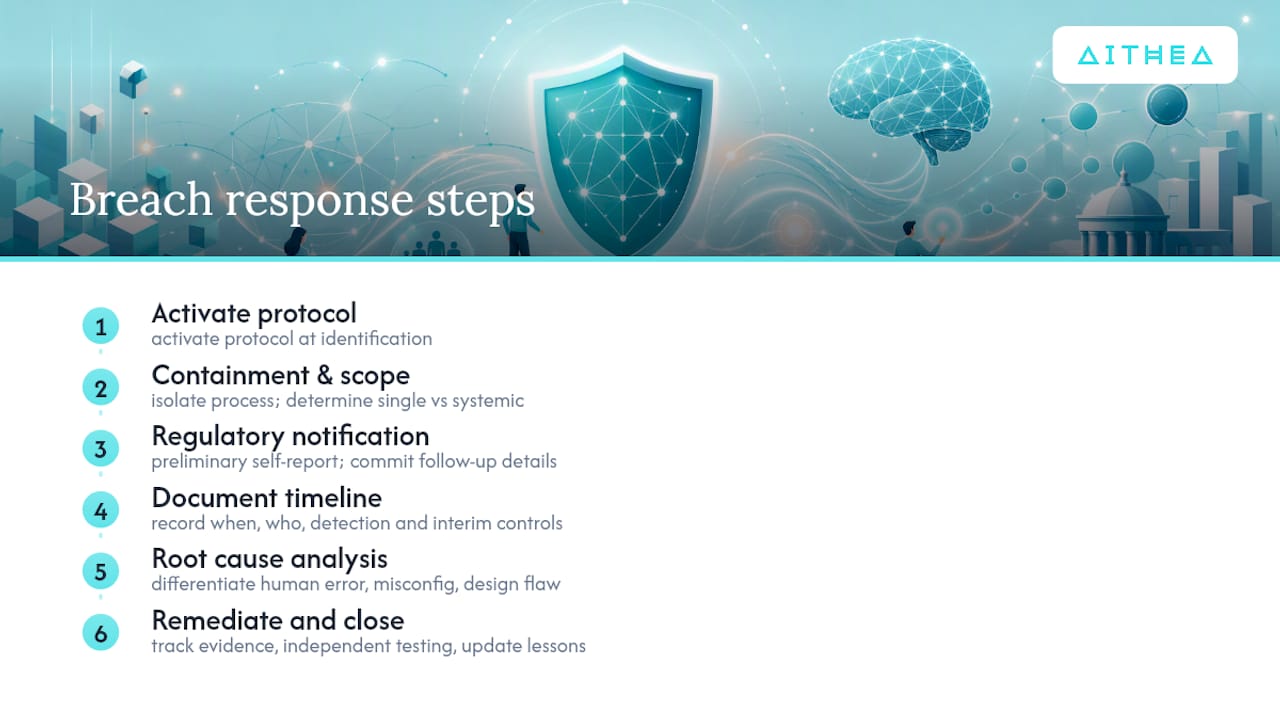
A breach, whether a missed SAR deadline, a sanctions screening failure or an unreported fraud incident, needs a defined response protocol activated the moment it's identified, not once the internal review concludes.
The first step is containment: isolate the affected process, transaction or customer relationship to stop further exposure. Simultaneously, someone needs to determine scope. Was this a single missed alert, or a systemic control failure affecting multiple periods? That distinction changes everything about the response that follows.
Notification timelines vary by jurisdiction and breach type, but the operating principle is consistent: regulators penalise concealment or delay far more harshly than they penalise the underlying error, provided the firm self-reports promptly and cooperates fully. Waiting to have a "complete picture" before notifying a regulator is a common and costly mistake. Preliminary notification with a commitment to follow-up detail is almost always the safer path.
Internally, the incident needs a documented timeline: when the control failure occurred, when it was detected, who was informed and when, and what interim controls were applied. This record becomes the backbone of both the regulatory response and any subsequent remediation plan.
Root cause analysis should follow, distinguishing between a one-off human error, a system misconfiguration and a genuine design flaw in the control itself. Each demands a different fix. Retraining one analyst doesn't help if the transaction monitoring rule itself was miscalibrated for an entire product line.
Finally, close the loop. Remediation should be tracked to completion with evidence, not just marked resolved in a spreadsheet. Independent testing should verify the fix actually works before the incident is formally closed, and lessons learned should feed back into the risk assessment and training curriculum. A breach that doesn't change anything structurally is a breach waiting to repeat itself.
How does financial crime compliance fit into enterprise risk management?
FCC has historically sat in its own silo, reporting through a compliance function that rarely spoke the same language as operational risk, credit risk or enterprise risk management (ERM) more broadly. That separation is increasingly untenable, and regulators are pushing back on it directly.
Financial crime risk is, at its core, operational risk with a legal and reputational overlay. A sanctions screening failure isn't just a compliance breach; it's an operational control failure with potential regulatory, financial and reputational consequences that ERM frameworks are specifically designed to capture and quantify. Treating it as a standalone compliance concern misses how it interacts with third-party risk, technology risk and conduct risk across the organisation.
Practical integration starts with a shared risk taxonomy. If FCC risk categories don't map cleanly onto the enterprise risk register, aggregation at board level becomes guesswork. The board sees a compliance risk score and a separate operational risk score, with no clear line connecting them, which weakens the board's ability to set coherent risk appetite.
Reporting cadence should align too. If ERM reports quarterly to the board but FCC metrics surface only during annual reviews or ad hoc incident disclosures, the board is making decisions on stale information for one of its highest-consequence risk categories.
Technology and data integration matter as much as governance structure here. A case management system that feeds FCC incident data into a broader enterprise risk dashboard, rather than sitting isolated in a compliance-only tool, gives the board and senior management a genuinely unified view of exposure. This is where digital transformation投资 in FCC pays dividends well beyond the compliance function itself, supporting faster, better-informed enterprise-wide risk decisions.
What can real compliance failures teach us?
The pattern across major FCC enforcement actions is remarkably consistent: it's rarely a single catastrophic error. It's an accumulation of smaller gaps that individually seemed manageable and collectively became indefensible.
A recurring theme in large AML enforcement cases is inadequate ongoing monitoring following initial onboarding. Firms often build strong onboarding checks, then let customer risk profiles go stale for years, missing the point where a low-risk retail customer's transaction pattern shifts into something that warrants a second look. Static due diligence, rather than an outright absence of controls, tends to be the root failure.
A second common thread is transaction monitoring systems tuned for volume rather than risk. Alert queues become so large that genuine red flags get buried in noise, and analysts, under pressure to clear backlogs, develop informal shortcuts for closing alerts quickly rather than investigating them properly. The technology wasn't the failure; the operational discipline around it was.
A third pattern involves correspondent banking and cross-border payment chains, where firms rely on intermediary banks' due diligence rather than conducting adequate look-through analysis of ultimate beneficiaries. When that intermediary's own controls are weak, the risk passes through unchecked, often for years before detection.
The lesson that runs through nearly every documented failure isn't a lack of policy. Policies existed, often in comprehensive detail. It's the gap between the policy on paper and the operational reality of how alerts were actually handled, how profiles were actually updated, and how escalations were actually resourced. Closing that gap is where technology, training and governance have to work together, not as separate workstreams but as one connected system.
Why procurement discipline matters more than the AI hype cycle
Most firms don't fail at financial crime compliance because they lack ambition about technology. They fail because they buy tools without first defining what "good" looks like in measurable terms, then discover eighteen months later that the vendor's explainability claims don't hold up under regulatory scrutiny.

The uncomfortable truth is that AI adoption in FCC is often driven by vendor marketing rather than a genuine gap analysis of where automation actually reduces risk versus where it just moves the bottleneck. A screening tool that cuts false positives by half is worthless if nobody documented the false positive rate beforehand, or if the model's decision logic can't be reconstructed for an examiner eighteen months after deployment.
Prudent adoption means treating every technology decision as a governance decision first, and a procurement exercise second. That's the discipline Aithea works through with clients: helping compliance teams define selection criteria before they meet a single vendor, structuring RFPs so comparisons are actually apples-to-apples, and building the learning programmes that make sure staff can actually operate what gets bought.
— Aneta
Get hands-on support for your financial crime compliance technology decisions
Choosing the right screening engine, transaction monitoring platform or case management system shouldn't mean sitting through a dozen vendor demos with no consistent way to compare them. Compliance consulting firms can give compliance teams a structured route through that process: a clear vendor-evaluation framework, RFP support that builds explainability and SLA targets into the request from day one, and procurement guidance that keeps decisions grounded in your actual risk profile rather than a vendor's roadmap.

Aithea's technology selection navigator helps teams shortlist compliance vendors against criteria that matter for their specific control environment, while the compliance consulting service supports the wider procurement and RFP process end to end. Paired with role-based digital learning programmes, teams get both the technology fit and the internal capability to run it properly. If your next step is a technology refresh or an RFP you don't want to get wrong, get in touch with Aithea to talk through a diagnostic before you approach vendors.
Sources
- FFIEC: Assessing Compliance With BSA Regulatory Requirements
- IMF: Financial integrity / AML-CFT topic page
- The CPA Journal: An introduction to the fraud prevention pyramid
- GAO-26-107609: Combating fraud — approaches to evaluate effectiveness and demonstrate integrity
FAQ
What is financial crime compliance?
Financial crime compliance is the combination of policies, controls and technology a regulated firm uses to prevent, detect and report money laundering, sanctions violations and fraud, overseen by senior management and tested independently.
What are the seven types of financial crime?
Common categories include money laundering, terrorist financing, fraud, bribery and corruption, sanctions evasion, market abuse and cybercrime, though exact taxonomies vary by regulator and jurisdiction.
Is AML compliance a good career?
AML compliance offers strong demand and clear certification pathways through bodies like the ICA, with growing scope as EU supervision consolidates under AMLA and firms invest more heavily in screening and monitoring technology.
What is a red flag during KYC verification?
Common red flags include mismatched identity documents, reluctance to provide beneficial ownership detail, unusual fund sources relative to stated occupation, and transaction patterns inconsistent with the customer's declared business purpose.
How does AI help reduce false positives in transaction monitoring?
AI models can improve pattern detection and cut alert volume where properly tuned, but explainability and human review remain essential since regulators expect firms to reconstruct why a system cleared or escalated any given case.