
The digital skills that deliver the most immediate impact for UK compliance teams are data analytics, AI literacy, automation and continuous compliance, digital risk management (including cybersecurity standards such as ISO/IEC 27001, NIS2, and DORA), NLP-assisted document review, and GRC/tool literacy. If you can only start one thing this week, run a 90-minute gap session with your team to map which of these six skills exist at practitioner level and which are absent entirely.
Quick-start checklist:
- Nominate a digital skills sponsor (a senior compliance manager who owns the upskilling agenda)
- Map your team against the six core skills using a simple awareness/practitioner/lead scale
- Identify one live process (SAR production, audit pack assembly, policy review) to pilot a digital tool against
- Set a measurement trigger: define what "better" looks like before you start (time saved, error rate, evidence quality)
- Book a 90-minute gap session within 72 hours and document the output
Data literacy and AI oversight are now identified as core competencies for modern compliance leaders, not optional extras. The rest of this guide explains each skill, maps it to the technology categories you will encounter, and closes with a 90-day action plan your team can start this week.
Key takeaways
Building digital skills for compliance is not a one-time training event; it is a structured programme that starts with a gap assessment, prioritises data analytics and AI literacy first, and measures progress against regulator-facing KPIs.
| Point | Details |
|---|---|
| Start with a gap session | Score your team against six core skills within 72 hours to identify priority development areas. |
| Prioritise data analytics and AI literacy | These two skills underpin every other digital competency and are the ones regulators probe most directly. |
| Measure before you change anything | Set baseline KPIs (audit pack time, alert triage time, evidence quality) before any pilot begins. |
| Use the 90-day roadmap | Diagnose in weeks 1–2, pilot in weeks 5–8, and present findings to the board by week 12. |
| Ai-thea and NanoAcademy | Ai-thea's skills framework and NanoAcademy microlearning provide a structured, role-mapped route to building these competencies quickly. |
Table of Contents
- What digital skills do compliance teams actually need?
- Soft and operational skills that make digital investments pay off
- Technology categories every compliance professional should understand
- How to build and measure digital skills across your team
- Why UK regulators and auditors care about your team's digital skills
- Ai-thea's recommended skills framework and 90-day action plan
- What success actually looks like in practice
- NanoAcademy: a fast route to building compliance digital skills
- Sources
- FAQ
What digital skills do compliance teams actually need?
The phrase "digital skills for compliance" covers a wide range of capabilities, from reading a dashboard to configuring an automated monitoring rule. The industry term for the broader discipline is digital compliance competency, and it sits at the intersection of regulatory knowledge, data fluency, and technology acumen. Here is what each core skill enables in practice.
1. Data analytics
Data analytics in compliance means interpreting transactional data, spotting financial anomalies, and running automated audits. A practitioner-level analyst can segment a customer population by risk tier, identify outliers in payment flows, and produce a defensible narrative for a regulator. At the awareness level, a compliance manager needs to read a BI dashboard and ask the right questions of the data team.
Compliance use case: Shortening SAR detection cycles. Teams that can query structured data directly reduce the time between alert generation and decision from days to hours.
Microtask: Pull a sample transaction dataset (even synthetic data) into Microsoft Excel or Power BI and build one pivot table that segments by risk category. Time yourself. That friction is your baseline.
2. AI literacy
AI literacy is not about building models. It is about understanding what a model does, where it can fail, and how to interpret its outputs responsibly. For compliance, this means reading a model card, understanding false-positive rates in AML screening, and knowing when to escalate a model's decision for human review. The implications of agentic AI for compliance oversight make this skill increasingly urgent.
Compliance use case: Evaluating an AI-driven transaction monitoring engine during procurement. A team with AI literacy can ask the vendor for explainability documentation and assess whether the model's logic is auditable.
Microtask: Read one vendor's model card or explainability summary and write three questions you cannot yet answer from it. Those gaps are your AI literacy development targets.
3. Automation and continuous compliance
Continuous compliance through lightweight verification tools keeps codebases and control environments compliant on every change, rather than at point-in-time audit. For compliance teams, this means understanding CI/CD concepts well enough to specify requirements to IT, and recognising when a policy can be expressed as a machine-readable rule (policy-as-code).
Compliance use case: Automated control testing embedded in a cloud environment flags a configuration drift the moment it occurs, rather than at the next quarterly review.
Microtask: Identify one manual control check your team runs monthly. Write a plain-English specification of what "pass" and "fail" look like. That specification is the first input to an automated check.
4. Digital risk management and cybersecurity awareness
Compliance professionals do not need to be security engineers, but they do need to identify cybersecurity exposures, data privacy gaps under UK GDPR, and software-based vulnerabilities that create regulatory risk. Familiarity with standards such as ISO/IEC 27001, NIS2, and DORA is now a baseline digital competency for practitioners in regulated sectors. The intersection of cybersecurity and financial crime compliance is where many of the most consequential risks now sit.

Compliance use case: Reviewing a third-party vendor's data handling practices before onboarding. A compliance manager with digital risk awareness can assess a vendor's ISO 27001 certification and data processing agreement without relying entirely on IT.
Microtask: Review your organisation's last vendor due diligence questionnaire. Identify which questions relate to data security and which you could not evaluate independently. That gap is your development target.
5. NLP and digital document review
Natural language processing tools extract structured information from unstructured documents: contracts, regulatory filings, sanctions lists, and policy documents. Evidence-based compliance engineering models show how NLP combined with automated reasoning can support continuous verification of compliance status, dramatically accelerating audit evidence production.
Compliance use case: Accelerating evidence collection for an FCA audit. NLP tools can extract relevant clauses from hundreds of contracts in minutes, a task that previously required days of manual review.
Microtask: Take ten policy documents and use a free NLP tool to extract the top 20 terms. Compare the output to your manual reading. Note where it helps and where it misses context.
6. GRC and tool literacy
GRC (Governance, Risk and Compliance) platform literacy means knowing how to configure workflows, generate audit trails, and extract evidence from systems such as ServiceNow GRC, MetricStream, or equivalent platforms. LMS familiarity, AML engine configuration basics, SIEM alert triage, and BI tool navigation all fall under this umbrella.
Compliance use case: Producing a board-ready risk register from a GRC platform without IT involvement, reducing the reporting cycle from two weeks to two days.
Microtask: Log into your current GRC or case management system and export one report you have never exported before. Identify what data is missing and why.
Pro Tip: Don't try to build all six skills simultaneously across the whole team. Prioritise data analytics and AI literacy first — they underpin every other skill and deliver the fastest visible return on investment for regulators and boards.
Soft and operational skills that make digital investments pay off
Technical skills alone rarely determine whether a digital compliance programme succeeds. The capabilities that unlock the value of new tools are almost always organisational: the ability to communicate what a model's output means to a board, to manage a vendor through a procurement cycle, and to embed a new workflow into a team that is already stretched.
Stakeholder engagement and translation. Compliance managers who can translate a model's false-positive rate into a business risk narrative get faster board sign-off on technology investments. This is not a soft skill in the dismissive sense; it is a precision capability that determines whether good technology gets funded.
Vendor management and procurement. Evaluating compliance technology vendors requires a structured approach. Before any demonstration, ask:
- What evidence does the tool produce for auditors, and in what format?
- How is the model's decision logic documented and explainable?
- Where is data stored, and how does the tool handle UK GDPR data subject requests?
- What is the vendor's approach to model versioning and change management?
- Can the tool integrate with your existing data pipelines without a full IT project?
Change management for new tools. Embedding a new tool into existing control workflows requires more than a training session. Three things that consistently improve adoption:
- Involve frontline compliance staff in the pilot design, not just the selection decision
- Tie the new tool to a pain point the team already recognises (slow audit pack assembly, manual alert triage)
- Document the "before and after" in measurable terms so the team can see the improvement
Communication for evidence retention. Three practical tips for maintaining adoption and audit-ready records:
- Require staff to log decisions made with AI tool outputs, not just the outputs themselves
- Create a shared template for documenting digital tool use in case files
- Run a monthly 20-minute review of tool-generated evidence to catch quality drift early
Technology categories every compliance professional should understand
Knowing the name of a technology category is not the same as understanding what it delivers. Here is a vendor-neutral map of the categories you will encounter, what each produces for auditors, and the operational questions to ask before procurement.
GRC platforms (ServiceNow GRC, MetricStream, Riskonnect and equivalents) centralise risk registers, control libraries, and audit workflows. For auditors, they produce timestamped evidence of control testing and issue remediation. Key operational question: who owns data quality in the platform, and how is it kept current?
LMS and compliance learning systems manage training records, completion rates, and assessment results. For regulators, they demonstrate that staff received required training and passed competency checks. Key question: can the system export training records in a format acceptable to your regulator?
AML and transaction monitoring engines screen transactions against rules and models to generate alerts. They produce alert logs, decision rationales, and SAR referral records. Key question: how does the engine document the reason a transaction was flagged, and can that reason be exported for a regulator?
SIEM and security tooling (Splunk, Microsoft Sentinel and equivalents) aggregate security event data and generate alerts for anomalous behaviour. For compliance, they provide evidence of access controls and incident detection. Key question: how long are logs retained, and are they tamper-evident?
BI and analytics platforms (Power BI, Tableau, Looker) turn raw data into dashboards and reports. They produce the visualisations and underlying data exports that support regulatory reporting. Key question: is the underlying data model documented so an auditor can trace a figure back to its source?
Automation and low-code orchestration tools (Microsoft Power Automate, Zapier for enterprise, or custom Python pipelines) connect systems and automate repetitive tasks. Automating verification inside development pipelines materially reduces the cost of periodic manual audits. Key question: are automated workflows version-controlled and auditable?
NLP and document review tools extract structured data from unstructured documents. Combining NLP with evidence models makes it practical to scale document review and accelerate audit evidence production. Key question: how does the tool handle ambiguous or contradictory text, and does it flag low-confidence extractions?
Common integration pain points and quick mitigations:
- Data quality: Establish a data quality owner before any tool goes live; poor input data produces unreliable outputs regardless of tool sophistication
- Identity linking: Agree a common customer/entity identifier across systems before integration; mismatched IDs are the single most common cause of false negatives in AML screening
- Versioning: Require vendors to maintain version history for models and rule sets; regulators expect to know which version of a model made a decision on a given date
How to build and measure digital skills across your team
Skills matrix template
Map each role against each of the six core skills using three levels: Awareness (understands the concept and can ask the right questions), Practitioner (can use the skill independently in a compliance context), and Lead (can design processes, evaluate tools, and train others).
| Role | Data analytics | AI literacy | Automation | Digital risk | NLP/doc review | GRC/tool literacy |
|---|---|---|---|---|---|---|
| Compliance analyst | Practitioner | Awareness | Awareness | Awareness | Practitioner | Practitioner |
| Investigator | Practitioner | Practitioner | Awareness | Awareness | Practitioner | Practitioner |
| Compliance manager | Practitioner | Practitioner | Practitioner | Practitioner | Awareness | Lead |
| Head of compliance | Awareness | Lead | Practitioner | Practitioner | Awareness | Lead |
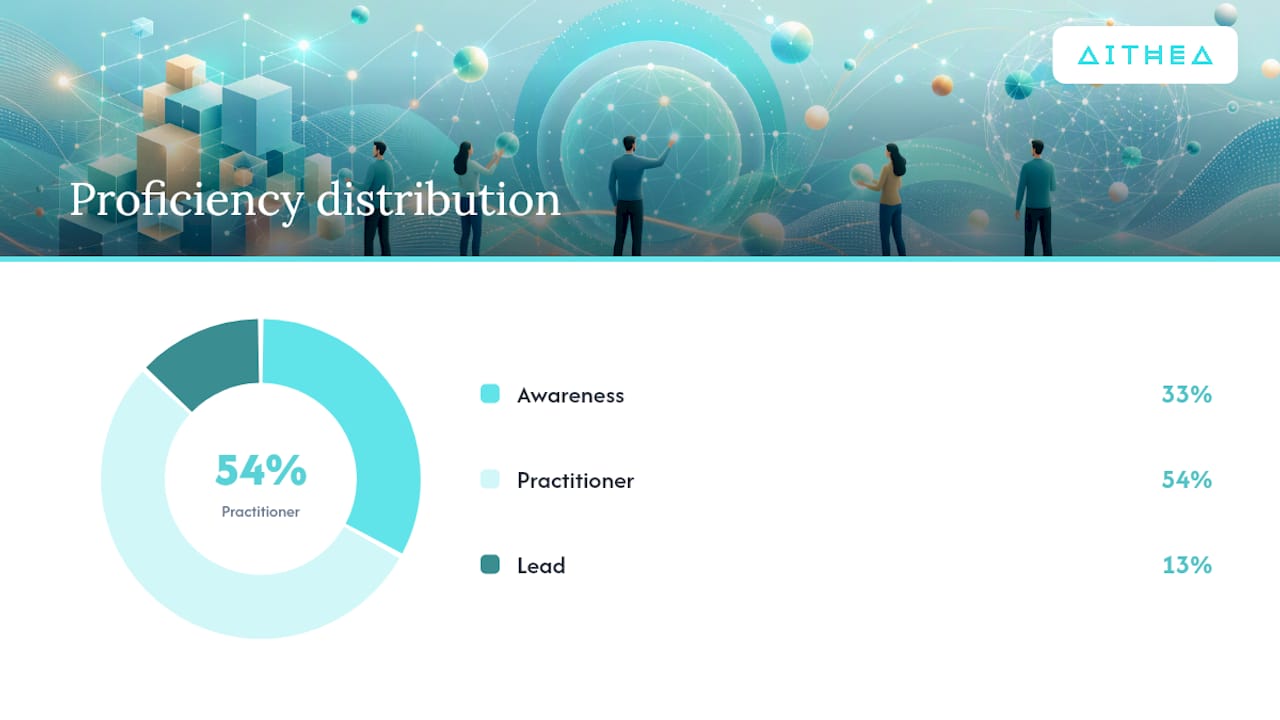
Adjust target levels to your organisation's risk profile and regulatory obligations. A team at a high-volume payments firm will need deeper automation and AML engine literacy than a corporate treasury function.
90-day roadmap
Weeks 1–2: Run the gap session. Score the team against the matrix. Identify the two highest-priority skill gaps and the one process to pilot.
Weeks 3–4: Select a training pathway for the priority skills. Options include Ai-thea's digital learning microlearning modules, vendor-led training, or structured self-study using platforms such as Coursera or the ACAMS digital learning catalogue.
Weeks 5–8: Run the pilot. One tool, one process, one team. Measure the baseline before you start.
Weeks 9–10: Review pilot results against the measurement triggers set in week one. Document lessons learned.
Weeks 11–12: Present findings to the board or senior leadership. Make the procurement or scale-up decision with evidence, not intuition.
KPIs to track progress
- Number of automated control checks created and running in production
- Percentage of audit evidence assembled by digital tools rather than manual compilation
- Reduction in time to produce a complete audit pack (baseline vs. post-pilot)
- Training completion rate and assessment pass rate per role
- Number of staff at practitioner level or above per skill (tracked quarterly)
Indicative budget bands: A pilot programme covering one skill area and one process typically incurs moderate costs in external training and tooling, depending on team size and tool complexity. A scaled programme across a compliance function of typical mid-sized teams incurs higher annual costs including training, tool licences, and internal coordination time. Internal training led by a digital skills sponsor can reduce costs but requires commitment of staff time.
Hiring and sourcing gaps: For skills that are genuinely absent and unlikely to be built quickly (advanced NLP configuration, SIEM administration), consider a contractor or a managed service rather than a full hire. The compliance function's role is to specify requirements and evaluate outputs, not to operate every tool.
Why UK regulators and auditors care about your team's digital skills
UK regulators are not yet prescribing specific technology stacks, but their expectations for evidence, auditability, and explainability are rising in ways that make digital literacy a practical necessity rather than a competitive advantage.
The ICO expects organisations to demonstrate that automated decisions affecting individuals are explainable and that data subjects' rights can be fulfilled promptly. For compliance teams using AI-driven screening or profiling tools, this means being able to document how a decision was reached, which model version made it, and what data it relied on. Teams without AI literacy cannot produce this documentation reliably.
The NCSC publishes guidance on supply chain security and cloud security that directly affects how compliance teams should evaluate technology vendors. Familiarity with NCSC's Cyber Essentials framework and its requirements is a baseline expectation for any compliance professional involved in technology procurement.
Sectoral supervisors (the FCA, PRA, and HMRC for AML purposes) increasingly expect compliance functions to show not just that policies exist, but that controls are operating continuously and that evidence is retained in a retrievable, versioned format. This is the practical implication of the shift from oversight to strategy that defines modern compliance leadership.
Regulatory readiness checklist:
- Can you produce a complete, timestamped audit trail for any automated compliance decision made in the last 12 months?
- Is your model documentation (for any AI tool in use) current and accessible to a non-technical auditor?
- Are your data retention and deletion policies documented and technically enforced, not just written in a policy document?
- Can you demonstrate that staff training records are complete and exportable in a regulator-acceptable format?
- Is data provenance documented for every dataset used in regulatory reporting?
A one-sentence GDPR note: any personal data processed by a compliance tool must have a documented lawful basis, a retention schedule, and a mechanism for responding to data subject access requests. Involve your data protection officer before any new tool goes live. The Gov is the primary reference for UK organisations.
Involve legal and IT at two specific points: before signing any vendor contract (legal review of data processing agreements) and before any tool accesses production data (IT security review). Both are faster when the compliance team arrives with a clear specification rather than a vendor brochure.
Ai-thea's recommended skills framework and 90-day action plan
Ai-thea positions its skills framework around three priority categories: interpret (data analytics and AI literacy), automate (continuous compliance and GRC/tool literacy), and protect (digital risk management and NLP/document review). Each category maps to a set of roles and a recommended skill level, as described in the skills matrix above.
The framework is designed to be adopted incrementally. Most compliance teams do not need to build all three categories simultaneously. Start with interpret, because data literacy and AI literacy are the prerequisites for every other category and the skills regulators most frequently probe during reviews.
Step-by-step 90-day action plan
Days 1–14: Diagnose
- Run the gap session (90 minutes, all compliance staff, anonymous scoring)
- Score the team against the skills matrix
- Identify the top two skill gaps and one pilot process
- Nominate a digital skills sponsor
Days 15–30: Design
- Select training pathways for priority skills
- Draft a one-page pilot brief: scope, tool, success criteria, measurement method
- Identify the vendor or internal resource for the pilot tool
- Brief IT and legal on data handling requirements
Days 31–60: Pilot
- Run the pilot with a small group (3–5 people, one process)
- Measure against baseline KPIs weekly
- Document decisions, outputs, and issues in a shared log
Days 61–75: Review
- Analyse pilot results against success criteria
- Identify what worked, what did not, and what needs to change
- Prepare a one-page findings summary for senior leadership
Days 76–90: Decide and plan
- Present findings and a recommended next step (scale, adjust, or stop)
- If scaling, draft an RFP or procurement brief using the checklist below
- Set quarterly KPI targets for the scaled programme
RFP and procurement checklist for compliance technology
When evaluating any compliance technology vendor, ask for written answers to these questions before any demonstration:
- How does the tool document the reason for each automated decision or alert?
- What version control exists for models, rules, and configurations?
- Where is data stored, and which jurisdiction's law governs it?
- How does the tool support UK GDPR data subject access requests?
- What audit log format does the tool produce, and how long are logs retained?
- Has the tool been deployed in a UK-regulated environment, and can the vendor provide a reference?
- What is the vendor's approach to model drift and ongoing monitoring?
For AI-driven tools specifically, the AI vs. traditional methods analysis from Ai-thea provides a useful framework for structuring vendor comparison questions around explainability and audit trail quality.
Board and regulator measurement template
Report quarterly on five metrics: (1) skill matrix scores by role, (2) pilot KPI results, (3) training completion rates, (4) number of automated controls in production, and (5) time to assemble audit pack. Present the trend, not just the current figure. Regulators and boards respond to evidence of direction, not just a snapshot.
Pro Tip: Run a small, time-boxed pilot before any procurement decision. A 30-day pilot with real data and a clear success criterion tells you more than any vendor demonstration. It also gives you evidence to present to a regulator if the tool is later questioned.
What success actually looks like in practice
Compliance teams that make progress with digital upskilling often start with a specific problem, measure before changing anything, and treat the first pilot as a learning exercise rather than as a proof of concept that must succeed.
The most common misstep is the reverse: selecting a tool because it looks impressive in a demonstration, then trying to find a use case for it afterwards. This produces low adoption, poor evidence quality, and a sceptical board. The second most common misstep is treating digital skills as an IT responsibility. Compliance teams that delegate all technology decisions to IT end up with tools that are technically sound but operationally useless, because the configuration reflects IT's understanding of the problem, not the compliance team's.
Lessons from advising compliance teams on digital upskilling:
- Teams that nominate a digital skills sponsor (a compliance professional, not an IT manager) move faster and sustain progress longer
- The fastest wins come from automating evidence assembly, not from replacing human judgement
- Cultural signals of success: staff start asking "can we automate this?" rather than waiting to be told
- The biggest risk is not moving too fast; it is moving without measuring, so you cannot demonstrate value to regulators or boards
One observation that recurs across engagements: compliance teams that invest in data literacy first consistently produce better outcomes from every subsequent technology investment. A team that can read and interrogate data can evaluate a vendor's claims, spot a model's blind spots, and produce regulator-ready evidence. A team that cannot is dependent on vendors and IT for every answer, which is a governance risk in itself.
NanoAcademy: a fast route to building compliance digital skills
For compliance teams that need a structured, fast, and practical training route, NanoAcademy from Ai-thea is built specifically for this purpose. It covers the six core digital skills mapped in this guide, with microlearning modules designed for compliance professionals who cannot commit to multi-day courses.

NanoAcademy suits teams of 5–50 people, particularly those in financial services, fintech, and corporate compliance functions with a moderate to high regulatory risk profile. A typical pilot runs over four weeks and produces measurable improvements in skills matrix scores and training completion rates. Modules are short (10–20 minutes each), role-mapped, and designed to be completed alongside existing workloads rather than instead of them.
To start a pilot or discuss which modules fit your team's priority gaps, get in touch with Ai-thea and reference your gap session findings. The team will recommend a module sequence aligned to your skills matrix and regulatory context.

Sources
- Digital Skills and Jobs Platform — regulatory compliance (cyber)
- Continuous compliance: Lightweight verification tools and deployment
- Evidence-based compliance engineering (conceptual model)
- From oversight to strategy: The skills redefining the modern compliance officer
- Digital literacy skills: examples, tips & how to improve | WeVideo
Retain versioned copies of all evidence produced by digital tools, including model documentation, audit logs, and training records. Regulators expect to see not just that a control exists, but that it operated correctly on a specific date with a specific configuration.
FAQ
What are the core digital skills needed for compliance?
The six core digital skills for compliance are data analytics, AI literacy, automation and continuous compliance, digital risk management (including familiarity with cybersecurity standards such as ISO/IEC 27001, NIS2, and DORA), NLP-assisted document review, and GRC/tool literacy. Data analytics and AI literacy are the highest-priority starting points for most UK compliance teams.
What skills do compliance professionals need beyond technical knowledge?
Compliance professionals need stakeholder communication, vendor management, change management, and the ability to translate technical outputs into regulatory narratives. These operational skills determine whether digital tools actually get adopted and produce auditable evidence.
What are the seven pillars of compliance?
Definitions vary across frameworks, but a widely used model covers: policies and procedures, training and education, monitoring and auditing, reporting mechanisms, enforcement and discipline, response and prevention, and leadership commitment. Digital skills support most of these pillars directly, particularly monitoring, auditing, and training.
How does digital literacy differ from technical IT skills in a compliance context?
Digital literacy in compliance covers practical capabilities such as evaluating digital information critically, using compliance tools confidently, and communicating data-driven findings clearly. It sits between basic computer use and specialist IT engineering, and it is the level most compliance professionals need to develop.
How can compliance teams measure progress in digital upskilling?
Track five KPIs quarterly: skills matrix scores by role, training completion rates, number of automated controls in production, percentage of audit evidence produced by digital tools, and time to assemble a complete audit pack. Ai-thea's NanoAcademy provides role-mapped assessments that feed directly into this measurement framework.