

TL;DR:
- UK organizations must demonstrate that personal data is stored, processed, and transferred within permitted jurisdictions using technical and contractual controls. Non-compliance risks arise from overlooked data objects like logs, backups, ML datasets, and support access, which often escape jurisdictional boundaries. Effective programs require comprehensive mapping, enforceable vendor contractual commitments, and technical safeguards such as customer-managed keys and geo-pinning.
Data residency compliance for UK organisations means demonstrating, with audit-quality evidence, that personal and regulated data is stored, processed, backed up, and accessed only within jurisdictions permitted under UK GDPR, ICO guidance, and applicable sector rules such as DORA. That obligation extends beyond your primary database to every replica, backup, disaster recovery site, observability log, ML training set, and third-party processor in your supply chain. As of early 2026, over 60 countries enforce some form of data residency or localisation requirement; these rules are generally classified into ‘hard’ or ‘soft’ approaches and often feature sectoral exceptions.
Three actions to take today:
-
Map high-risk data classes — identify where personal data, special-category data, and regulated financial or health records are stored, including replicas, caches, and third-party processors.
-
Run a transfer impact assessment (TIA) for every non-UK transfer, confirming whether an adequacy decision, UK Addendum to SCCs, or supplementary technical measures are in place.
-
Confirm vendor geo-pinning and key management — verify that your cloud and SaaS providers have contractually committed to region pinning, that customer-managed keys (CMKs) are in use, and that audit logs are retained within the UK.
The evidence auditors will ask for: Data Protection Impact Assessment (DPIA) records, data flow maps, contractual commitments (SCCs with UK Addendum where applicable), KMS key policies, geo-pinning configuration records, and deletion workflow logs.
Table of Contents
-
How does data residency differ from data sovereignty and data localisation?
-
Why cloud, backups, DR and supply chains complicate residency compliance
-
How to build a data residency compliance programme step by step
-
What does a residency programme typically cost and how long does it take?
-
Which technical architectures support residency most effectively?
-
What should your vendor RFP include for residency assurance?
-
Ai-thea helps you select and evaluate compliant technology vendors
What does data residency actually cover?
Data residency defines where data is physically stored and processed, and which legal jurisdiction governs that storage. For compliance purposes, it is not enough to know that your primary application database sits in a UK cloud region. The full scope of what must be controlled is considerably wider.
In-scope data objects:
-
Primary application databases and their read replicas
-
Backup files and snapshot archives
-
Disaster recovery (DR) sites and failover clusters
-
Search indexes and caches
-
Feature stores and ML training datasets derived from personal data
-
Observability and application logs containing personal identifiers
-
Data warehouse copies and analytics derivatives
-
Third-party processor storage (SaaS integrations, managed services)
Borderline cases that often catch teams out:
-
Metadata — file names, access timestamps, and query patterns can constitute personal data under UK GDPR if they are linkable to an individual.
-
Pseudonymised derivatives — pseudonymisation reduces risk but does not remove data from scope; the pseudonymised dataset and the key table together remain personal data.
-
Support and engineering access — a support engineer in a non-UK jurisdiction accessing a UK-resident database constitutes a restricted transfer under UK GDPR Chapter V, even if no data is copied.
Practitioners consistently find that most organisations have a residency policy on paper but lack matching technical implementation. The gaps are almost always in logging pipelines, backup storage, AI/ML services, and support access, precisely the objects listed above.
Pro Tip: Selecting a UK cloud region is necessary but not sufficient. Data routinely escapes the chosen region through: (1) cross-region log aggregation pipelines, (2) vendor-managed backups that default to a global bucket, (3) analytics and observability tools that stream data to a US-based SaaS endpoint, and (4) support tickets that attach log snippets and are routed to offshore engineers. Audit each of these channels explicitly.
How does data residency differ from data sovereignty and data localisation?
These three terms are used interchangeably in vendor marketing and, occasionally, in regulatory guidance, but they describe distinct legal and technical situations. Getting the distinction right determines which controls you actually need.
| Dimension | Data residency | Data sovereignty | Data localisation |
|---|---|---|---|
| Core meaning | Where data is physically stored and processed | Which jurisdiction’s laws govern the data, regardless of where it sits | A legal or regulatory requirement to keep data within a specific territory |
| Legal reach | Contractual and technical; no automatic legal consequence from location alone | Determined by the laws of the jurisdiction where the controller/processor is established or where data is stored | Mandatory; non-compliance is a regulatory breach |
| Transfer mechanisms | Adequacy decisions, SCCs/UK Addendum, TIAs | Supplementary technical measures (CMKs, access controls) to limit foreign-law exposure | Compliance is binary; transfers may be prohibited or heavily conditioned |
| Technical mitigations | Geo-pinning, CMKs, access logging | Customer-managed encryption keys, strict access controls, jurisdictional key storage | Full data plane isolation; no cross-border replication of regulated data |
| Contract items | Region-pin commitments, subprocessor lists, audit rights | Governing law clauses, data access restrictions, foreign-law notification obligations | Contractual prohibition on cross-border transfer; mandatory local processing clauses |
The practical consequence for UK organisations: data residency is the technical and contractual discipline of keeping data where you intend it to be. Data sovereignty is the legal question of whether a foreign government can compel access to that data. Data localisation is a hard legal obligation, typically sector-specific, that removes discretion entirely.
A cloud region pin addresses residency. It does not, on its own, address sovereignty. If your cloud provider is subject to US CLOUD Act orders, a UK-region pin does not prevent lawful access by US authorities. Addressing sovereignty requires supplementary technical measures, principally CMKs held outside the provider’s key management infrastructure, combined with contractual foreign-law notification obligations.
Why does data residency matter for UK organisations?
The regulatory case for treating residency as a governance priority, rather than a configuration task, rests on several converging obligations.

UK GDPR and ICO guidance
UK GDPR Chapter V restricts transfers of personal data to third countries unless an adequacy decision is in place, appropriate safeguards (such as SCCs with the UK Addendum) are used, or a specific derogation applies. The ICO has published guidance on international transfers that makes clear the accountability obligation: controllers must be able to demonstrate that transfers are lawful, not merely assert it. Failure to maintain that evidence is itself a breach of the accountability principle under Article 5(2).
DORA for financial services
The Digital Operational Resilience Act imposes contractual and operational resilience obligations on financial entities that extend to data accessibility, audit rights over ICT third-party providers, and contractual provisions covering data location and processing. UK financial services firms operating under equivalent domestic obligations should treat DORA’s contractual requirements as a benchmark for what regulators expect in vendor agreements.
Sector-specific obligations
-
Health sector: NHS data security standards and the Data Security and Protection Toolkit require demonstrable control over where patient data is stored and processed, with explicit restrictions on offshore processing without appropriate safeguards.
-
Telecoms: The Communications Act and associated security regulations impose obligations on network operators regarding the location of certain communications data.
-
Public sector procurement: Government frameworks, including G-Cloud, require suppliers to declare data processing locations and obtain approval for any offshore processing.
The enforcement reality
Cumulative GDPR fines exceeded €7.1 billion by January 2026, reflecting regulators’ appetite for enforcement where accountability evidence is absent. The ICO has made clear that it expects organisations to maintain records of processing activities, DPIAs, and transfer mechanisms as a baseline, not as a response to an investigation.
Pro Tip: The sectoral auditors most likely to demand geo-pinning evidence are the PRA and FCA (for DORA-aligned reviews), NHS Digital (for health data), and government framework assessors (for public sector contracts). Prepare a residency evidence pack — architecture diagrams, KMS key policies, contractual addenda, and access log samples — before any audit cycle begins, not in response to a request.
What transfer mechanisms should UK organisations use?
The UK’s post-Brexit transfer framework operates independently of the EU’s GDPR regime, though the mechanisms are structurally similar. Understanding which mechanism applies, and when a TIA is required, is the first practical step in managing cross-border data flows.
Available transfer mechanisms
-
UK adequacy regulations: The UK has granted adequacy to the EEA, Gibraltar, and a small number of other territories. Transfers to these destinations do not require additional safeguards. The UK-US Data Bridge provides a mechanism for transfers to certified US organisations, but it covers only participating entities and does not remove the need for a TIA where intelligence-law exposure is a concern.
-
International Data Transfer Agreements (IDTAs) and UK Addendum to EU SCCs: For transfers to countries without adequacy, the IDTA or the UK Addendum to the EU’s standard contractual clauses are the primary safeguard mechanisms. These must be incorporated into contracts with processors and sub-processors in non-adequate countries.
-
Binding Corporate Rules (BCRs): Available for intra-group transfers; require ICO approval and are resource-intensive to implement.
-
Derogations: Article 49 derogations (explicit consent, contractual necessity, public interest) are available in limited circumstances and are not suitable as a routine transfer mechanism.
Transfer impact assessment: a step-by-step checklist
-
Identify the transfer: confirm the destination country, the data categories involved, and the volume and frequency of transfers.
-
Identify the transfer mechanism: confirm which safeguard (IDTA, UK Addendum, adequacy) applies.
-
Assess the destination country’s legal framework: does the destination country have laws that could compel disclosure to public authorities in ways that undermine the safeguard? Key risk factors include broad national security laws, absence of judicial oversight, and no meaningful redress for data subjects.
-
Identify supplementary measures: where legal-framework risk is high, document technical measures (CMKs, encryption in transit and at rest, access controls) and contractual measures (foreign-law notification, audit rights, data minimisation obligations).
-
Document the assessment: record the outcome, the measures adopted, and the residual risk accepted. This document is the TIA.
-
Review triggers: re-run the TIA when the destination country’s legal framework changes, when the transfer mechanism is updated, or when the data categories or volumes change materially.
Schrems II-style concerns and supplementary measures
Transfers to countries with expansive intelligence laws — the United States being the most common example — carry a residual risk that contractual safeguards alone cannot eliminate. The supplementary technical measures that materially reduce this risk are:
-
Customer-managed encryption keys held in a UK or EEA key management service, so the cloud provider cannot decrypt data in response to a foreign-law order without the key.
-
Strict access logging and alerting for any non-UK access to personal data.
-
Data minimisation: transfer only what is necessary, and pseudonymise or aggregate where possible before transfer.
-
Contractual foreign-law notification clauses requiring the processor to notify the controller before complying with any foreign-government data request.
Why cloud, backups, DR and supply chains complicate residency compliance
The most common source of residency failures is not a deliberate policy breach. It is the default behaviour of cloud platforms and SaaS tools, which are designed for global availability, not jurisdictional containment.
Where residency illusions occur:
-
Cross-region replication: many managed database services replicate data to a secondary region by default for availability. Unless explicitly disabled or restricted, this creates an out-of-jurisdiction copy.
-
Logging and observability pipelines: tools such as centralised SIEM platforms, APM services, and error-tracking tools often stream logs to a US-based SaaS endpoint, carrying personal data identifiers with them.
-
Managed AI/ML services: training jobs and inference endpoints on cloud AI platforms may process data in regions selected by the platform, not the customer, unless explicitly configured otherwise.
-
Support access by non-local engineers: vendor support portals that allow engineers in any geography to access production environments constitute a restricted transfer under UK GDPR.
-
Third-party SaaS integrations: CRM, HR, and finance platforms integrated via API may store copies of personal data in their own infrastructure, subject to their own residency defaults.
Targeted mitigations:
-
Configure geo-pinning at the infrastructure level and verify it with periodic automated checks, not just at deployment.
-
Implement CMKs for all data stores containing personal data, with keys held in a UK-resident KMS.
-
Require dedicated support access controls: named-engineer lists, just-in-time access, and access logging routed to an in-jurisdiction SIEM.
-
Audit all SaaS integrations for their data storage locations and subprocessor lists; treat each as a potential out-of-jurisdiction transfer.
-
Store SIEM and observability logs in an in-jurisdiction bucket, separate from the vendor’s default global log aggregation.
Vendor audit questions for procurement and operations teams:
-
Where, precisely, are primary data stores, backups, and DR sites located? Can you provide architecture diagrams?
-
What is the default behaviour for cross-region replication, and how is it disabled?
-
Where are logs and observability data stored, and can log storage be pinned to a specific region?
-
Who has access to production data, from which geographies, and how is that access logged?
-
Who are your subprocessors, where are they located, and how will you notify us of changes?
Pro Tip: The single most revealing vendor question is: “Show me the default configuration for backup storage in your UK region.” Most vendors’ defaults route backups to a global bucket. If the vendor cannot demonstrate a UK-only backup configuration with a screenshot or architecture diagram, treat that as a residency gap requiring contractual remediation before signing.
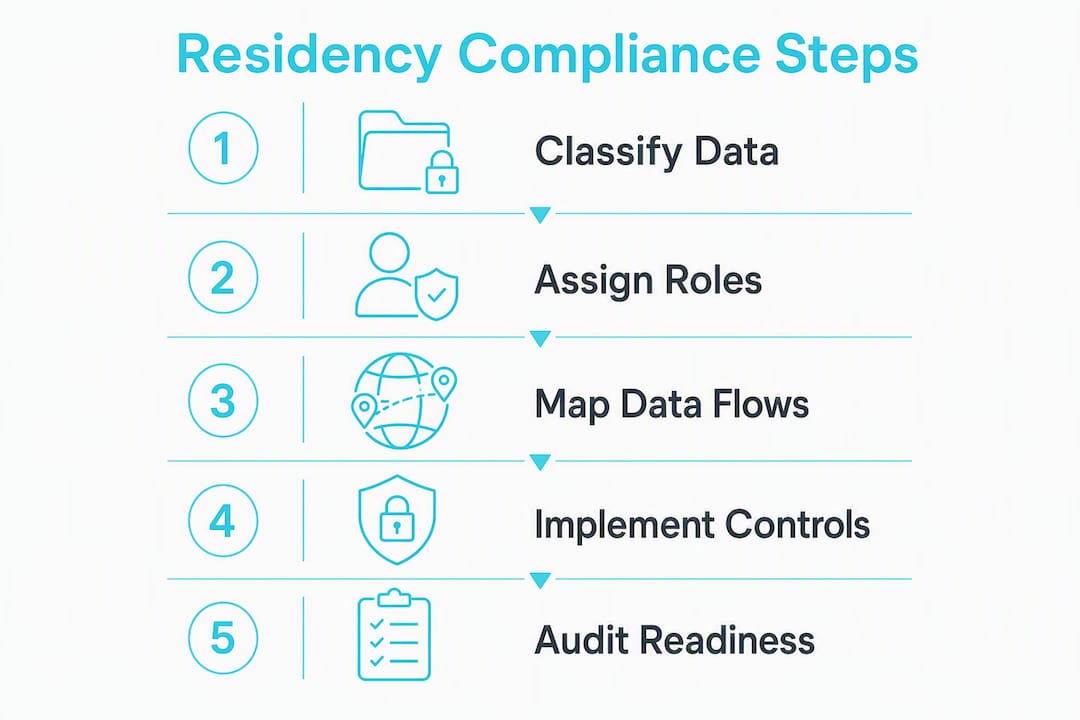
How to build a data residency compliance programme step by step
A residency programme that will stand up to an ICO review or a DORA audit needs to be structured, evidenced, and owned. The following sequence moves from discovery to continuous assurance.
-
Data classification — classify all data by sensitivity (personal, special-category, regulated financial, health) and assign residency requirements to each class. Owner: Data Protection Officer / Legal.
-
Data flow mapping — produce a record of processing activities (RoPA) that includes storage locations, processing locations, transfer destinations, and subprocessors for each data class. Owner: Data Protection Officer, supported by Cloud Operations.
-
Gap analysis — compare current storage and processing locations against residency requirements. Identify out-of-jurisdiction stores, uncontrolled transfers, and missing contractual safeguards. Owner: Compliance / Security.
-
DPIA for high-risk processing — conduct DPIAs for processing activities that present high residency risk (offshore AI/ML processing, cross-border analytics, new SaaS integrations). Owner: Data Protection Officer.
-
Contractual remediation — amend vendor contracts to include geo-pinning commitments, IDTA/UK Addendum where required, subprocessor notification obligations, audit rights, and CMK provisions. Owner: Legal / Procurement.
-
Technical controls implementation — deploy CMKs for all in-scope data stores, configure geo-pinning, restrict cross-region replication, and route logs to in-jurisdiction storage. Owner: Cloud Operations / Security Engineering.
-
Testing and validation — run transfer tests to confirm data does not leave the designated region; verify CMK key policies; test deletion workflows end-to-end. Owner: Security Engineering / Compliance.
-
Monitoring and continuous assurance — implement automated alerts for out-of-jurisdiction data movement, schedule quarterly subprocessor reviews, and maintain a residency evidence pack. Owner: Compliance / Cloud Operations.
Roles and responsibilities
| Activity | Accountable | Responsible | Consulted |
|---|---|---|---|
| Data classification | DPO | Data stewards | Legal, Security |
| Data flow mapping | DPO | Cloud Ops, Procurement | Legal |
| DPIA | DPO | Compliance team | Legal, Security |
| Contractual remediation | General Counsel | Procurement | DPO, Vendor Management |
| Technical controls | CISO | Cloud Ops, Security Engineering | DPO |
| Testing and validation | CISO | Security Engineering | Compliance |
| Monitoring and assurance | DPO / CISO | Compliance, Cloud Ops | Legal |
Building reusable controls — classification, access control, audit logging, retention automation, and lineage — and mapping them to multiple legal requirements reduces repeated rework across UK GDPR, DORA, and sector-specific obligations. Design the control set once; map it to each regulation rather than treating each law as a separate project.
What does a residency programme typically cost and how long does it take?
Decision-makers setting budget expectations should plan for a programme that runs in phases, with the most resource-intensive work concentrated in the remediation and technical implementation stages.
Typical programme timeline
| Phase | Typical duration | Key activities |
|---|---|---|
| Discovery and classification | 4–8 weeks | Data flow mapping, RoPA update, gap analysis |
| Remediation design | 2–4 weeks | Architecture decisions, contractual gap list, DPIA scoping |
| Vendor negotiations | 4–12 weeks | Contract amendments, IDTA/UK Addendum execution, subprocessor confirmations |
| Technical implementation | 8 weeks | CMK deployment, geo-pinning, log re-routing, DR reconfiguration |
| Testing and validation | 2–4 weeks | Transfer tests, deletion workflow tests, access-log verification |
| Audit preparation | 2–4 weeks | Evidence pack assembly, governance documentation, staff briefing |
Total elapsed time for a mid-sized organisation with multiple cloud providers and SaaS integrations: typically 6–12 months from kick-off to audit-ready state.
Primary cost drivers:
-
Engineering effort: re-architecting data pipelines, implementing CMKs, and reconfiguring DR sites is the largest cost item for most organisations.
-
KMS licensing: customer-managed key management adds per-key and per-operation costs on top of standard cloud pricing.
-
Additional regional storage: pinning backups and DR to a single region may increase storage costs compared with global default configurations.
-
Vendor contract amendments: legal time for negotiating and executing IDTAs, UK Addenda, and bespoke contractual provisions across multiple vendors.
-
Professional services: external consulting for gap analysis, DPIA support, and audit preparation.
Pro Tip: Prioritise remediation by data sensitivity and regulatory exposure, not by system size. Remediating your highest-risk data class — special-category personal data, regulated financial records, or NHS patient data — first delivers the greatest risk reduction per pound spent and creates an early compliance milestone you can evidence to regulators before the full programme is complete.
Which technical architectures support residency most effectively?
The architecture you choose determines how much ongoing compliance effort you carry. Getting the topology right at the design stage is far cheaper than retrofitting controls onto a global-default architecture.
The regional data plane + global control plane pattern
The HLD Handbook recommends the regional data plane with a global control plane as the default topology for multi-tenant SaaS. In this model, all user content — personal data, regulated records, derived datasets — is stored and processed within a designated regional data plane. The global control plane handles only metadata: tenant routing, authentication tokens, configuration, and billing records that do not contain personal data.
Engineering notes: routing must be enforced at the API gateway layer, not merely at the database layer, to prevent accidental cross-region data leakage through shared services. Authentication tokens should carry only a tenant identifier and a region pointer; personal data must never be embedded in tokens that traverse the global plane.
Alternative topologies
-
Full silos: each jurisdiction gets a completely independent deployment with no shared infrastructure. Appropriate for health, defence, and high-sensitivity financial data where even metadata sharing is unacceptable. High operational cost; justified where regulatory requirements are absolute.
-
Masked global: a single global deployment with PII masked or tokenised before it enters shared analytics or observability pipelines. Suitable for analytics use cases where aggregate insights are needed globally but personal data must remain local. Requires a robust tokenisation layer and careful lineage tracking.
Technical control checklist:
-
Per-subject encryption keys (DEKs) stored in a jurisdiction-resident KMS, with the KMS itself outside the cloud provider’s key management infrastructure where sovereignty risk is high.
-
Crypto-shredding for erasure: destroying the per-subject DEK renders ciphertext across primaries, replicas, and backups computationally unrecoverable. Deletion must propagate to derived stores (indexes, caches, data warehouses) before the origin key is destroyed, to avoid reclocking data from immutable logs.
-
WORM/immutable logs for audit trails, stored in-jurisdiction.
-
Lineage and deletion DAGs to track where each data object has flowed and confirm deletion propagation.
Pro Tip: The most common architecture mistake is treating authentication as a global service without scrutiny. A global identity provider that issues tokens containing personal data attributes — email address, national identifier, health record number — creates a cross-border transfer every time a user authenticates from a non-UK region. Separate the authentication assertion (a pseudonymous identifier) from the personal data profile (held in the regional data plane) and resolve them only within the regional plane.
What should your vendor RFP include for residency assurance?
Vendor claims about data residency are frequently marketing assertions rather than contractual commitments.
The following questions and contract items convert assertions into evidence.
RFP question list:
-
State the precise geographic locations of all primary data stores, read replicas, backups, and DR sites for UK-region deployments. Provide architecture diagrams.
-
What is the default configuration for cross-region replication, and how is it disabled or restricted for UK deployments?
-
Where are logs, observability data, and support-ticket attachments stored? Can log storage be pinned to the UK region?
-
Who are your subprocessors, where are they located, and what is your process for notifying customers of subprocessor changes?
-
Do you support customer-managed encryption keys? Which KMS integrations are available, and can keys be held outside your infrastructure?
-
How is support access to production data controlled? Are access events logged, and can those logs be provided to the customer?
-
What contractual commitments will you make on geo-pinning, audit rights, and data export restrictions?
-
What is your breach notification timeline, and does it meet the 72-hour ICO requirement?
Scoring template (categories and indicative weights):
| Category | Weight | What to assess |
|---|---|---|
| Technical controls | — | CMK support, geo-pinning proof, log storage location |
| Contractual assurances | 30% | IDTA/UK Addendum, audit rights, subprocessor notification |
| Operational controls | — | Support access controls, access logging, incident response |
| Evidence quality | — | SOC 2 Type II, architecture diagrams, region-pin proofs |
Sample contract clauses to request:
-
Geo-pinning: “Provider shall store and process all Customer Personal Data exclusively within [UK/EEA] and shall not replicate, transfer, or make accessible such data to systems or personnel outside [UK/EEA] without prior written consent.”
-
Audit right: “Customer shall have the right to audit Provider’s data processing facilities and records, on reasonable notice, no less than once per calendar year.”
-
Subprocessor notification: “Provider shall give Customer no less than 30 days’ written notice before engaging a new subprocessor or changing the location of an existing subprocessor.”
-
Key control: “Provider shall support Customer-managed encryption keys and shall not retain copies of Customer keys outside the Customer’s designated KMS.”
-
Breach notification: “Provider shall notify Customer within 24 hours of becoming aware of any personal data breach.”
Pro Tip: The vendor artefacts that provide the strongest residency evidence are: (1) a customer KMS integration guide showing keys held outside the vendor’s infrastructure, (2) a SOC 2 Type II report with a specific control covering data location, (3) a signed contractual addendum committing to geo-pinning, and (4) an architecture diagram reviewed and signed off by the vendor’s security team. Marketing datasheets and website FAQs are not evidence.
How do you build an audit-ready residency programme?
Governance is what separates a residency programme that holds up under scrutiny from one that collapses when an auditor asks for evidence. The structure below reflects what ICO, FCA/PRA, and DORA auditors typically expect.
Governance model
A residency programme needs a steering committee with representation from Legal, Compliance, Security, Cloud Operations, and Procurement, meeting at least quarterly. Data stewards — individuals accountable for specific data domains — are the operational backbone: they own the data flow maps, maintain the RoPA entries, and escalate residency risks. Reporting should flow from data stewards to the DPO and CISO, with a summary to the board or audit committee annually.
Evidence checklist for audits:
-
DPIAs for all high-risk processing activities, with residency risk explicitly addressed
-
TIAs for all non-UK transfers, including the legal-framework assessment and supplementary measures
-
Data flow maps and RoPA entries, current within the last 12 months
-
Retention schedules and deletion DAGs, with evidence of automated enforcement
-
KMS key records: key creation dates, rotation history, access policies, and deletion records
-
Access logs for all production data environments, retained in-jurisdiction for the required period
-
Incident timelines for any residency-related breaches or near-misses
-
Contractual evidence: signed IDTAs, UK Addenda, geo-pinning addenda, and subprocessor lists
Testing and assurance:
-
Periodic transfer testing: automated checks that confirm data does not leave the designated region, run at least monthly.
-
Subprocessor attestations: annual written confirmation from each subprocessor of their data storage locations and any changes.
-
Breach scenario drills: tabletop exercises covering a residency breach (data found in an out-of-jurisdiction store) to test the incident response and notification process.
-
Continuous monitoring: automated alerts for out-of-jurisdiction data movement, integrated into the SIEM.
Governance capabilities — classification, lineage, access control, and audit trails are the durable foundation for compliance across multiple regimes. An organisation that has built these capabilities for UK GDPR is already most of the way to meeting DORA’s contractual evidence requirements and NHS data security standards.
Responding to audit requests: Maintain a residency evidence pack — a structured folder containing all the artefacts above — updated quarterly. When an auditor requests evidence, the response should be a curated extract from this pack, not a reactive document-gathering exercise. The pack itself is evidence of a mature governance programme.
Key takeaways
Effective data residency compliance requires demonstrating, with audit-quality evidence, that personal and regulated data is stored, processed, and transferred only within permitted jurisdictions, backed by CMKs, geo-pinning, and contractual controls across every vendor in your supply chain.
| Point | Details |
|---|---|
| Map all data objects | Scope covers primary stores, replicas, backups, DR, logs, ML datasets, and third-party processors, not just the primary database. |
| Use CMKs and geo-pinning | Customer-managed keys held outside the cloud provider’s infrastructure are the primary technical control for both residency and sovereignty risk. |
| Run TIAs for non-UK transfers | Every transfer to a non-adequate country requires a documented transfer impact assessment with supplementary measures where legal-framework risk is high. |
| Demand contractual evidence | Vendor geo-pinning commitments, IDTA/UK Addendum, audit rights, and subprocessor notification clauses must be in signed contracts, not marketing materials. |
| Ai-thea supports procurement | Ai-thea’s vendor matchmaking and RFP assistance help compliance teams evaluate and select technology providers against residency requirements with structured, evidence-based scoring. |
The residency illusion: what most programmes get wrong
The most persistent failure in data residency programmes is not a lack of policy. It is the gap between what a policy says and what the infrastructure actually does. Organisations invest in drafting residency requirements, selecting a cloud region, and ticking the DPIA box, then assume the work is done. The assumption is almost always wrong.
The residency illusion takes a specific form: the primary application database is correctly pinned to a UK region, but the logging pipeline streams to a US-based SaaS observability tool, the ML training job runs on a globally-distributed managed service, and the vendor’s support engineers access production from three continents. The policy says “UK only.” The data says otherwise.
What separates organisations that pass audits from those that scramble when an auditor asks for evidence is not the sophistication of their policy documents. It is the discipline of treating every data object, every pipeline, and every access event as a potential residency gap until proven otherwise. The teams that succeed tend to share two behaviours: they map data flows before they configure infrastructure, and they treat vendor contracts as technical specifications, not legal formalities.
The procurement stage is where the most durable compliance gains are made. A vendor contract that includes geo-pinning commitments, CMK support, audit rights, and subprocessor notification obligations is worth more than six months of post-deployment remediation. The organisations that negotiate these terms at the outset spend far less time and money on compliance than those that try to retrofit controls onto a global-default architecture after go-live.
One anonymised example: a mid-sized financial services firm discovered, during a DORA readiness review, that its cloud-based document management platform was replicating files to a US DR site by default. The primary contract contained no geo-pinning clause. Remediation required a contract renegotiation, a six-week technical migration to a UK-only DR configuration, and a retrospective DPIA. The total cost was substantially higher than the legal and technical effort that would have been required to negotiate the right terms at procurement. The lesson is straightforward: residency compliance is a procurement discipline as much as a technical one.
Aithea helps you select and evaluate compliant technology vendors
Compliance teams working through a residency programme face a specific challenge: the vendor market is large, vendor claims are inconsistent, and the technical and contractual questions that matter most are rarely answered in product documentation. Ai-thea addresses that directly.

Ai-thea’s vendor matchmaking and RFP support gives compliance teams a structured, evidence-based process for evaluating cloud and SaaS providers against residency requirements. Rather than working through vendor datasheets and marketing claims, you get a clear scoring framework, the right contractual questions, and a shortlist of providers whose technical architecture and contractual terms have been assessed against your specific regulatory obligations. For teams facing DORA readiness reviews, ICO accountability requirements, or public sector procurement assessments, that structured approach reduces both the time to a compliant vendor selection and the risk of a post-deployment remediation project.
The Heliolus AI compliance technology navigator maps your organisational requirements to compliant technical architectures, helping you identify which vendors can genuinely meet your residency, sovereignty, and audit-rights requirements before you sign a contract. If you are at the start of a residency programme or facing an upcoming audit, get in touch with Ai-thea to discuss a data residency discovery engagement.
Useful sources
The following authoritative references are the sources UK compliance teams should cite when responding to auditors and regulators.
-
ICO guidance on international transfers — the ICO’s definitive guidance on UK GDPR Chapter V transfer mechanisms, including IDTAs, the UK Addendum to EU SCCs, and adequacy decisions. Use this as the primary reference for transfer mechanism selection.
-
UK-US Data Bridge explainer (GOV.UK) — official government explanation of the UK-US Data Bridge mechanism, scope, and limitations. Relevant for any organisation transferring personal data to US-certified organisations.
-
UK GDPR (EUR-Lex / retained EU law) — the source text of the UK GDPR as retained in UK law. Chapter V (Articles 44–49) covers international transfers; Article 5(2) covers the accountability principle.
-
OECD data localisation trends and challenges — OECD analysis of global data localisation measures, definitions, and policy trends. Useful for contextualising UK obligations within the global regulatory environment.
-
OECD preliminary mapping of data localisation measures — detailed mapping of localisation measure types across jurisdictions. Relevant for organisations with multi-jurisdictional operations.
-
HLD Handbook: data residency and compliance architecture — practitioner reference for the regional data plane + global control plane topology, crypto-shredding, and deletion DAG patterns. Use as the technical architecture reference.
-
Commit Issues: A field guide to data residency in 2026 — practitioner essay covering residency illusions, policy-implementation gaps, and supplementary technical measures. Useful for gap analysis and cloud supply chain sections.
-
Snowflake: data governance regulations and compliance — guidance on building reusable governance controls mapped to multiple regulatory regimes. Relevant for the governance-first approach to compliance programme design.
-
Semarchy: data governance regulations — overview of governance capabilities as the foundation for multi-regime compliance, including GDPR, DORA, and emerging AI regulations.
FAQ
What is data residency compliance under UK GDPR?
Data residency compliance under UK GDPR means demonstrating that personal data is stored, processed, and transferred only within jurisdictions permitted by UK GDPR Chapter V, with audit-quality evidence including data flow maps, DPIAs, and signed transfer mechanisms such as IDTAs or the UK Addendum to SCCs.
How does UK GDPR differ from the EU GDPR on international transfers?
UK GDPR operates independently of EU GDPR following Brexit, with its own adequacy decisions, transfer mechanisms (IDTAs and the UK Addendum), and ICO oversight. Transfers between the UK and EEA are covered by mutual adequacy decisions, but transfers to other countries require UK-specific safeguards, not EU SCCs alone.
What is an example of a data residency compliance failure?
A common failure is a cloud deployment where the primary database is correctly pinned to a UK region but backup files replicate to a global storage bucket, log data streams to a US-based SaaS observability tool, and support engineers access production from non-UK geographies, each constituting an uncontrolled restricted transfer under UK GDPR.
Does DORA apply to UK financial services firms?
DORA is an EU regulation and applies directly to financial entities operating within the EU. UK firms with EU operations or EU-regulated subsidiaries are in scope. UK-only firms are subject to equivalent domestic obligations from the PRA and FCA, which increasingly reflect DORA’s contractual and operational resilience requirements for ICT third-party providers.
What transfer mechanism should UK organisations use for transfers to the US?
UK organisations transferring personal data to US organisations should use the UK-US Data Bridge (for certified US recipients) or an IDTA/UK Addendum to EU SCCs for non-certified recipients. Where the US recipient is subject to broad intelligence-law access, supplementary technical measures — principally customer-managed encryption keys held outside the US provider’s infrastructure — are required to reduce lawful-access risk.