

TL;DR:
- Continuous controls monitoring automates real-time verification of security and compliance controls, replacing manual sample testing. Starting with a pilot mapping high-risk controls to available data feeds, organizations can achieve faster detection, reduced audit effort, and stronger regulatory evidence. Success relies on reliable data feeds, clear ownership, and structured implementation rather than platform sophistication alone.
Continuous controls monitoring (CCM) is a technology-driven process that verifies the effectiveness of security and compliance controls in real or near-real time, replacing periodic sample-based testing with population-wide, automated verification. If your team is assessing readiness, the single most productive first step is an instrumentation and pilot scoping exercise of several weeks that maps your highest-risk controls to available data feeds. Standards such as ISO 27001, SOC 2, and FCA operational resilience requirements all point in the same direction: continuous assurance over controls, not annual snapshots.
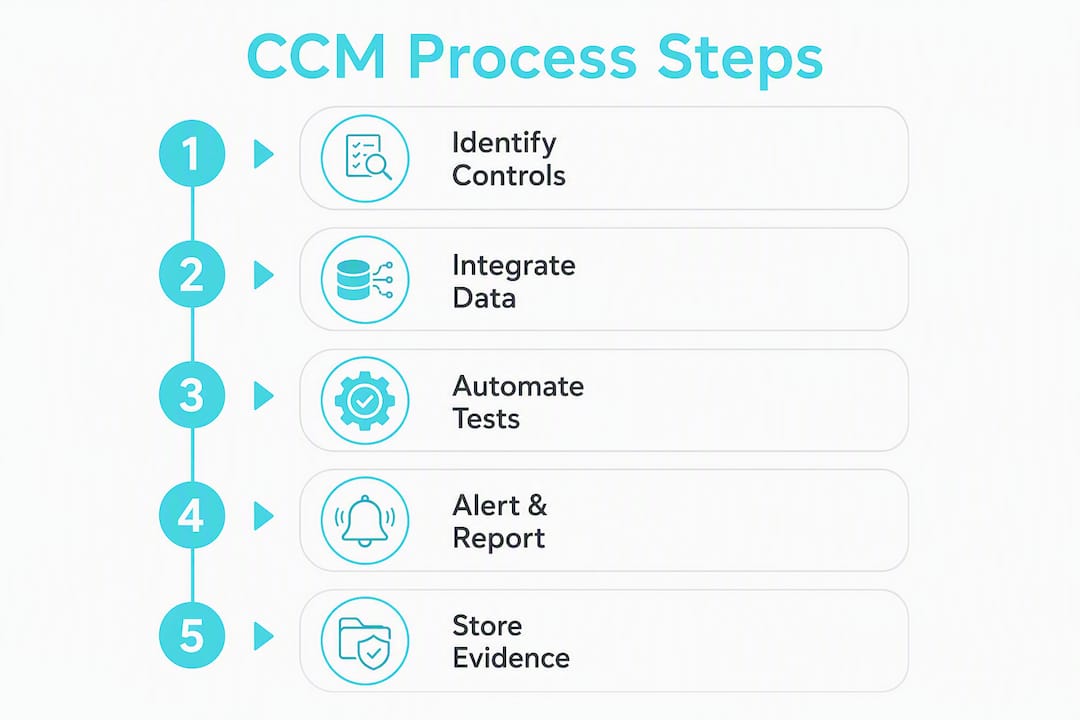
Table of Contents
- What is continuous controls monitoring and how does it differ from periodic testing?
- Why CCM delivers real value for UK risk, compliance and audit teams
- Practical CCM use cases with UK-relevant examples
- How does the technical architecture of CCM actually work?
- What do you need in place before starting CCM?
- A practical roadmap from pilot to enterprise scale
- Which CCM vendors should UK organisations consider?
- How do you choose the right CCM vendor for your organisation?
- What KPIs prove the value of CCM to your board?
- Authoritative best practices from Ai-thea's CCM experience
- What is the verdict, and what should UK teams do next?
- Key takeaways
- The gap between CCM's promise and what actually matters
- Ai-thea helps you move from CCM shortlist to working pilot
- Useful sources for UK teams
- FAQ
What is continuous controls monitoring and how does it differ from periodic testing?
CCM moves organisations from periodic "snapshot" checks to dynamic, ongoing assessments that reduce the window of vulnerability between a control failure and its detection. Where a traditional internal audit tests a sample of transactions or access rights once a quarter, CCM monitors the entire population, continuously, using automated tests against live data feeds.
Within a broader governance, risk and compliance (GRC) framework, CCM sits inside what the Cloud Security Alliance describes as continuous assurance, a set of activities that also includes continuous data assurance and continuous risk monitoring. Think of CCM as the operational engine inside that wider assurance model: it is the layer that actually tests whether controls are working, not just whether they are documented.
Periodic testing vs. continuous monitoring at a glance:
| Dimension | Periodic testing | Continuous controls monitoring |
|---|---|---|
| Coverage | Sample-based (5% of population) | Full population |
| Frequency | Quarterly or annual | Real-time or near-real-time |
| Detection lag | Weeks to months | Hours to days |
| Evidence format | Manual workpapers | Machine-readable logs, JSON |
| Audit burden | High (manual prep) | Significantly reduced |
Control types CCM typically monitors:
- Access provisioning and entitlement drift (IAM systems)
- Segregation of duties (SoD) violations in finance and ERP
- Change management and change-control deviations
- Financial transaction controls (payment approvals, threshold breaches)
- Cloud configuration and infrastructure-as-code policy compliance
- Supplier onboarding and third-party risk controls
Why CCM delivers real value for UK risk, compliance and audit teams
Early detection is the headline benefit: a control failure caught within hours costs materially less to remediate than one discovered months later during a traditional audit cycle. That gap, between when a control breaks and when a periodic audit finds it, is where regulatory exposure and financial loss accumulate.

For UK organisations operating under FCA oversight, UK GDPR, or sector-specific frameworks such as DORA, the ability to produce continuous, verifiable evidence of control effectiveness is increasingly expected rather than merely desirable. CCM directly addresses that expectation.
Core benefits for UK teams:
- Reduced audit preparation time. Automation tools claim savings of over 100 hours per quarter and audit cost reductions of 40–60%, by eliminating manual evidence collection.
- Faster remediation. Alerts fire when a control deviates, not when an auditor next visits. Mean time to remediate drops from weeks to days.
- Better FCA and UK GDPR evidence. Immutable, timestamped logs provide regulators with verifiable proof of control operation, not reconstructed narratives.
- Operational cost savings. Reduced duplication of testing across first, second, and third lines of defence frees analyst capacity for higher-value work.
- Full-population coverage. Every transaction, every access event, every configuration change is checked, not a statistically selected subset.
Deloitte's CCM guidance frames this organisationally: successful deployments shift routine control ownership to first-line teams, while second and third lines gain transparent, real-time oversight rather than periodic status reports. That structural shift is where the efficiency gains compound.
Practical CCM use cases with UK-relevant examples
The controls that benefit most from continuous monitoring share two characteristics: they generate high-volume, machine-readable data, and the cost of a failure is disproportionate to the cost of monitoring it. Below are five use cases that resonate strongly with UK compliance and audit teams.
1. Access provisioning and entitlement drift When a member of staff changes role or leaves, their access rights should be revoked or adjusted within a defined window. CCM monitors IAM systems continuously, flagging accounts that retain elevated privileges beyond policy thresholds. For FCA-regulated firms, orphaned privileged accounts are a recurring finding in supervisory reviews.
2. Segregation of duties in finance An ERP system may technically enforce SoD rules at configuration, but those rules erode as workarounds accumulate. CCM tests every transaction against the SoD matrix in real time, surfacing violations before month-end close rather than after an external audit. UK finance teams operating under SOX-equivalent controls for US-listed parents find this particularly valuable.
3. Change-control deviations in cloud infrastructure Cloud environments change at a pace that manual change-control processes cannot match. CCM connects to cloud provider APIs (AWS Config, Azure Policy, GCP Security Command Centre) and flags any infrastructure change that bypasses the approved change management workflow.
4. High-value payment approvals Payment controls are a perennial focus for UK financial services regulators. CCM monitors every payment against dual-approval rules, value thresholds, and sanctioned-party screening results, generating an alert the moment a payment is processed outside policy.
5. Supplier onboarding and third-party risk checks NHS procurement teams and financial institutions alike face pressure to verify that suppliers meet baseline security and compliance standards before contracts are activated. CCM can monitor supplier certification expiry dates, screening results, and onboarding checklist completion continuously.
Pilot selection guidance: Start with access provisioning or SoD monitoring. Both generate high-volume, structured data from systems you already own (Active Directory, your ERP), the evidence value is immediately demonstrable to auditors, and the remediation workflow is straightforward to define. These two use cases consistently deliver the fastest time-to-value in a 6–8 week pilot.
How does the technical architecture of CCM actually work?
CCM operates across five layers: instrumentation, ingestion, test execution, alerting, and evidence storage. Each layer must be in place before the next adds value, which is why instrumentation failures are the most common cause of stalled programmes.

Instrumentation connects source systems to the monitoring platform via APIs, agents, or log forwarding. Ingestion normalises data into a consistent format (typically JSON or structured logs) and routes it to the test engine. Test execution runs automated control tests against the ingested data, comparing actual state against expected policy. Alerting routes exceptions to the appropriate owner via ticketing integrations (ServiceNow, Jira). Evidence storage maintains an immutable, timestamped record of every test result, queryable by auditors and regulators.
Common connectors and data sources:
- Identity and access management (Active Directory, Okta, CyberArk)
- ERP systems (SAP, Oracle Financials, Microsoft Dynamics)
- HRIS platforms (Workday, SAP SuccessFactors)
- SIEM platforms (Splunk, Microsoft Sentinel, IBM QRadar)
- Cloud provider APIs (AWS Config, Azure Policy, GCP Security Command Centre)
- Databases and data warehouses (for financial transaction monitoring)
- Ticketing and ITSM systems (ServiceNow, Jira, Remedy)
Audit-ready evidence in machine-readable formats, JSON, SARIF, or immutable logs, is a high-value output that shortens audit cycles and provides verifiable proof for regulators. Platforms that map findings to ISO 27001, SOC 2, PCI DSS, DORA, and NIS2 simultaneously reduce the overhead of multi-framework reporting, which is increasingly relevant for UK financial services firms subject to both FCA rules and EU-origin standards.
Pro Tip: Before selecting a CCM platform, map every planned data source to its available API or log format. A connector that requires a custom integration for your ERP version will add weeks to your pilot and months to your scale-up. Prioritise vendors with pre-built connectors for your specific system versions.
What do you need in place before starting CCM?
The single most important prerequisite is reliable, continuous data feeds from your key systems. Without them, automated monitoring produces incomplete coverage and, worse, a false sense of security. Bitsight's CCM guidance is direct on this point: data quality and coverage determine the monitoring's effectiveness, not the sophistication of the test engine.
Operational and technical prerequisites checklist:
- Defined ownership model: which team owns each control, and who is accountable for remediation?
- Canonical data sources identified and documented for each control in scope
- Centralised control inventory (a register of controls, owners, and policy thresholds)
- Baseline process maps for each control workflow (what "good" looks like before you automate the test)
- Identity and access inventory (current state of all accounts, roles, and entitlements)
- Data classification: which systems hold the data CCM will ingest, and at what sensitivity level?
- IT and security team buy-in for API access and log forwarding
Pro Tip: Run an "instrumentation sprint" before your pilot formally begins. Spend two to three weeks integrating and normalising feeds from your IAM, cloud APIs, and ERP. Teams that skip this step spend the first half of their pilot debugging data quality rather than validating control tests.
Deloitte's research highlights a structural risk that is easy to overlook: lack of role clarity across technology risk, internal controls, and compliance teams causes CCM projects to stall. Define ownership before you instrument. First-line teams should own routine remediation; second and third lines retain oversight and exception escalation.
A practical roadmap from pilot to enterprise scale
A phased approach works best: pilot, validate, expand, embed. Trying to instrument every control simultaneously is the fastest route to a failed programme.
Step-by-step implementation:
- Define objectives and scope. Identify three to five high-risk controls for the pilot. Set measurable success criteria (exception rate, mean time to remediate, audit evidence hours saved).
- Map controls to data sources. For each control, document the source system, data format, API availability, and update frequency.
- Instrument data sources. Build or configure connectors. Normalise data formats. Validate feed continuity over at least two weeks before running tests.
- Build and validate automated tests. Write control tests against documented policy thresholds. Run in parallel with existing manual processes to validate accuracy.
- Tune thresholds and reduce false positives. Expect a tuning period of two to four weeks. High false-positive rates destroy analyst trust and undermine adoption.
- Establish remediation workflows. Connect alerts to your ITSM system. Define SLAs for each control type. Assign ownership to first-line teams.
- Scale to additional controls. Once the pilot controls are stable, add the next priority tier. Repeat the instrument-test-tune cycle.
- Embed into governance. Integrate CCM dashboards into board and audit committee reporting. Use evidence exports in external audit packs.
Timeline and resource expectations:
- Pilot (steps 1–5): 6–12 weeks, depending on integration complexity
- Validation and tuning (step 5): 2–4 weeks within the pilot
- Scale-up to 20–30 controls: 3–6 months post-pilot
- Enterprise embedding: 12–18 months for large, complex organisations
A cross-functional pilot team typically includes a project lead from internal audit or risk, a technical lead from IT or security, control owners from the first line, and vendor or managed service support. SME time from finance, HR, and IT operations is needed during the instrumentation and test-building phases.
Standard implementation phases map directly to these steps: identify key controls, define objectives, set up automated tests, and establish monitoring and reporting with appropriate key risk indicators (KRIs).
Which CCM vendors should UK organisations consider?
A shortlist reduces procurement risk and focuses demo time on the dimensions that actually differentiate platforms. The six vendors below represent the range of approaches available to UK organisations, from purpose-built CCM platforms to broader GRC suites with CCM modules.
Vendor comparison
| Dimension | Panaseer | MetricStream | Diligent | Hyperproof | ServiceNow | RSA Archer |
|---|---|---|---|---|---|---|
| Best for | Enterprise security control metrics | Integrated GRC + CCM | Board and audit reporting | Cloud-native compliance teams | ITSM-integrated CCM | Large enterprise GRC |
| Pricing model | Enterprise subscription | Enterprise subscription | Subscription, seat-based | Subscription, tiered | Enterprise licensing | Enterprise licensing |
| Integrations | SIEM, IAM, cloud APIs, ERP | ERP, IAM, SIEM, GRC data | ERP, audit tools, board portals | Cloud APIs, SaaS tools, IAM | ITSM, SIEM, IAM, ERP | ERP, IAM, SIEM, databases |
| Deployment | SaaS | SaaS / on-prem / hybrid | SaaS | SaaS | SaaS / on-prem | SaaS / on-prem / hybrid |
| UK regulatory support | ISO 27001, FCA, DORA | ISO 27001, SOX, GDPR | UK Corporate Governance Code, ISO 27001 | SOC 2, ISO 27001, GDPR | ISO 27001, GDPR, FCA | ISO 27001, SOX, GDPR |
| Scalability | Full population monitoring | Full population | Sample + population | Full population | Full population | Full population |
| Reporting | Metrics dashboards, evidence export | Dashboards, audit evidence | Board-ready reports, evidence packs | Dashboards, evidence export | ITSM dashboards, audit logs | Dashboards, audit workpapers |
| Implementation time | 6–8 weeks | 12–24 weeks | 6–8 weeks | 4–12 weeks | 12–24 weeks | — |
| Alerting / workflow | Automated alerts, ticketing integration | Workflow engine, escalation | Issue tracking, board escalation | Automated alerts, Jira/Slack | Native ITSM workflow | Workflow engine, escalation |
Vendor summaries
Panaseer is purpose-built for continuous security control metrics, connecting to SIEM, IAM, and cloud APIs to produce a single, normalised view of control coverage across the enterprise. Its strength is translating raw security telemetry into board-level metrics. UK financial services firms with mature security operations centres tend to find it a natural fit.
MetricStream offers a broad GRC platform with CCM as an integrated module. It suits organisations that want a single platform for risk, compliance, audit, and controls monitoring. The implementation timeline is longer, but the benefit is a unified data model across GRC activities.
Diligent approaches CCM from the board and audit committee angle. Its strength is producing board-ready evidence packs and connecting audit findings to governance workflows. For UK organisations focused on the UK Corporate Governance Code and audit committee reporting, it offers a differentiated proposition.
Hyperproof is the most accessible entry point for cloud-native teams. Its pre-built framework mappings (SOC 2, ISO 27001, GDPR) and SaaS-first architecture mean faster time to value for organisations without legacy on-premises infrastructure. Smaller compliance teams find the interface intuitive without needing dedicated platform administrators.
ServiceNow brings CCM into an ITSM workflow that many UK enterprises already operate. If your organisation runs ServiceNow for IT service management, adding CCM through the same platform reduces integration effort and keeps remediation workflows inside a familiar tool. The trade-off is that ServiceNow's CCM capability is less specialised than purpose-built platforms.
RSA Archer is a long-established GRC platform with deep workflow customisation. It suits large, complex organisations with bespoke control frameworks and the internal resources to configure and maintain the platform. Implementation timelines can vary widely among platforms, balanced by flexibility and organisational resources.
Validating vendor claims during a proof of value: Request a sample evidence export in machine-readable format (JSON or SARIF) against a real control test. Ask for the API specification for your specific ERP and IAM versions. Require at least two UK or EMEA customer references in a comparable regulatory context. Any vendor that cannot provide these during a proof of value is not ready for your environment. Gartner's CCM reviews are a useful independent reference for peer ratings across these platforms.
How do you choose the right CCM vendor for your organisation?
Top eight selection criteria:
- Data source coverage: does the vendor have pre-built connectors for your IAM, ERP, and cloud platforms?
- Population monitoring: does it test the full population or revert to sampling under load?
- Evidence export: can it produce machine-readable, immutable evidence mapped to your regulatory frameworks?
- Scalability: what is the tested transaction volume per day, and how does latency change at scale?
- Managed service options: can the vendor provide managed detection and response, or is it purely self-service?
- Integration effort: what is the realistic time to first alert for your specific system versions?
- Security posture: what are the vendor's own ISO 27001 or SOC 2 certifications, and where is data hosted?
- Pricing transparency: is the pricing model predictable at scale, or does it introduce per-alert or per-connector fees?
RFP questions by category:
Technical:
- Provide the API specification for [your ERP version] and [your IAM platform].
- What is the maximum data latency from source event to alert?
- How do you handle schema changes in source systems?
Functional:
- Provide a sample machine-readable evidence export for a failed access provisioning control test.
- How does the platform handle false-positive tuning, and who owns that process?
- Which UK regulatory frameworks are natively mapped, and how frequently are mappings updated?
Commercial:
- Provide a fully loaded cost model for 50, 200, and 500 controls.
- What is the SLA for data ingestion latency and platform availability?
- Provide two UK or EMEA references in a comparable regulatory context.
Red flags to watch for:
- No machine-readable evidence export: PDF-only outputs are not audit-ready in the way regulators increasingly expect.
- Vague integration story: "we can connect to anything" without a specific connector list is a warning sign.
- Custom-only solutions: high total cost of ownership from bespoke development that locks you into the vendor.
- No UK regulatory mapping: a vendor without documented FCA, UK GDPR, or ISO 27001 mappings will require your team to build them.
- Absence of UK or EMEA references: a vendor with no comparable deployments in your regulatory context carries delivery risk.
Pro Tip: Structure your proof of value around three specific controls, two weeks of live data, and a defined success metric (e.g. "detect 100% of SoD violations present in the test dataset within four hours"). A vendor that resists a structured PoV with defined success criteria is telling you something important about their confidence in the product.
What KPIs prove the value of CCM to your board?
Focus on four metrics: control coverage, mean time to detect, audit evidence time savings, and remediation cycle time. Together, they tell a complete story from detection through resolution to regulatory readiness.
KPI list for CCM programmes:
- Percentage of in-scope controls monitored continuously (target: 100% of pilot controls within 90 days)
- Control pass rate (percentage of automated tests passing policy thresholds; trend over time is more meaningful than a point-in-time figure)
- Mean time to detect (MTTD) control failures, measured from event occurrence to alert generation
- Mean time to remediate (MTTR) exceptions, measured from alert to closure
- Audit evidence preparation hours saved per audit cycle (compare pre- and post-CCM manual effort)
- Number of automated detections versus manually discovered issues (the ratio demonstrates CCM's incremental value)
Boards and audit committees want three things from CCM reporting: immutable evidence they can rely on, trend charts that show whether the control environment is improving, and exception drilldowns that demonstrate management is acting on findings. A dashboard that shows only green RAG statuses without exception detail will not satisfy a sceptical non-executive director or an FCA supervisor.
Automation of evidence collection reduces manual workload and enables teams to focus on high-impact investigations rather than assembling evidence packs. That shift in analyst time is itself a measurable KPI: track hours spent on evidence preparation before and after CCM deployment.
Authoritative best practices from Ai-thea's CCM experience
Treat CCM as a capability and a governance change, not a point-tool purchase. The technology is the enabler; the operating model is the substance. Organisations that buy a CCM platform without redesigning ownership, instrumentation, and evidence pipelines typically find themselves with an expensive dashboard that nobody trusts.
Governance, people, process, and technology checklist:
- Assign a named control owner for every control in scope before instrumentation begins.
- Document the "expected state" for each control in machine-readable policy before writing automated tests.
- Build evidence pipelines that produce immutable, timestamped outputs from day one of the pilot.
- Establish a continuous improvement cadence: review false-positive rates, threshold accuracy, and coverage gaps monthly.
- Align CCM outputs to existing board and audit committee reporting cycles so findings reach the right audience.
Procurement framework scoring criteria (suggested weightings):
| Criterion | Suggested weight |
|---|---|
| Pre-built integrations for your systems | 40–60% |
| Evidence export quality and format | 20% |
| UK regulatory framework mapping | 20% |
ISACA's practical guidance on continuous control monitoring remains a useful reference for governance design, particularly the ownership and escalation model. Pair it with Deloitte's three-lines-of-defence framing for a complete governance blueprint.
Pro Tip: Use Ai-thea's Heliolus vendor selection navigator to score CCM vendors against your specific integration requirements and regulatory context before committing to a proof of value. It reduces the shortlisting phase from weeks to days.
What is the verdict, and what should UK teams do next?
CCM is worthwhile for any UK organisation that operates more than 20 material controls, faces FCA, UK GDPR, or ISO 27001 obligations, and currently relies on periodic testing to evidence control effectiveness. The investment in instrumentation pays back in audit efficiency, faster remediation, and regulatory confidence.
Recommended action plan:
- Run a 6–8 week pilot scoping exercise: map your three to five highest-risk controls to available data feeds.
- Instrument those controls first, validate feed continuity for two weeks, then activate automated tests.
- Set KPIs before the pilot starts: MTTD, MTTR, audit evidence hours saved, and control pass rate.
- Run a structured proof of value with at least one vendor, using real data and defined success criteria.
- Use evidence exports from the PoV in your next internal audit cycle to demonstrate value to the audit committee.
Pilot success criteria checklist:
- Reliable, continuous data feeds from all pilot control sources (zero feed gaps over the pilot period)
- Reproducible, machine-readable evidence for every automated test result
- Meaningful exception rates (neither zero nor overwhelming; tune thresholds until the signal is actionable)
- Measurable reduction in audit evidence preparation time compared with the previous manual cycle
Key takeaways
Continuous controls monitoring delivers its greatest value when treated as an operational capability built on reliable data feeds, clear ownership, and machine-readable evidence pipelines — not as a software deployment alone.
| Point | Details |
|---|---|
| CCM replaces sampling with population monitoring | Every transaction and access event is tested continuously, closing the detection gap that periodic audits leave open. |
| Instrumentation comes before automation | Reliable, continuous data feeds from IAM, ERP, and cloud APIs must be in place before automated tests add value. |
| Audit savings are measurable | Some automation tools claim savings of over 100 hours per quarter and audit cost reductions of 40–60% by eliminating manual evidence collection. |
| Pilot on three to five controls first | Access provisioning and SoD monitoring deliver the fastest time-to-value and the clearest evidence for audit committees. |
| Ai-thea supports vendor selection and pilot design | Ai-thea's procurement and matchmaking services help UK compliance teams shortlist CCM vendors, structure RFPs, and design evidence pipelines. |
The gap between CCM's promise and what actually matters
CCM conversations tend to focus on the technology: which platform, which connectors, which dashboards. That framing misses the harder problem. The organisations that struggle with CCM are not struggling because they chose the wrong vendor. They are struggling because they automated a broken process, or because nobody agreed who owns remediation when an alert fires at 11pm on a Friday.
Two failure modes appear consistently. The first is ownership ambiguity: when an alert fires and three teams each assume one of the others will act, the mean time to remediate stretches from hours to weeks, and the CCM programme loses credibility with the audit committee. The corrective action is straightforward but requires discipline: assign a named individual, not a team, to every control before the pilot begins.
The second failure mode is rushing automation without instrumentation. Teams that skip the feed-validation phase discover, mid-pilot, that their IAM system exports stale data with a 24-hour lag, or that their ERP log format changed with the last patch. The fix is the instrumentation sprint described earlier: two to three weeks of feed integration and normalisation before a single automated test runs. It feels slow. It prevents the most common pilot failure.
The vendors in this shortlist are all credible. The differentiator in your deployment will be the quality of your instrumentation and the clarity of your ownership model, not the sophistication of the platform's UI.
Ai-thea helps you move from CCM shortlist to working pilot
Selecting a CCM vendor is only part of the challenge. Designing the instrumentation architecture, structuring the RFP, and building the evidence pipelines that regulators and auditors will actually rely on requires a different kind of expertise, one that sits at the intersection of compliance knowledge, technology procurement, and operational delivery.

Ai-thea offers practical pilot design and vendor selection support for CCM projects, including pilot scoping and control prioritisation, vendor shortlisting and RFP structuring using the criteria in this guide, instrumentation and evidence pipeline design, and training and change management for first-line control owners. The Heliolus navigator scores vendors against your specific regulatory context and integration requirements, cutting shortlisting time significantly. UK and EMEA references are available on request.
If you are ready to scope a pilot or want a second opinion on your vendor shortlist, get in touch with the Ai-thea team to arrange a consultation.
Useful sources for UK teams
- Cloud Security Alliance: Everything you should know about CCM: Practical overview of CCM within the continuous assurance framework; useful for defining scope and explaining CCM to senior stakeholders.
- Bitsight: Continuous controls monitoring: Clear definition and technical architecture overview; good reference for instrumentation and data quality requirements.
- Deloitte: Continuous controls monitoring: Governance and three-lines-of-defence framing; the strongest reference for ownership model design.
- Gartner: CCM market reviews: Independent peer ratings for CCM platforms; use during vendor shortlisting and PoV planning.
- ISACA: A practical approach to continuous control monitoring: Governance design and escalation model guidance from a recognised audit and risk standards body.
- Sprinto: Continuous control monitoring: Practical implementation step sequencing; useful for pilot planning and roadmap design.
- AquilaX compliance scanner: Framework mapping reference for ISO 27001, SOC 2, PCI DSS, DORA, and NIS2; relevant for multi-framework evidence export requirements.
FAQ
What is continuous controls monitoring?
Continuous controls monitoring is a technology-driven process that verifies the effectiveness of security and compliance controls in real or near-real time across the full population of transactions or events, replacing periodic sample-based testing.
What is an example of continuous control monitoring in practice?
A financial services firm connecting its IAM system to a CCM platform to flag any user account that retains elevated access rights more than 24 hours after a role change is a typical example. Every access event is checked automatically, not sampled quarterly.
What does CCM mean in GRC?
In a GRC context, CCM is a subset of continuous assurance: the automated, ongoing testing of whether controls are operating as designed, sitting alongside continuous data assurance and continuous risk monitoring to provide real-time visibility across the control environment.
How long does a CCM pilot typically take?
A focused pilot covering a few critical controls typically runs for several weeks, including two to three weeks of instrumentation and feed validation before automated tests are activated.
Which UK regulatory frameworks does CCM support?
CCM produces evidence relevant to FCA operational resilience requirements, UK GDPR accountability obligations, ISO 27001 control effectiveness, SOC 2, and, for firms in scope, DORA and NIS2 reporting requirements.