

Build a weighted scorecard before you take a single demo, shortlist three to five vendors against it, then run a proof of concept on a representative compliance workflow. The reasoning matters more than the tool: audit evidence and contract terms decide long-term value, not interface polish. Start the scorecard this week, not after the first sales call.
TL;DR:
- Building a weighted scorecard before demos ensures your team focuses on regulatory fit and creates a defensible audit trail for vendor decisions.
- Clarify your scope by documenting specific frameworks, data flows, and internal processes to avoid comparing incompatible solutions like GRC suites versus point tools.
- Prioritize operational features such as audit trail integrity, regulatory mapping, explainability, and security, which directly influence audit outcomes and breach risks.
- Run a focused proof of concept on a representative workflow with fixed criteria and a standardized dataset to evaluate vendors objectively and avoid marketing bias.
- Insist on clear contractual clauses for data ownership, export rights, implementation milestones, support SLAs, renewal caps, and breach notification to protect long-term value.
Table of Contents
- What is compliance software selection and why does the framework matter?
- How do you define scope before comparing vendors?
- Which operational features actually change audit outcomes?
- How should you shortlist vendors and run a proof of concept?
- What contract clauses protect you after signing?
- How do you turn a signed contract into a working system?
- How does AITHEA support the procurement process?
- What procurement mistakes actually cost the most?
- How AITHEA helps you buy with confidence
- Where to check the detail before you sign
- Sources
- FAQ
What is compliance software selection and why does the framework matter?
Compliance software selection is the structured process of matching a regulated organisation's actual risk exposure to a vendor's genuine capability, then locking that fit into a contract before money changes hands. Most teams do this backwards. They watch a demo, get impressed by a dashboard, and only later discover the platform cannot produce the audit trail a regulator actually wants.
Crowe's five-step procurement method frames this correctly: understand your objectives first, build a scorecard, shortlist against it, run structured demos, then decide. That order is not bureaucratic box-ticking. It stops feature lists dictating the outcome instead of your actual regulatory scope.
A scorecard forces two disciplines that vendor demos never will. First, it makes your team agree, in writing, what matters most before anyone gets swayed by a slick user interface. Second, it creates a defensible audit trail for the decision itself, which matters when a regulator or internal audit later asks why you chose the platform you did.
Suggested scoring categories and default weightings:
- Regulatory depth and framework mapping accuracy: 20%
- Audit evidence traceability and immutability: 20%
- Integration breadth with existing case management and data systems: 15%
- Automation fidelity (false positive and false negative rates on your data): 15%
- Explainability of AI-driven decisions: 10%
- Security certifications and data residency compliance: 10%
- Vendor support model and total cost of ownership: 10%
These weightings shift depending on maturity. A newly regulated fintech building its first sanctions screening capability should weight integration and support higher, because it has no internal expertise to fall back on. A tier-one bank replacing a legacy AML platform should weight automation fidelity and explainability higher, because false positives at scale are what burn analyst hours.
How to score each category (0 to 5 scale):
- Score 0 to 1 if the vendor cannot demonstrate the capability on your data, only on a generic demo dataset.
- Score 2 to 3 if the capability exists but requires significant configuration or a paid professional-services engagement.
- Score 4 if the capability works out of the box against a representative sample of your own transactions or cases.
- Score 5 only if the vendor can show the capability already live at a comparable organisation in your sector, with a reference you can call.
Multiply each category score by its weighting, then sum the totals across your shortlist. A platform scoring 3.8 overall with strong audit evidence and weak integration is often a better long-term bet than one scoring 4.1 with the reverse profile, because integration gaps are expensive to fix later and evidence gaps are close to impossible to retrofit.
Pro Tip: Run the scorecard twice, once before demos and once immediately after. If the post-demo scores move by more than one point in any category, someone on your panel was persuaded by presentation rather than substance, and it is worth revisiting that score with the evidence, not the memory of the pitch.
Smaller compliance functions should collapse this into four categories rather than seven, keeping regulatory depth and evidence traceability as non-negotiable, and folding automation fidelity and explainability into a single "AI quality" line. Larger programmes running multiple frameworks across jurisdictions should split regulatory depth by framework and score each separately, because a vendor strong on EU sanctions regimes may be considerably weaker on national AML transposition rules.
How do you define scope before comparing vendors?
Comparing an enterprise GRC suite against a point solution for transaction monitoring is comparing different products entirely, and it happens constantly because teams skip the scope exercise. ComplianceCatalog's buyer guidance makes the point plainly: framework count is a vanity metric. What matters is depth against the specific frameworks causing your organisation operational pain right now.
Document scope before you write a single vendor email. That means listing the specific regulatory frameworks you must map to (the EU's AMLD6, DORA, the UK's MLRs, or sector-specific rules), the internal processes those frameworks touch (onboarding, transaction monitoring, sanctions screening, whistleblower handling), the systems already holding relevant data, and the data flows between them.
Four category types and when each fits:
- Automation-first platforms suit teams with high transaction volumes and a mature data infrastructure, where the bottleneck is analyst throughput rather than policy design.
- Enterprise GRC suites suit large, multi-jurisdiction organisations that need one system of record spanning risk, audit, and multiple compliance domains, at the cost of longer implementation.
- Point tools suit a narrow, well-defined gap, such as sanctions list screening or KYC document verification, where depth beats breadth.
- Platform-plus-expertise models suit teams that lack in-house configuration capacity and need a vendor or advisory partner who can translate regulatory requirements into working rules.
Diagnostic questions that reveal the right category:
- Which specific framework requirement currently causes the most manual rework in your team?
- Does your organisation have the internal expertise to configure and maintain rule logic, or does it need that delivered as a managed service?
- How many separate systems currently hold the evidence a regulator would ask for, and could a single platform realistically consolidate them?
- Is your compliance function growing into new jurisdictions in the next 18 months, and does that change which category you need?
Answering these before a single vendor conversation cuts shortlists down fast and stops procurement teams wasting weeks evaluating platforms that were never built for their actual scope.
Which operational features actually change audit outcomes?
Six features separate platforms that survive an audit from those that create more work during one, and Glynac's 2026 market analysis identifies them as the genuine differentiators buyers should test rather than take on faith.
Audit-ready evidence and source linking. Every alert, decision, and escalation needs a traceable path back to its source data, with an immutable review history that cannot be edited after the fact. Ask vendors to show you the actual audit log for a sample case, not a mock-up. If they cannot produce a real one during the demo, that is your answer.
Automated regulatory mapping across multiple frameworks. A platform should map a single control to several frameworks simultaneously (say, a KYC check that satisfies both AMLD6 and a sector-specific due diligence rule) and update that mapping when a regulation changes, without you filing a change request and waiting weeks.
Explainable AI with logged reasoning. This is where 2026 buyer expectations have moved fastest. It is no longer acceptable for a platform to flag a transaction as high risk without showing which factors drove that score and in what proportion. Human-in-the-loop design matters here: the system should draft a recommendation, but a named reviewer should confirm or override it, with that decision logged. Aithea's own analysis of AI versus traditional methods in sanctions compliance covers why explainability, not raw detection rate, is becoming the real differentiator regulators care about.
Cross-system timeline reconstruction. When an investigator needs to reconstruct what happened across five systems over eighteen months, the platform should assemble that timeline automatically rather than requiring someone to export five spreadsheets and stitch them together manually.
A clear line between automated output and drafted items awaiting human confirmation. Some vendors blur this distinction in demos, presenting AI-drafted suspicious activity reports as if they were finished outputs. Insist on seeing exactly which parts of any document are machine-generated and which require a compliance officer's sign-off before submission.
Security, data residency, encryption, and export formats. For organisations operating across the EU, data residency questions intersect directly with GDPR and, increasingly, DORA's operational resilience requirements for financial entities. Ask specifically where data physically sits, in what encrypted state, and in what format you could extract it if the relationship ended tomorrow.
- Confirm the platform logs every automated decision with a timestamp and the specific data points used.
- Confirm regulatory updates to mapped frameworks are pushed automatically, not billed as change requests.
- Confirm a named human, not "the system," is accountable for every high-risk decision in the audit trail.
- Confirm data export is available in a usable, non-proprietary format at any point in the contract term.
Pro Tip: Ask the vendor to walk you through their worst recent false positive, not their best success story. How they diagnosed and fixed it tells you more about audit readiness than any dashboard screenshot.
Breach notification obligations sharpen why this matters. The OAIC's most recent notifiable data breaches report shows breach volumes climbing, and any compliance platform holding sensitive case data becomes part of your own breach exposure. A vendor's security posture is not a checkbox: it is a direct extension of your organisation's regulatory risk.
How should you shortlist vendors and run a proof of concept?
Source your shortlist from peers facing the same regulatory scope, not from a generic search results page. Regulatory peer networks, sector associations, and industry events surface vendors who have already solved your specific problem, and a reference call with an existing customer in your sector is worth more than an hour with a sales engineer.
- Draft a demo script before contacting vendors, specifying the exact use case, dataset shape, and questions you will ask, so every vendor is evaluated against the same standard.
- Insist that the compliance officer who will use the platform daily, not just IT or procurement, attends every demo and scores it independently.
- Narrow the shortlist to three to five vendors maximum before starting proof-of-concept discussions, because running more than that dilutes attention and slows the decision.
- Design the proof of concept around one representative workflow and one real (anonymised where necessary) dataset, rather than a broad tour of every feature.
- Set explicit success criteria before the trial starts: evidence completeness, false positive rate against your historic data, integration latency with your existing systems, and export usability.
- Agree a fixed trial length, typically four to six weeks, long enough to surface integration friction but short enough to keep momentum.
This mirrors what Glynac's research found works best: proving value on a single high-impact process beats a broad, shallow demo tour every time. A vendor who performs well on one genuinely difficult workflow tells you more than one who performs adequately across ten easy ones.
During the POC, get vendor commitments in writing, not verbally. If a sales engineer promises a feature will be "ready by go-live" or that integration will take "two weeks," email a summary immediately and ask for written confirmation. Verbal promises made during a proof of concept evaporate the moment a contract is signed and a different account manager takes over.
- Measure evidence completeness by sampling ten resolved cases and checking whether the full decision trail is reconstructable without asking the vendor for help.
- Measure integration latency by timing how long a test record takes to appear correctly across connected systems.
- Measure exportability by actually exporting a full case file and checking it opens cleanly in a non-proprietary format.
Pro Tip: Ask each finalist to run the exact same POC dataset. Identical inputs make the scorecard comparison honest; letting each vendor pick its own showcase data guarantees you compare marketing, not performance.
What contract clauses protect you after signing?
Contracts, not demos, decide long-term value, and this is where compliance buyers most often get trapped. Data export rights, ownership terms, and implementation scope are the three areas where vendors have every incentive to stay vague, and where you have every reason to insist on precision before signature.
Data ownership and export rights. The contract must state explicitly that you own your data outright, specify the exact export formats available, and guarantee exit assistance (a defined period of vendor support to extract and migrate your data if you terminate). The OAIC's Australian Privacy Principles quick reference sets out the kind of data-handling obligations that should shape these clauses, particularly around minimisation and the purposes data can be used for.
Implementation deliverables and acceptance criteria. Vague statements of work create disputes. Insist on named milestones, dated deliverables, defined acceptance tests for each phase, and financial penalties if the vendor misses agreed dates.
SLA and support specifics. A generic "we respond promptly" clause is worthless. Demand specific response times by severity tier, a named escalation path, and a defined support model (dedicated account manager versus shared ticket queue) written into the contract itself.
Pricing transparency and renewal mechanics. Ask for the renewal price increase cap in writing before signing the first contract, not at renewal when you have no leverage. Many vendors offer attractive year-one pricing with uncapped increases from year two onward.
Security, audit rights, and breach notification. Insist on a contractual right to audit the vendor's security controls, current certifications, and a specific breach notification timeframe. Given rising breach volumes documented in the OAIC's most recent reporting period, a vague "reasonable notice" clause is not acceptable for a system holding sanctions or KYC data.
- List every data field the vendor will hold and confirm export includes all of it, not a summary subset.
- Confirm exit assistance duration and whether it is included in the base contract or billed separately.
- Confirm the escalation path names actual roles, not just "our support team."
- Confirm the renewal price cap and the notice period required before any price change takes effect.
How do you turn a signed contract into a working system?
Present four artefacts for internal sign-off before implementation begins: the completed scorecard with final scores, the proof-of-concept results against your success criteria, the redlined contract showing what changed from the vendor's first draft, and a resource plan naming who owns implementation internally.
- Assign a named project owner from compliance, not IT, to lead the 90-day pilot, because the person accountable for regulatory outcomes needs to drive adoption.
- Set week-by-week milestones: system access and data migration by week three, core workflow configuration by week six, user training by week nine, and a formal acceptance test by week twelve.
- Run training as scenario-based sessions using real (anonymised) cases rather than generic vendor materials, so analysts see the platform solving their actual problems.
- Build a formal acceptance test at the end of the pilot that mirrors the proof-of-concept success criteria exactly, so you are measuring the live system against the same bar the POC set.
Change management determines whether a technically sound platform actually gets used. Analysts who spent years trusting a legacy system's quirks will resist a new one unless they see it catching something the old system missed, early and visibly. Publicise small wins during the pilot: the case the new platform flagged correctly that the old one missed, the report that took four hours instead of two days.
- Track early ROI through concrete metrics: analyst hours saved per week, reduction in false positives, and time to close a case.
- Review scope at the 90-day mark and adjust configuration based on real usage patterns, not assumptions made during procurement.
- Keep the vendor's implementation team accountable to the contracted milestones, even after go-live enthusiasm sets in.
Pro Tip: Schedule a formal 90-day review meeting with the vendor before the pilot even starts. Vendors treat a diarised, named review far more seriously than an open-ended "we'll check in."
How does AITHEA support the procurement process?
Aithea works specifically at the intersection of regulation, technology, and AI, helping compliance teams become genuinely technology-savvy rather than dependent on whichever vendor pitched hardest last quarter. That positioning matters because most compliance functions are asked to evaluate AI-driven platforms without ever having been trained to interrogate an AI vendor's claims.
Some tools are built to help teams navigate the vendor landscape directly: running structured RFPs, managing the procurement cycle, and avoiding the common trap of comparing vendors on marketing material rather than operational fit.
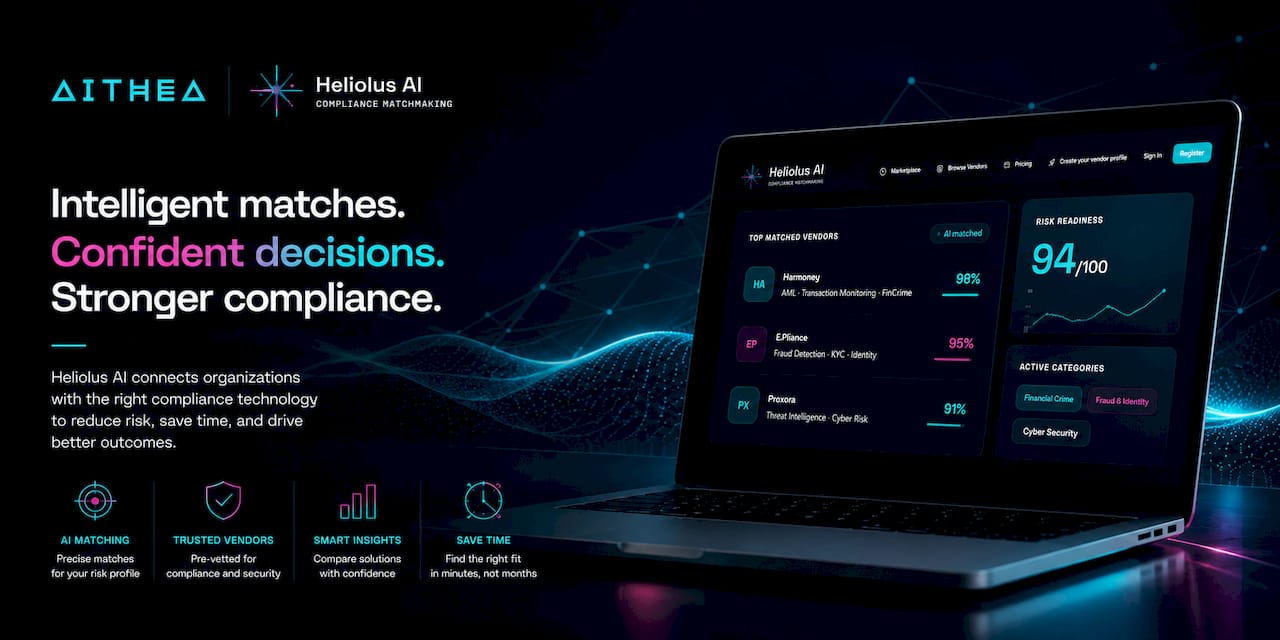
- Heliolus, Aithea's AI-based compliance technology selection navigator, is built specifically to support this kind of structured evaluation rather than an ad hoc vendor search.
- Aithea's broader service offering covers digital transformation consulting for financial crime, trade, and regulatory compliance technology procurement.
- Compliance education and microlearning resources can give internal teams the vocabulary and confidence to challenge vendor claims during demos, not just after a platform underperforms.
For a compliance officer without a dedicated technology procurement function, that combination of navigator tooling and consulting support closes a genuine capability gap.
What procurement mistakes actually cost the most?
The most expensive mistake compliance teams make is letting the loudest internal voice, usually whoever attended the flashiest demo, override the scorecard. I have seen procurement panels abandon a well-reasoned weighting scheme within a single meeting because a vendor's interface looked impressive, only to discover months later that the platform could not produce a defensible audit trail.
The second mistake is skipping reference calls with existing customers in a comparable regulatory position, relying instead on the vendor's chosen case studies. The third is signing before pinning down export rights, discovering the true cost of leaving only once they need to.
Two safeguards fix most of this: score the scorecard twice (before and after demos) and never sign without a written exit and export clause. My rapid triage checklist is short: does the audit trail survive scrutiny, does the contract let you leave, and did a real user, not a slide deck, confirm the fit?
— Aneta
How AITHEA helps you buy with confidence
Aithea gives compliance teams a structured alternative to running vendor evaluation alone, with Heliolus purpose-built to turn the scorecard approach in this article into a working shortlist rather than a spreadsheet nobody maintains.
If your team has the internal capacity to build and run a scorecard, use this guide as your framework and revisit it before every major renewal. If you need structured support (RFP design, vendor shortlisting, or a second opinion on contract redlines before signature), consulting work drawing on the same evaluation logic this article walks through can help. Heliolus is designed to help procurement teams run objective, weighted vendor comparisons rather than relying on memory and gut feel after a run of demos.
Related reading on emerging risk, including cybersecurity's growing overlap with financial crime, is worth reviewing before you finalise scope, since several 2026 platforms now bundle fraud and financial crime detection together.
To talk through a specific shortlist or get a second opinion on a contract before you sign, get in touch with Aithea directly.
Where to check the detail before you sign
- OAIC notifiable data breaches reporting for breach-notification benchmarks to hold vendors to.
- OAIC Australian Privacy Principles quick reference for data-handling and residency obligations.
- A partner resource on identity verification upgrade checklists for integration-specific due diligence.
Sources
- OAIC — Notifiable data breaches report July to December 2024
- Crowe — 5 steps to choosing a compliance platform
- Glynac — Compliance software: how to choose the right platform for your business in 2026
- ComplianceCatalog — How to choose compliance software
- OAIC — Australian privacy principles: quick reference
FAQ
What is the best software for compliance?
There is no single best platform. The right choice depends on your regulatory scope, data maturity, and whether you need automation-first tooling, enterprise GRC, or a point solution. A weighted scorecard tailored to your objectives, tested through a proof of concept, is a more reliable route than any generic ranking.
What are the seven pillars of compliance?
Definitions vary across sources, but a commonly cited version includes written policies, a designated compliance officer, effective training, open communication lines, auditing and monitoring, consistent enforcement, and prompt response to detected issues.
What are the four main types of compliance?
Most frameworks group compliance into regulatory, financial, security, and operational compliance, though the exact split can vary by sector and jurisdiction.
How long should a compliance software proof of concept run?
Proof of concept durations vary but are generally brief enough to identify integration issues and test evidence quality while maintaining momentum and engagement.
What should be in a compliance software contract before signing?
Data ownership and export rights, defined implementation milestones with acceptance criteria, specific SLA response times, a capped renewal pricing mechanism, and clear breach notification timelines all belong in the contract, not left to verbal assurance.