

Beneficial ownership data identifies the real human beings who own or control a company, as distinct from the legal entities listed on paper. Compliance teams use it for anti-money laundering checks, procurement vetting and tax transparency. The single most important operational decision organisations face is adopting machine-readable standards, chiefly the Beneficial Ownership Data Standard, and integrating registers with identifiers like the Legal Entity Identifier rather than treating registry lookups as a one-off task.
TL;DR:
- Machine-readable standards like BODS are essential for integrating beneficial ownership data with public registries, procurement, and tax systems to improve transparency.
- Reconciliation must include identifiers like LEI, address normalization, and conflict flagging, not just name and percentage data; provenance metadata is critical for audit trails.
- Regular re-checks, layered data sources, and visualisation of ownership networks mitigate delays and gaps caused by snapshot-based registers and indirect control structures.
- Vendor evaluation should confirm BODS support, provenance tracking, and network visualisation capabilities, with realistic implementation timelines of 3 to 6 months.
- Automation tools like AI-based validation and network mapping significantly reduce manual effort, but require proper governance, training, and vendor support for effective deployment.
Table of Contents
- Why beneficial ownership data matters for compliance and transparency
- Standards and formats: BODS, OCDS, LEI and registry APIs
- Typical data fields and the minimum dataset to collect
- How to collect, validate and exchange BO data operationally
- Uses, limitations and data-quality risks to plan for
- Implementation checklist and vendor questions for procurement
- What technology and AI actually change in this picture
- Get procurement-ready for beneficial ownership data projects
- Sources
- FAQ
Why beneficial ownership data matters for compliance and transparency
Beneficial ownership data feeds three distinct compliance functions, and treating them as one workflow is a common mistake. AML teams use it to trace ultimate control before onboarding a customer. Procurement teams use it to vet suppliers bidding for public contracts. Tax authorities use it to spot profit shifting through opaque holding structures.
The World Bank's Beneficial Ownership Transparency Working Group makes a point that gets overlooked constantly: registers only deliver value when connected to other public systems. A name sitting in a register tells you little until it is cross-referenced against procurement bid histories or tax filings.
That connective work is where most programmes fall short. Typical gaps include:
- Registers queried in isolation, with no link to procurement or tax records
- Ownership data pulled once at onboarding and never refreshed
- No mapping between registry identifiers and international entity identifiers like the LEI
- Manual PDF extraction replacing structured, queryable data
Standards and formats: BODS, OCDS, LEI and registry APIs
Beneficial ownership data only becomes useful at scale once it is machine-readable. The Beneficial Ownership Data Standard, known as BODS, is an open standard purpose-built for collecting, storing and exchanging ownership information across borders and systems, and Gov explicitly recommends it for government bodies publishing this data.
BODS does not operate alone. Three other reference points matter for interoperability:
- OCDS (Open Contracting Data Standard) links ownership records to public procurement bids, closing the gap the World Bank working group flagged
- LEI (Legal Entity Identifier) gives each legal entity a unique global code, letting you reconcile the same company across multiple national registers
- Registry APIs, such as Companies House's, expose the raw fields a BODS-aligned pipeline needs to ingest
Pro Tip: Companies House's corporateEntityBeneficialOwner API resource is worth studying even if you never touch UK filings, because its schema is a useful blueprint for any canonical BO dataset. It exposes fields including etag (a version marker for change detection), natures_of_control (the specific type and threshold of control held), and is_sanctioned (a boolean flag), documented in the Companies House API specification. Mapping your own pipeline to fields like these early avoids a costly schema rebuild later.
Typical data fields and the minimum dataset to collect
A workable beneficial ownership dataset needs more than a name and a percentage. The minimum viable schema breaks down into three groups:
- Identity elements: full legal name, national identifiers (passport or tax ID where available), jurisdiction of residence, and both registered and current address, since these often diverge
- Control detail: the nature of control (shareholding, voting rights, or the right to appoint directors), the percentage or threshold held, and the effective date the control began
- Provenance metadata: the source of the declaration, the date it was last verified, and a version marker so you can detect when a record has changed since last ingestion
- Risk flags: sanctions status, links to underlying source documents, and an auditable attestation trail showing who confirmed the data and when
Skipping provenance metadata is the most common shortcut, and it is the one that causes the most pain during an audit. Without a timestamp and a version marker, you cannot prove a record was current when a decision was made on it.
How to collect, validate and exchange BO data operationally
Collection routes vary by use case, and most mature programmes run several in parallel rather than picking one. Registry harvesting via API pulls structured records directly from national registers. Customer declarations capture ownership at onboarding, typically the only route for private companies with no public register entry. Third-party data feeds fill gaps where a jurisdiction has no digital register at all.
Raw records rarely arrive clean. Validation and enrichment steps that matter most:
- Automated identifier matching to catch the same person recorded under slightly different name spellings
- LEI mapping to reconcile the same legal entity across multiple national sources
- Address normalisation to reduce false negatives during screening
- Cross-source reconciliation rules that flag conflicting ownership percentages for manual review
Open Ownership's guidance is blunt about the alternative: locking ownership data inside scanned PDFs or non-machine formats prevents automated analysis entirely, forcing teams back into manual, high-cost review.
Exchange is the final piece, and it needs the same rigour as collection. Export data in BODS-compliant machine-readable formats, expose it through access-controlled API endpoints rather than flat file drops, and log every access request. That logging matters for two reasons: it satisfies data-protection accountability requirements, and it gives you an audit trail if a data quality dispute arises later.
Pro Tip: Build your reconciliation rules to flag discrepancies rather than silently overwrite them. A silent overwrite destroys the audit trail you need to defend a decision six months later.

Uses, limitations and data-quality risks to plan for
Every public register is a snapshot, not a live feed. Filing delays mean a register can show a company's ownership as it stood weeks or months ago, and that lag is where genuine blind spots open up, particularly around rapid corporate restructuring designed to obscure control.
The recurring quality issues compliance teams report are fairly consistent across jurisdictions:
- Missing or inconsistent identifiers, making it hard to confirm two records refer to the same person
- Ambiguous or outdated addresses that fail geographic risk screening
- Self-declared attestations with no independent verification behind them
- Indirect control structures that a single register entry does not capture
Open Ownership recommends treating registers as one layer among several rather than a complete answer. Practical mitigations include scheduling periodic re-checks rather than a single onboarding pull, layering in LEI and third-party feeds for continuity, and running network visualisation to surface indirect or nominee-based control that a flat register entry would never reveal.
Implementation checklist and vendor questions for procurement
A basic beneficial ownership data pipeline is a manageable project if scoped correctly. Follow this sequence:
- Adopt BODS as your canonical internal schema, even if source registers use different formats
- Define your minimum dataset (identity, control, provenance, risk flags) before writing a single integration line
- Map every entity to an LEI where one exists, to enable cross-register reconciliation
- Build ingestion and reconciliation pipelines with explicit conflict-flagging rules, not silent overwrites
- Set a service-level agreement for how frequently records are re-checked against source registers
When evaluating vendors or drafting an RFP, four questions separate genuine capability from marketing claims: Does the platform support BODS natively, or does it require a custom export? Which API fields and provenance metadata does it actually ingest, versus discard? How does it visualise ownership networks, particularly indirect and nominee control? What data-protection controls govern access logging and retention?
Pro Tip: Ask for a live demonstration against a genuinely messy ownership structure, not the vendor's clean demo dataset. A realistic timeline for a minimal pipeline, covering ingestion, reconciliation and basic visualisation, runs 3 to 6 months with a small vendor team and clear data governance in place from day one.
What technology and AI actually change in this picture
The regulatory case for beneficial ownership transparency is well established across Europe. What is less settled is how compliance teams actually operationalise it without drowning in manual reconciliation, and that is where automation earns its place rather than being a nice-to-have layered on top.
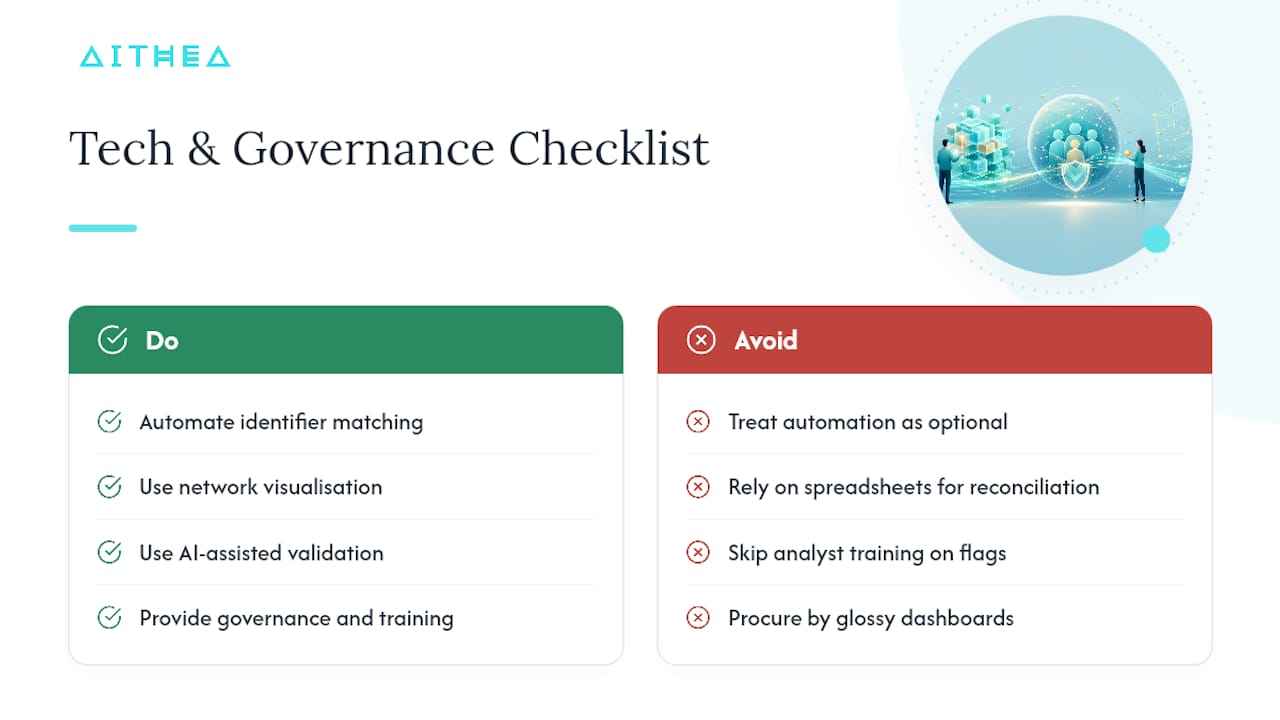
Automated identifier matching and network visualisation do something a spreadsheet cannot: they surface hidden control chains across dozens of linked entities in minutes rather than days. AI-assisted validation reduces the manual cross-referencing that currently eats analyst time, freeing that time for the judgement calls that actually require a human.
None of this works without governance underneath it. Teams need training on what the automation is actually flagging, and procurement functions need the readiness to evaluate vendors against BODS support rather than glossy dashboards. Aithea's work with organisations navigating this shift centres on exactly that gap, closing the distance between regulatory obligation and the technology capable of meeting it.
— Aneta
Get procurement-ready for beneficial ownership data projects
Compliance teams needing vendor clarity may seek specialized support rather than undergoing a prolonged evaluation cycle. Specialized services focus on matching compliance teams to appropriate BODS-capable technology and guiding the RFP process to improve vendor selection.
Aithea's Heliolus AI compliance technology selection navigator exists for precisely the checklist questions raised above: BODS support, provenance handling, network visualisation and data-protection controls. If your team is drafting an RFP for a beneficial ownership data pipeline or evaluating whether your current registry integration is fit for purpose, get in touch with Aithea to scope the project before you commit to a vendor.
Sources
For the technical schema itself, the BODS documentation on Open Ownership is the primary reference. GOV.UK's guidance covers public-sector adoption, while the Companies House API specification shows live schema fields. US reporting obligations sit with FinCEN's BOI guidance, and broader policy context comes from the World Bank's BOT Working Group. For governance frameworks around making this data operationally usable, Keystone Consulting's roadmap on AI for governance is a useful companion read.
This article is general information, not a substitute for advice from a qualified financial advisor. Consult a qualified financial professional about your own circumstances before acting on anything here.
- Beneficial Ownership Data Standard | Open Ownership
- Gov
- Beneficial Ownership Transparency Working Group | World Bank
- Companies House — corporateEntityBeneficialOwner API
FAQ
What is beneficial ownership data?
It is information identifying the natural persons who ultimately own or control a company, typically through shareholding thresholds, voting rights or the power to appoint directors, as distinct from the legal entities named on incorporation documents.
Do I need to report beneficial ownership information?
Reporting obligations depend on jurisdiction and entity type; in the US, the Corporate Transparency Act requires many companies to file with FinCEN, while UK companies file with Companies House, so check the specific rules for your entity's jurisdiction.
What information is required for a beneficial owner?
Minimum requirements typically include full legal name, identifying documents, jurisdiction, address, the nature and percentage of control held, and the effective date that control began, with sanctions status increasingly required alongside these fields.
Why isn't a public register enough on its own?
Registers are point-in-time snapshots subject to filing delays, so Open Ownership recommends layering registry data with LEI mapping and third-party feeds to track changes and catch indirect control structures.
How does AI help with beneficial ownership data?
Automated tools handle identifier matching, cross-source reconciliation and network visualisation at a scale manual review cannot match, reducing the reconciliation burden on compliance analysts while surfacing hidden or indirect control chains.