

Asset management banking is the part of banking that invests and oversees clients' capital on their behalf, combining portfolio management, custody, and client reporting under a fiduciary duty. As the World Bank Treasury describes it, the function covers managing assets to meet clients' defined objectives, with custody and oversight as integral components. The industry term for this activity is simply "asset management," though you will encounter it described as "investment management" or "fund management" depending on context.
The core elements you should expect from any asset management service in the UK are:
- Discretionary portfolio management: the manager makes investment decisions within agreed parameters without seeking approval for each trade.
- Collective investment vehicles: pooled funds (OEICs, unit trusts) and exchange-traded funds (ETFs) that give individuals access to diversified exposure.
- Custody and fund administration: safekeeping of assets, settlement, and record-keeping.
- Advisory services and client reporting: regular performance, risk, and cost disclosure.
Asset management is distinct from investment banking, which raises capital and advises on transactions, and from retail banking, which takes deposits and lends. Asset management is an agency or fiduciary role: the manager acts in the client's interest, not its own book.
Key takeaways
Asset management banking is a fiduciary function that requires not only sound investment judgement but also auditable governance, transparent cost disclosure, and technology infrastructure capable of meeting FCA supervisory expectations.
| Point | Details |
|---|---|
| Definition and scope | Asset management is an agency role covering portfolio management, custody, and client reporting, distinct from investment banking or retail banking. |
| Fee awareness | Always calculate the total annual cost including OCF, platform fee, and transaction costs, not the management fee alone. |
| Regulatory risk | The FCA has found weak governance and manual evidence processes at smaller managers; these are high-risk liabilities for investor outcomes. |
| Technology as a control | Automated, timestamped audit trails and AI-assisted monitoring are the practical response to FCA expectations on continuous evidence. |
| Aithea's role | Aithea's Heliolus AI directory helps compliance teams identify and procure RegTech tools that close governance and evidence gaps identified by the FCA. |
Table of Contents
- What does asset management banking actually cover?
- Who does what in the asset management ecosystem?
- How does the investment process actually work?
- How are fees structured and what should you watch for?
- What risks do investors face, and how does UK regulation respond?
- How do you choose an asset manager? A practical checklist
- Which products do UK individuals use to access asset management?
- Major asset managers accessible to UK investors
- Tax implications of asset management investments in the UK
- How is asset management performance measured and benchmarked?
- What do client reporting standards require in UK asset management?
- Why technology and regulation are inseparable in asset management
- Closing the compliance gap with the right technology
- Sources
- FAQ
What does asset management banking actually cover?
The scope of services is broader than most individuals realise. Here are the main product and service categories you will encounter:
- Pooled funds (OEICs and unit trusts): The most common retail entry point. Investors buy units in a collective vehicle; the fund manager runs the underlying portfolio. OEICs are the dominant UK structure.
- Exchange-traded funds (ETFs): Index-tracking or thematic funds listed on a stock exchange. Lower cost than active funds and increasingly used in model portfolios and platform accounts.
- Segregated mandates: A bespoke portfolio managed exclusively for one client, typically institutions or high-net-worth individuals. The investor owns the underlying securities directly.
- Model portfolios: A standardised set of allocations managed centrally and replicated across many client accounts via a platform. A cost-efficient middle ground between pooled funds and full segregation.
- Long-Term Asset Funds (LTAFs): A newer UK structure designed to give retail investors access to private markets, infrastructure, and illiquid alternatives within a regulated wrapper.
- Private markets and alternatives: Private equity, private credit, real assets, and hedge funds, typically accessed by institutional or sophisticated investors.
- Custody and fund administration: The operational backbone. A custodian holds assets in safekeeping, settles trades, and maintains the register. Fund administration covers NAV calculation, compliance monitoring, and regulatory reporting.
- Performance and risk reporting: Managers are expected to provide regular, transparent reporting against agreed benchmarks, including cost disclosures under MiFID II and the PRIIPs Regulation.
- Platform wrappers (ISAs and SIPPs): Most UK retail investors access managed funds through a platform that wraps the investment in a tax-efficient account. The platform handles custody, reporting, and transaction processing.
The World Bank's sustainable fixed income impact reporting illustrates how institutional managers integrate ESG metrics into product design and reporting, a practice now filtering into UK retail fund disclosures.
Who does what in the asset management ecosystem?
Understanding who holds each responsibility matters when you are assessing a manager or investigating a problem.
- Discretionary manager: Makes investment decisions and is responsible for portfolio outcomes. Regulated by the FCA under COBS rules.
- Investment committee: The governance body that sets and monitors investment strategy, approves asset allocation ranges, and reviews risk.
- Authorised Fund Manager (AFM): The FCA-authorised entity legally responsible for operating a UK fund. Often the same entity as the investment manager, but not always.
- Custodian: Holds assets in safekeeping, independent of the manager. Reduces the risk of fraud or misappropriation. Major custodians in the UK include large global banks operating prime brokerage and custody divisions.
- Transfer agent: Processes investor subscriptions and redemptions, maintains the shareholder register.
- Distributor: Sells or recommends the fund to end investors, typically a platform, IFA network, or bank branch.
- Adviser: Provides personal recommendations to individual clients, subject to FCA authorisation and suitability obligations.
Bank asset-management divisions typically bundle several of these roles: they may act as AFM, investment manager, and distributor simultaneously. Private banks often add advisory and lending services on top. Independent asset managers, by contrast, tend to focus on investment management and outsource custody and administration to specialist third parties.
Pro Tip: When multiple roles sit within one group, ask specifically how conflicts of interest are managed. Group cross-selling, where a bank's asset-management arm recommends the bank's own products, is a known conflict. Look for a written conflicts policy and evidence that the investment committee operates independently of distribution.
Professional standards in the sector are anchored by qualifications such as the CFA programme and the IAM Certificate, which set expectations for analytical rigour and fiduciary conduct.
How does the investment process actually work?
From idea to client report, the process follows a structured sequence. Here is how a typical global equity mandate moves through the cycle:
- Investment research and idea generation: Analysts evaluate macroeconomic conditions, sector dynamics, and individual securities using data terminals (Bloomberg, Refinitiv), proprietary models, and third-party research. AI-assisted screening tools are increasingly used to surface signals across large universes.
- Asset allocation: The investment committee sets top-down allocation ranges across asset classes, geographies, and sectors. Strategic asset allocation is reviewed periodically; tactical tilts respond to market conditions.
- Security selection: Portfolio managers choose specific instruments within each allocation bucket, guided by research outputs, risk budgets, and mandate constraints.
- Order generation and pre-trade compliance: Before execution, orders pass through a compliance engine that checks against mandate restrictions, regulatory limits (e.g. UCITS concentration rules), and sanctions lists. Order Management Systems (OMS) such as Charles River or Aladdin automate this step.
- Execution: Trades are routed via an Execution Management System (EMS) to brokers or electronic venues. Best execution obligations under MiFID II require firms to demonstrate they achieved the best available outcome.
- Post-trade processing and custody: Trades settle through central counterparties (CCPs) and are recorded by the custodian. Reconciliation between the OMS, custodian, and fund administrator runs daily.
- Performance and risk monitoring: Portfolio risk tools (factor models, VaR engines) run continuously. Portfolio managers review attribution daily; the risk team monitors against mandate limits.
- Client reporting: Periodic reports covering performance, attribution, risk metrics, costs, and ESG data are generated from reporting engines and delivered to clients.
Operational resilience requirements are now shaping how firms build these systems. Servnet UK's guidance notes that segregating order-execution systems and embedding resilience testing into development pipelines materially reduces the cost of demonstrating recovery to supervisors.
How are fees structured and what should you watch for?
Fees in asset management are layered, and the total cost to an investor is often higher than the headline management fee suggests.
Common fee types:
- Annual Management Charge (AMC) / Management fee: The base fee charged by the investment manager, expressed as a percentage of AUM.
- Total Expense Ratio (TER) / Ongoing Charges Figure (OCF): The all-in cost of running the fund, including the AMC, administration, custody, and audit fees. The OCF is the figure disclosed in a KIID or PRIIP KID.
- Performance fee: An additional charge, typically 10–20% of outperformance above a hurdle rate or benchmark. Common in hedge funds and some alternative strategies.
- Platform fee: Charged by the investment platform (e.g. a SIPP or ISA wrapper provider) for custody, administration, and access.
- Transaction costs: Dealing spreads, stamp duty (0.5% on UK equities), and broker commissions. These are disclosed separately under MiFID II cost transparency rules.
When reading a KIID or PRIIP KID, focus on the OCF rather than the AMC alone. Check whether transaction costs are shown separately; under MiFID II they must be. For discretionary mandates, ask for a single all-in cost figure in pounds, not just percentages, so you can compare across providers.
Always model the total cost, not the fund fee alone.*
What risks do investors face, and how does UK regulation respond?
Core investor risks
- Market risk: The value of investments falls due to price movements in equities, bonds, currencies, or commodities.
- Liquidity risk: The fund cannot sell assets quickly enough to meet redemptions, particularly relevant for property funds, LTAFs, and some credit strategies.
- Counterparty and custody risk: The custodian or a counterparty fails. UK regulation requires asset segregation to mitigate this, but operational failures remain a residual risk.
- Operational and cyber risk: System failures, data breaches, or process errors affect settlement, reporting, or client assets. Cyber threats are an escalating concern across financial services.
- Conflicts of interest and conduct risk: The manager acts in its own interest rather than the client's, whether through fee structures, cross-selling, or poor execution practices.
The UK regulatory framework
The FCA is the primary regulator for asset management in the UK. The PRA supervises systemically important deposit-takers and insurers that may have asset-management subsidiaries. Key frameworks include:
- FCA COBS rules: Govern suitability, best execution, and client communications.
- Consumer Duty (2023): Requires firms to demonstrate good outcomes for retail clients, with evidence of suitability and value at every stage of the customer journey.
- SM&CR: Senior Managers and Certification Regime holds named individuals accountable for specific regulated activities and governance failures.
- AIFMD and UCITS: European-origin frameworks retained in UK law post-Brexit, governing fund structures, leverage, and investor protections.
What the FCA has actually found
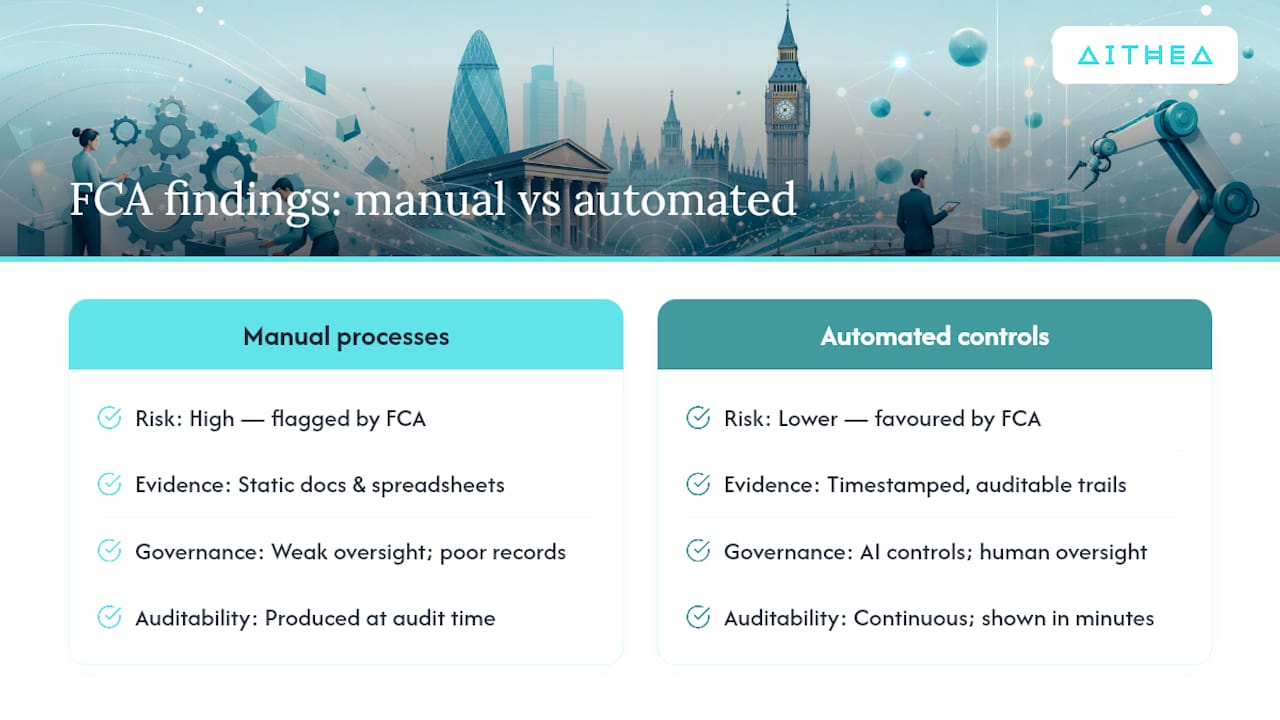
The FCA's review of smaller asset managers and alternatives firms identified weak governance arrangements and manual evidence processes as high-risk liabilities for investor outcomes and supervisory confidence. Specific findings included inadequate oversight of appointed representatives, insufficient documentation of investment decision rationale, and over-reliance on spreadsheets for compliance monitoring.
The FCA's wholesale buy-side priorities report extends these concerns to larger firms, setting explicit expectations on governance quality, valuation transparency, operational resilience, and third-party oversight. The message is consistent: regulators expect continuous, auditable evidence of control effectiveness, not static documents produced at audit time.
The technology implication is direct. Industry analysis warns of a "technology gap" between firms' high-level AI plans and their practical control frameworks, recommending operating-model changes that link AI use to regulatory duties and auditability. Meanwhile, Buzzacott's commentary on FCA AI expectations is clear: firms must maintain human accountability, embed AI governance, and treat AI deployment as a resilience issue with appropriate oversight and testing.
Firms that use technology to automate Consumer Duty evidence — timestamped suitability assessments, structured annual reviews, automated client outcome monitoring — are better placed than those relying on compliance teams alone to produce retrospective documentation.
Pro Tip: When assessing a manager's controls, ask specifically: "Can you show me a timestamped audit trail of a recent investment decision, including who approved it and what evidence was reviewed?" A manager that cannot produce this within minutes is likely relying on manual processes the FCA has already flagged as high risk.
How do you choose an asset manager? A practical checklist
- Clarify your objectives and time horizon before comparing managers. A manager strong in liquid equities may be a poor fit for a client seeking income or capital preservation.
- Assess fees on a total-cost basis. Request the all-in annual cost in pounds, including management, platform, and transaction charges.
- Examine track record against the stated benchmark, not just absolute returns. Consistent outperformance after fees over a full market cycle matters more than a single strong year.
- Review governance and conflicts of interest. Who sits on the investment committee? Is the compliance function independent? Does the firm have a written conflicts policy?
- Understand custody arrangements. Who holds your assets? Is the custodian independent of the manager? What happens to your assets if the manager fails?
- Evaluate reporting quality. Do reports show performance attribution, risk metrics, and costs clearly? Are they produced on a regular, predictable schedule?
- Check liquidity terms. For funds, what are the redemption notice periods? For mandates, how quickly can you exit?
- Verify FCA authorisation. Check the FCA Register before committing capital.
Questions worth asking in a meeting:
- "Who signs off investment decisions, and how is that documented?"
- "How do you evidence Consumer Duty outcomes for clients like me?"
- "What third-party vendors do you rely on, and how do you oversee them?"
Red flags to watch for:
- Inconsistent or delayed reporting with no clear explanation.
- Vague answers about who owns oversight of third-party vendors.
- No written conflicts policy or an investment committee that includes distribution staff.
- Reliance on spreadsheets for compliance monitoring or portfolio risk.
- Missing or incomplete audit trails for investment decisions.
Which products do UK individuals use to access asset management?
| Product | Typical investor suitability | Liquidity |
|---|---|---|
| Active OEIC / unit trust | Broad retail; growth or income objectives | Daily dealing (T+3 settlement) |
| ETF | Cost-sensitive; passive or thematic exposure | Intraday on exchange |
| Segregated mandate | High-net-worth; bespoke objectives | Negotiated; usually flexible |
| Model portfolio (platform) | Mid-market; standardised risk profiles | Daily dealing via platform |
| LTAF | Sophisticated retail; long-term illiquid exposure | Quarterly or longer redemption windows |
| SIPP (pension wrapper) | Long-term retirement savings; tax-deferred growth | Accessible from standard pension age |
| Stocks and Shares ISA | Annual allowance of £20,000; tax-free growth and income | Daily dealing for most funds |
Tax wrappers and how they interact with asset management:
- A Stocks and Shares ISA shelters investment returns from Income Tax and Capital Gains Tax. The annual subscription limit is £20,000. Most platforms allow you to hold funds, ETFs, and investment trusts within an ISA.
- A SIPP provides tax relief on contributions at your marginal rate and shelters growth from tax. Withdrawals are taxed as income. SIPPs are the primary vehicle for long-term, managed pension assets.
- Outside wrappers, gains above the annual CGT exempt amount are taxable, and income from funds is subject to Income Tax. Choosing the right wrapper before selecting a manager or fund is therefore a material decision.
For most retail investors, the practical route to managed exposure is a platform ISA or SIPP holding a model portfolio or a range of funds. Segregated mandates become relevant at higher asset levels where bespoke objectives justify the additional cost.
Major asset managers accessible to UK investors
These are widely known groups that UK investors commonly encounter. They are listed as pointers for further research, not as endorsements or a ranked comparison.
- BlackRock / iShares: The world's largest asset manager by AUM, best known for its iShares ETF range and multi-asset solutions.
- Vanguard: Known for low-cost index funds and ETFs; strong presence in UK retail platforms.
- Legal & General Investment Management (LGIM): One of the UK's largest managers, with particular strength in index strategies, liability-driven investment, and responsible investment.
- Schroders: A major UK-headquartered active manager with broad capabilities across equities, fixed income, and private assets.
- abrdn: UK-based manager with strengths in multi-asset, alternatives, and emerging markets.
- Fidelity International: Active manager with a large UK retail platform and broad fund range.
- M&G Investments: UK-based, with heritage in fixed income and multi-asset; part of M&G plc.
- Ninety One: Active manager with a focus on emerging markets and sustainable strategies.
When researching any manager, check their AUM as a scale indicator, review their FCA Register entry, and look for published governance and stewardship disclosures. AUM alone does not indicate quality, but it does signal operational scale and the resources available for risk management and technology investment.
Tax implications of asset management investments in the UK
Tax treatment depends on the wrapper, the asset class, and the investor's personal circumstances. The key taxes affecting UK investors in managed portfolios are:
Capital Gains Tax (CGT): Gains realised on the disposal of fund units or shares outside an ISA or SIPP are subject to CGT. The annual exempt amount has been reduced significantly in recent years. Always verify current rates with HMRC or a qualified tax adviser.
Income Tax: Dividends and interest distributed by funds are taxable as income outside a wrapper. The dividend allowance and personal savings allowance provide some relief, but both have been reduced. Income from bond funds is typically taxed as interest; income from equity funds as dividends.
ETFs listed on a recognised exchange are generally exempt, which is one reason ETFs are structurally cheaper than direct equity investment for retail investors.
Inheritance Tax (IHT): Assets held in a SIPP currently fall outside the estate for IHT purposes, though proposed changes announced in the 2024 Autumn Statement would bring pension assets into scope from April 2027. This is a material planning consideration for investors using SIPPs as intergenerational wealth vehicles.
Using tax wrappers efficiently is one of the most straightforward ways to improve net returns from asset management. A financial adviser or tax specialist can help you model the interaction between wrapper choice, asset class, and your personal tax position.
How is asset management performance measured and benchmarked?
Performance measurement in UK asset management follows a structured methodology, with the CFA Institute's Global Investment Performance Standards (GIPS) providing the internationally recognised framework for calculating and presenting returns.
Key metrics used by UK managers:
- Total return: The combined effect of capital growth and income, expressed as a percentage over a defined period.
- Benchmark-relative return (alpha): Performance above or below the stated benchmark index (e.g. FTSE All-Share, MSCI World). Alpha measures the manager's value added net of the benchmark.
- Information ratio: Alpha divided by tracking error. A higher ratio indicates more consistent outperformance per unit of active risk taken.
- Sharpe ratio: Return above the risk-free rate divided by the portfolio's standard deviation. Used to compare risk-adjusted returns across different strategies.
- Maximum drawdown: The largest peak-to-trough decline over a period. Relevant for investors with capital preservation objectives.
Benchmarks matter because they define the reference point against which a manager's skill is judged. A manager running a UK equity mandate should be benchmarked against a UK equity index, not a global one. Mismatched benchmarks are a known way to make performance look better than it is.
The FCA's Consumer Duty requires firms to demonstrate that charges represent fair value relative to outcomes. This is pushing managers to be more explicit about what benchmark they use, why, and whether performance fees are triggered by genuine outperformance or simply by rising markets.
What do client reporting standards require in UK asset management?
Client reporting in the UK is governed by a combination of FCA rules, MiFID II obligations (retained in UK law), and Consumer Duty expectations. The minimum standards for retail clients include:
- Pre-sale disclosure: A PRIIP KID (Key Information Document) or UCITS KIID must be provided before investment, covering objectives, risks, costs, and past performance.
- Periodic reporting: Firms must provide at least annual statements covering portfolio value, performance, and costs. Discretionary managers must report when the portfolio falls by 10% or more from the previous reporting period.
- Cost and charges disclosure: Total costs, broken down by component, must be disclosed in cash terms as well as percentages under MiFID II cost transparency rules.
- ESG and sustainability disclosure: Funds making sustainability claims must comply with the FCA's Sustainability Disclosure Requirements (SDR) and use the correct labelling regime. Greenwashing is an active FCA enforcement priority.
Beyond the regulatory minimum, leading managers are moving towards continuous digital reporting, where clients can access real-time portfolio data, attribution, and risk metrics through a portal. This shift is partly driven by Consumer Duty's emphasis on demonstrable good outcomes and partly by client expectations shaped by consumer technology.
The operational challenge is that producing consistent, accurate, and timely reports at scale requires integrated data architecture. Firms that rely on manual data extraction and spreadsheet-based report production face both accuracy risk and the supervisory scrutiny the FCA has already directed at manual evidence processes.
Why technology and regulation are inseparable in asset management
The FCA's findings are not abstract supervisory concerns. They describe a real operational gap that affects investor outcomes directly. When a manager cannot produce a timestamped audit trail of an investment decision, it cannot demonstrate to a regulator, a client, or a court that the decision was made in the client's interest. That is not a paperwork problem; it is a governance failure with material consequences.
What the FCA's smaller asset managers review and the wholesale buy-side priorities report together reveal is a sector where ambition often outpaces infrastructure. Firms adopt AI tools for research or client communication without building the governance layer that makes those tools auditable. The technology gap identified by industry analysts is not about capability; it is about the absence of a compliance overlay that logs human sign-offs, captures decision rationale, and retains evidence in a form supervisors can interrogate.
For individual investors, this matters because the quality of a manager's operational infrastructure is a proxy for the quality of its fiduciary conduct. A firm that cannot evidence its process is a firm you cannot hold accountable.
Closing the compliance gap with the right technology
Asset management firms facing FCA scrutiny on governance and evidence quality have a clear operational priority: convert regulatory obligations into continuous, auditable proof. That means timestamped audit trails for investment decisions, AI-assisted monitoring of portfolio and conduct risks, and structured vendor oversight that does not rely on manual checklists.

Aithea helps asset management firms and compliance teams navigate exactly this challenge. Through technology matchmaking, RFP support, and compliance education, Aithea connects firms with the RegTech tools that close the gaps the FCA has identified, without the guesswork of evaluating a fragmented vendor market alone. Heliolus AI is Aithea's AI-powered RegTech directory, built to help compliance professionals identify, evaluate, and procure the right technology for their specific regulatory obligations, from Consumer Duty evidence to operational resilience.
This section describes a service offering, not regulatory advice. Firms should conduct their own due diligence and seek qualified legal or regulatory counsel for specific compliance questions. To explore how Aithea can support your technology procurement, get in touch with the team.
Sources
- Smaller asset managers and alternatives business model review – our findings | FCA
- FinregE warns UK AI plan needs stronger bank controls | IT Brief
- Asset Management | World Bank Treasury
This article is general information, not a substitute for advice from a qualified financial advisor. Consult a qualified financial professional about your own circumstances before acting on anything here.
FAQ
What is an asset management bank?
An asset management bank, or a bank with an asset management division, is a financial institution that manages investment portfolios on behalf of clients under a fiduciary duty, combining portfolio management, custody, and reporting. It differs from a retail bank (which takes deposits and lends) and an investment bank (which raises capital and advises on transactions).
Who are the largest asset managers accessible to UK investors?
BlackRock, Vanguard, Legal & General Investment Management, Schroders, and Fidelity International are among the largest and most widely accessible. Each has a distinct focus: BlackRock and Vanguard are dominant in index and ETF strategies, while Schroders and Fidelity are known for active management.
What are the main fee types in UK asset management?
The principal fees are the Ongoing Charges Figure (OCF), which covers the all-in annual fund cost; performance fees charged on outperformance; platform fees for custody and administration; and transaction costs including dealing spreads and stamp duty. Always request a total annual cost figure in pounds, not percentages alone.
Does HSBC offer asset management services?
HSBC operates an asset management division, HSBC Asset Management, which manages funds and mandates for institutional and retail clients globally, including in the UK. UK retail investors can access HSBC funds through major investment platforms. Check the FCA Register and HSBC Asset Management's own disclosures for current product and governance details.
How does the FCA supervise asset managers in the UK?
The FCA supervises asset managers through conduct rules (COBS), the Consumer Duty, SM&CR accountability requirements, and thematic reviews. Its smaller asset managers review and wholesale buy-side priorities report have both identified governance gaps and manual evidence processes as priority supervisory concerns, with expectations that firms maintain continuous, auditable evidence of control effectiveness.