

AML model validation is the independent process that confirms a quantitative system — a sanctions screening engine, a transaction monitoring model, or a risk-scoring tool — is fit for its intended purpose and produces reliable, auditable results. For fintechs, payment providers, and wallet operators, that definition carries immediate operational weight. Examiners are no longer satisfied with a policy document; they want evidence that the model has been tested, challenged, and monitored by someone who did not build it.
The April 2026 interagency guidance (OCC Bulletin 2026-13) formalised what supervisors had been signalling for years: effective challenge is non-negotiable, and risk-based validation principles apply across institutions, not only the largest banks. SR 11-7 principles remain the conceptual backbone, and the SR 26-02 supervisory annex sets out the three pillars every validator must address: conceptual soundness, outcomes analysis, and ongoing monitoring. The FDIC’s revised guidance adds that model inventories, validation reports, and documented governance are now examiner expectations, not aspirational best practice. In Europe, the EBA’s model validation framework and MAS’s 2024 thematic review on AI model risk set parallel expectations for firms operating across EU jurisdictions and Asia-Pacific.
Industry reporting confirms a clear shift in 2025-2026: examiners have moved from headline bank fines toward scrutinising the detection systems themselves. That shift hits fintechs and payment providers hardest, because many operate vendor-supplied black-box screening tools with little documented validation behind them.
Examiner-ready checklist for sanctions screening models:
-
Confirm whether the system qualifies as a model (quantitative method, statistical element, or algorithmic decisioning) rather than a simple lookup tool
-
Document the model’s purpose, intended use-cases, and permitted limitations in a model card or equivalent artefact
-
Complete a conceptual soundness review covering inputs, feature selection, thresholds, and fuzzy-matching logic
-
Run data integrity checks across sanctions list feeds, PEP data, and field mapping
-
Conduct outcomes analysis: above-the-line alert testing and below-the-line near-miss review
-
Produce a monitoring plan with defined alert-volume thresholds, drift metrics, and escalation rules
-
Confirm independence: the validator must be separate from the model owner
-
Issue a formal validation report with a rating, open findings, and a remediation timeline
Pro Tip: Within 24-72 hours of reading this, pull your model inventory and confirm every sanctions screening system has a documented model purpose and a named model owner. That single artefact is the first thing an examiner requests, and its absence signals systemic weakness across the whole programme.
Key takeaways
Effective AML model validation requires documented independence, outcomes testing that goes below the alert line, and a risk-tiered monitoring plan that treats political disruption as a trigger for revalidation, not just a list update.
| Point | Details |
|---|---|
| Model identification is the first step | Confirm whether each system qualifies as a model under the 2026 interagency definition before assigning a validation scope. |
| Outcomes analysis must include near-miss testing | Below-the-line sampling using typology scenarios is the test most programmes skip and examiners most often flag. |
| Independence cannot be waived for size | Fintechs without internal capacity should use a hybrid or fully outsourced model to satisfy the effective-challenge requirement. |
| Political disruption is a revalidation trigger | Rapid sanctions list changes since 2022 mean institutions need a documented process for assessing whether a geopolitical event requires out-of-cycle revalidation. |
| Aithea supports the full validation cycle | From model inventory creation to exam-ready validation reports and AI governance embedding, Aithea provides the combined AML and model risk expertise most fintechs cannot build internally. |
Table of Contents
-
Outcomes analysis and performance testing for AML and sanctions models
-
Ongoing monitoring, triggers, and risk-based revalidation frequency
-
Independence, effective challenge, and governance accountabilities
-
Validating vendor and proprietary third-party sanction screening solutions
-
AI, machine learning, and generative models: extra validation tasks
-
A step-by-step validation workflow for sanctions screening models
-
Resourcing, skills, and cost drivers for a validation programme
-
Aithea’s support for validation-ready sanctions screening programmes
How to assess conceptual soundness in AML model validation
The first question a validator must answer is whether the system under review actually qualifies as a model. Under the 2026 interagency guidance, a model is any quantitative method, system, or approach that applies statistical, economic, financial, or mathematical theories to transform inputs into outputs used for decision-making. A static watchlist lookup with no scoring or ranking logic sits outside that definition. A fuzzy-matching engine that assigns match scores, or a transaction monitoring system that applies risk weightings to generate alerts, sits firmly inside it. For fintechs and payment providers, this distinction matters because it determines the validation burden: tools require less formal governance than models, but misclassifying a model as a tool is itself an exam finding.
Once a system is confirmed as a model, the conceptual soundness review examines whether its design is appropriate for the institution’s products, customers, and risk profile. A wallet provider serving cross-border remittances faces a different typology mix than a domestic card issuer, and the model’s segmentation, thresholds, and feature set should reflect that.
Design review checklist for sanctions screening models:
-
Inputs and data sources: are all sanctions lists (OFAC SDN, EU Consolidated List, UN list, HMT) ingested with documented update cadence?
-
Feature selection: does the model use name, date of birth, nationality, address, and entity identifiers in a documented and defensible way?
-
Fuzzy-matching logic: is the algorithm (Jaro-Winkler, Levenshtein, phonetic matching) appropriate for the language and script coverage required?
-
Thresholds: are match-score cut-offs documented, tested, and approved by a model risk committee?
-
Decisioning pipeline: is the end-to-end alert-generation and disposition workflow mapped?
-
Fallback rules: what happens when a vendor component returns no result or an error?
-
Vendor black-box components: is there a documented explanation of what the vendor’s algorithm does, even if source code is unavailable?
Documenting assumptions and limitations is where many fintechs fall short. Examiners expect a model card or architecture diagram that states, explicitly, what the model does not cover. A model designed for individual name screening that is also applied to corporate entity screening without reconfiguration is operating outside its documented scope, and that gap will surface in a review.
Evidence to collect during data integrity checks:
-
Completeness: confirm all required sanctions lists are loaded and no entries are missing
-
Timeliness: verify the lag between a list update and ingestion into the screening system
-
Field mapping: confirm that customer data fields map correctly to the screening engine’s expected inputs
-
Enrichment feeds: validate PEP list sources, adverse media feeds, and their update frequency
-
False positive handling: document the process for reviewing and dispositioning false positives, including typology-shift scenarios
Outcomes analysis and performance testing for AML and sanctions models
Conceptual soundness tells you whether the model is designed correctly. Outcomes analysis tells you whether it actually works. These are different questions, and both require documented evidence.
Above-the-line testing examines the alerts the model generates: are they accurate, proportionate, and correctly prioritised? Below-the-line testing is harder and more revealing. It asks what the model missed. For sanctions screening, a below-the-line review involves sampling transactions or customers that did not generate an alert and checking whether any should have, using investigator adjudications, intelligence flags, or typology-based labelling as a proxy for ground truth.
Core performance metrics for sanctions screening validation:
-
Precision (PPV): of all alerts generated, what proportion are genuine matches? Low precision drives alert fatigue and operational cost
-
Recall (sensitivity): of all true sanctions matches in the population, what proportion did the model catch? Low recall is a regulatory failure
-
F1 score: the harmonic mean of precision and recall, useful when both matter and the population is imbalanced
-
KS statistic / Gini coefficient: measures the model’s ability to rank-order risk; critical for transaction monitoring models that score and prioritise alerts
-
False positive ratio: alerts that close as non-suspicious divided by total alerts; a rising ratio signals threshold miscalibration or data quality degradation
Regulatory signal: The 2021 interagency BSA/AML statement confirmed that institutions remain accountable for the performance of third-party models they deploy. Examiners now expect documented outcomes testing even where the model is vendor-supplied, and FinCEN’s CDD framework ties suspicious activity detection quality directly to the underlying model’s performance.
Building surrogate outcomes is a practical necessity for sanctions screening, where confirmed true positives are rare. Validators can construct labelled datasets using historical enforcement cases, typology scenarios from FATF or the Egmont Group, and investigator adjudications from prior alert reviews. Stratified sampling is important here: because sanctions hits are low-prevalence events, a random sample will contain almost none, making standard accuracy metrics misleading. Sample stratification by risk tier, product line, and geography produces a more honest picture.
When a test fails, the remediation path depends on the failure type. A precision failure usually points to threshold recalibration or improved name-normalisation logic. A recall failure is more serious and may require retraining, additional feature engineering, or a change in the underlying matching algorithm. Both require a documented remediation plan with a timeline and a revalidation trigger.
Ongoing monitoring, triggers, and risk-based revalidation frequency
A validation completed at model deployment is not a validation programme. The SR 26-02 annex is explicit: ongoing monitoring is a core validation component, and its frequency should reflect model materiality and risk. For fintechs and payment providers operating on short release cycles, that principle demands a structured monitoring plan from day one.
Risk-tiered monitoring schedule:
-
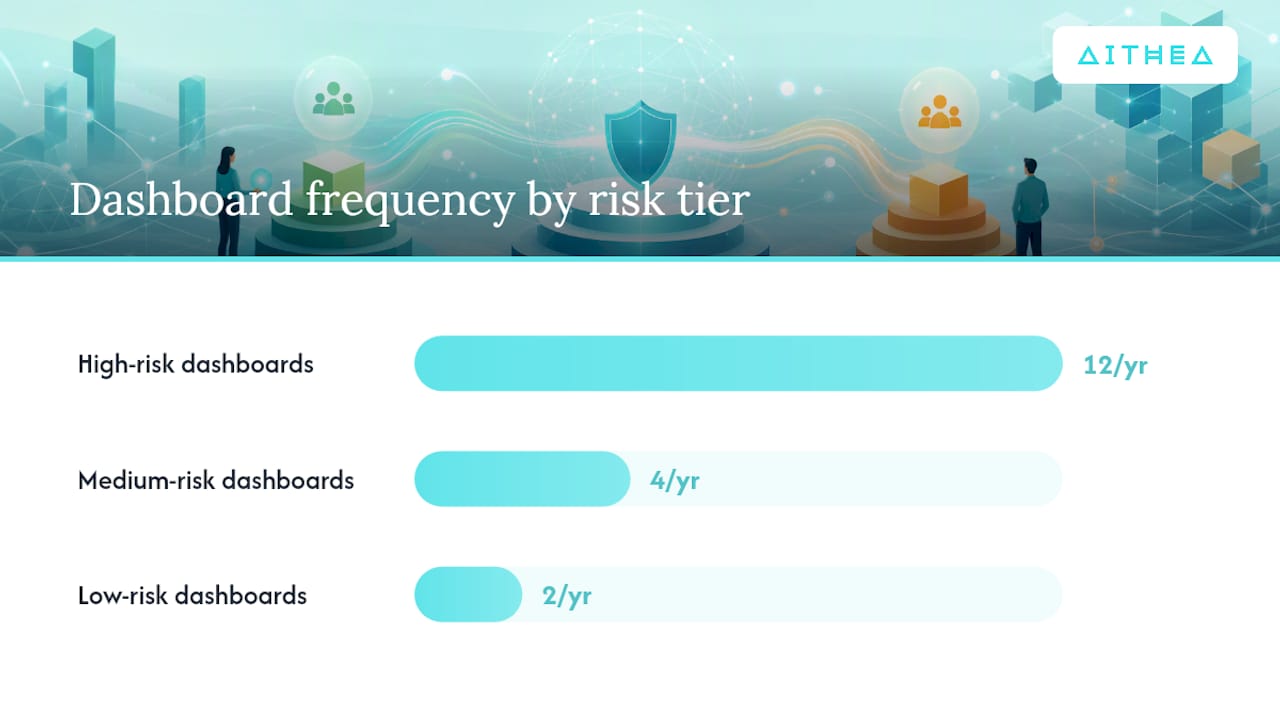
High-risk models (AI/ML components, cross-border payment rails, new product lines): monthly performance dashboards, quarterly targeted reviews, annual independent validation as a minimum floor
-
Medium-risk models (rules-based transaction monitoring with periodic threshold changes): quarterly dashboards, semi-annual reviews, annual independent validation
-
Low-risk rulesets (static rule sets with no ML component and limited product scope): semi-annual dashboards, annual independent validation
Monitoring indicators to track continuously:
-
Alert volume trends (sudden spikes or drops signal data feed or model issues)
-
Disposition rates (proportion of alerts closed as non-suspicious)
-
SAR conversion rate (alerts escalated to suspicious activity reports)
-
False positive ratio over time
-
Model drift metrics for ML models (feature distribution shift, prediction score distribution)
-
Sanctions list feed health: ingestion latency, error logs, and coverage gaps
Event triggers for out-of-cycle revalidation:
-
Merger, acquisition, or significant change in customer base
-
Vendor software upgrade or algorithm change
-
New product launch or entry into a new payment corridor
-
Material change in the political or sanctions environment (new designations, country-level sanctions programmes)
-
Significant deterioration in a monitored performance metric
-
Regulatory finding or internal audit observation relating to the model
The political dimension of trigger four deserves specific attention. The pace of sanctions list changes since 2022 has been unprecedented: OFAC, the EU, HMT, and other authorities have issued designations in rapid succession in response to geopolitical events. A sanctions screening model validated against a list profile from twelve months ago may be materially out of date. Fintechs and wallet providers with exposure to high-risk corridors, cryptocurrency rails, or cross-border remittances need a documented process for assessing whether a major sanctions event triggers revalidation, not just a list update.
Practical timeline for a fintech or wallet provider:
-
Monthly: automated dashboard review of alert volumes, false positive ratio, and feed health
-
Quarterly: targeted performance review against defined thresholds; escalate anomalies to model risk committee
-
Annually: independent validation covering all three pillars; update model card and validation report
-
Event-driven: revalidation scoping within 10 business days of a defined trigger event
Independence, effective challenge, and governance accountabilities
The 2026 interagency guidance is unambiguous: validation must be conducted by staff or parties independent of those who developed and use the model. For a large bank, that means a dedicated model validation unit sitting in the second line. For a fintech with a ten-person compliance team, it means something different in practice, but the principle does not change.
Structural options for smaller fintechs and payment providers:
-
Internal second-line validator: a compliance or risk officer with no involvement in model development or tuning; feasible only where the team has sufficient technical depth
-
Hybrid model: internal scoping and documentation, with an external specialist conducting the technical validation and issuing the formal report
-
Fully outsourced independent validation: a third-party model risk firm conducts the full validation; the institution reviews findings and owns remediation
The FDIC’s revised guidance supports a risk-based approach to resourcing, but it is clear that independence cannot be waived on grounds of size. An examiner who finds that the person who configured the screening thresholds also signed off the validation report will treat that as a governance failure regardless of the institution’s headcount.
Roles and responsibilities:
-
Model owner (first line): develops, configures, and operates the model; produces model documentation and responds to validation findings
-
Validator (second line or independent third party): conducts the independent review, issues the validation report with a formal rating, and tracks remediation
-
Model risk committee: reviews validation reports, approves model use, and escalates material findings to senior management
-
Senior management and board: receive periodic model risk reporting; approve risk appetite for model use and validation frequency
What qualifies as effective challenge:
-
Documented critiques of the model’s design assumptions, not just a sign-off
-
Re-performance of key calculations or tests independently of the model owner’s outputs
-
Alternative benchmarking: comparing the model’s outputs against a different approach or a challenger model
-
Escalation records showing that findings were raised, tracked, and resolved with management sign-off
Governance artefacts examiners expect:
-
A model inventory listing every model, its risk tier, owner, last validation date, and next scheduled review
-
Validation reports with a formal rating (pass, conditional pass, fail) and open findings
-
Remediation plans with named owners and target dates
-
Model risk committee minutes showing that findings were discussed and decisions recorded
Validating vendor and proprietary third-party sanction screening solutions
Most fintechs and payment providers do not build their own sanctions screening engines. They buy them. That commercial reality does not reduce the validation obligation: the 2021 BSA/AML interagency statement is explicit that institutions remain accountable for third-party model performance. Examiners will not accept “the vendor said it works” as a validation.
Due diligence checklist before procurement:
-
Model description document: what algorithm does the vendor use, and what are its documented limitations?
-
Data provenance: which sanctions lists are covered, and what is the update cadence for each?
-
Change management: how does the vendor notify clients of algorithm changes, and what is the SLA for accuracy restoration after a list update?
-
Explainability artefacts: can the vendor produce match-score explanations at the individual alert level?
-
Audit access: does the contract permit the institution to conduct or commission an independent technical review?
-
Remediation commitments: what are the vendor’s obligations if a validation finds material deficiencies?
Validation tactics for vendor black-box systems:
-
Interface testing: submit known test cases (confirmed sanctions matches, near-misses, and clean records) and document whether the system responds correctly
-
Output benchmarking: compare the vendor system’s outputs against a reference dataset or an alternative screening tool on the same population
-
Historical back-testing: run the system against historical transaction or customer data where outcomes are known
-
Overlay and adjustment layers: where the vendor score is insufficient, document any internal adjustment logic and validate that separately
Pro Tip: When requesting a vendor validation pack, ask for: (1) the model description document, (2) a sample of test cases used in the vendor’s own quality assurance, (3) the last three sanctions list update logs with ingestion timestamps, (4) a sample match-score explanation for five alerts, and (5) the change management log for the past twelve months. Vendors who cannot supply these within two weeks are signalling a documentation gap that will become your exam finding.
For sanctions compliance technology selection, Aithea’s Heliolus navigator provides structured due diligence frameworks that map vendor capabilities against these validation requirements before procurement, reducing the risk of inheriting an unvalidatable black box.

AI, machine learning, and generative models: extra validation tasks
Traditional rules-based sanctions screening is giving way to ML-driven name matching, graph analytics for network detection, and, increasingly, generative or agentic AI for alert narrative drafting and case prioritisation. Each step up the AI complexity ladder adds validation tasks, not replaces them.
The 2026 interagency guidance confirms that traditional validation principles apply to most models, but supervisors expect higher governance for generative and agentic AI. MAS’s 2024 thematic review observed that embedding validation early in the development lifecycle and documenting runtime authorisations and human oversight triggers makes AI deployments materially more defensible to supervisors. The EBA’s model validation expectations for European firms apply the same logic across EU jurisdictions.
Additional validation tasks for AI and ML models:
-
Explainability checks: can the model produce a feature importance ranking or a decision-level explanation for each alert? SHAP values and LIME are common approaches for tree-based and neural models
-
Bias and fairness checks: does the model perform consistently across customer segments, nationalities, and name scripts? Disparate performance by demographic group is both a regulatory and reputational risk
-
Stress tests: how does the model perform when input data quality degrades, when a new sanctions list is added mid-cycle, or when transaction volumes spike?
-
Adversarial scenario testing: can the model be fooled by common evasion techniques (name transliteration, entity structuring, layering through multiple wallets)?
-
Data lineage and reproducibility: can the training dataset be reconstructed, and can the model’s outputs be reproduced from a given checkpoint?
-
Hyperparameter change logs: every change to model configuration must be logged, dated, and linked to a revalidation assessment
Operational controls for AI in sanctions screening:
-
Human-in-the-loop rules: define which alert types or risk scores require human review before a decision is taken
-
Escalation triggers: set thresholds at which the model’s output is automatically escalated to a senior analyst or compliance officer
-
Tamper-proof audit trails: every model decision, override, and disposition must be logged in a way that cannot be altered retrospectively
-
Continuous monitoring for model degradation: track prediction score distributions and feature importance stability over time
For teams evaluating agentic AI in compliance workflows, the governance requirements are more demanding still: runtime authorisation controls and documented human oversight triggers are the minimum bar MAS and other supervisors expect.
Pro Tip: *For audit-ready explainability, produce a one-page “decision rationale” template for each AI-generated alert that captures: the top three features driving the score, the threshold applied, the human reviewer’s disposition, and the timestamp.
A step-by-step validation workflow for sanctions screening models
The sequence below reflects the three-pillar structure in the SR 26-02 annex and is calibrated for fintechs and payment providers where release cycles are short and product changes are frequent.
-
Scoping and inventory (Week 1, second line): confirm the model is in the inventory, assign a risk tier, identify the model owner, and define the validation scope and objectives
-
Conceptual soundness review (Weeks 2-3, validator): review model documentation, architecture diagrams, and model card; assess design appropriateness for the institution’s risk profile
-
Data integrity checks (Week 3, data engineer + validator): validate sanctions list feeds, field mapping, enrichment sources, and ingestion timeliness
-
Technical testing (Weeks 4-5, validator): above-the-line alert testing, below-the-line near-miss sampling, and statistical performance metrics
-
Outcomes analysis (Week 5, validator): calculate precision, recall, F1, and KS/Gini; document findings and compare against pre-defined performance thresholds
-
Governance sign-off (Week 6, model risk committee): present validation report with formal rating; agree remediation plan and timeline
-
Monitoring plan activation (Week 6 onwards, first line + second line): implement dashboard, define escalation triggers, and schedule next review
| Validation step | Required output | Typical artefact | Owner |
|---|---|---|---|
| Scoping and inventory | Risk tier and scope document | Model inventory entry | Second line |
| Conceptual soundness | Design assessment | Model card, architecture diagram | Validator |
| Data integrity | Feed validation log | Data quality report | Data engineer + validator |
| Technical testing | Test results with pass/fail | Back-test summary, test case log | Validator |
| Outcomes analysis | Performance metrics | Metrics report with KS/Gini, PPV, recall | Validator |
| Governance sign-off | Formal validation report | Validation report with rating | Model risk committee |
| Monitoring plan | Ongoing monitoring schedule | Dashboard specification, trigger log | First line + second line |
For fintechs on rapid release cycles, the key adaptation is to decouple the monitoring plan from the annual validation cycle. A model that receives a configuration change mid-year should trigger a scoping assessment within five business days, with a decision on whether a full or partial revalidation is required. Documenting that decision, even when the conclusion is “no revalidation needed,” is itself an exam-ready artefact.
Resourcing, skills, and cost drivers for a validation programme
Validation is not cheap, and pretending otherwise leads to under-resourced programmes that fail at the first examiner visit. The honest picture is that a full independent validation of a complex ML-based sanctions screening model, including data work and outcomes analysis, can take four to eight weeks of specialist effort. A simpler rules-based system may take two to three weeks.
Core skill sets required:
-
Statisticians or data scientists for outcomes analysis, metric calculation, and ML model review
-
Model validators with AML subject-matter expertise who understand typologies and screening logic
-
Data engineers to validate feed integrity, field mapping, and data lineage
-
Legal and compliance oversight to confirm the validation scope aligns with regulatory expectations
Cost drivers:
-
Model complexity: an ML model costs significantly more to validate than a static ruleset
-
Validation frequency: high-risk models validated quarterly cost more than annual reviews
-
Scope of data work: poor data documentation increases the time required for integrity checks
-
Vendor support: a vendor who provides full documentation reduces external validation cost; one who does not increases it materially
-
External validation fees: specialist independent validators command market rates that reflect the scarcity of combined AML and model risk expertise
Resourcing models and their trade-offs:
-
Internal model validation unit: highest control and institutional knowledge; requires sustained investment in specialist hiring and training; rarely feasible for fintechs below a certain scale
-
Hybrid model: internal compliance team handles scoping, documentation, and monitoring; external specialist conducts the technical validation and issues the report; balances cost and independence
-
Fully outsourced: fastest to stand up; highest per-engagement cost; appropriate for institutions without internal technical depth or for one-off revalidations
Ways to control cost without compromising quality:
-
Risk-tier the model inventory and focus intensive validation effort on high-risk models
-
Build reusable testing frameworks and test case libraries that can be applied across model reviews
-
Automate monitoring dashboards so that ongoing performance tracking does not require manual analyst time
-
Negotiate contractual clauses with vendors that require them to provide validation artefacts, reducing the data work burden on the institution
What examiners actually find, and how to fix it fast
Three findings appear in almost every sanctions screening validation that has not been actively managed. The first is a missing or incomplete model inventory. Institutions know they have a screening tool; they cannot always say who owns it, when it was last validated, or what risk tier it sits in. The fix is straightforward: a spreadsheet with seven columns (model name, owner, risk tier, last validation date, next review date, validation status, open findings) is sufficient to start. It is not elegant, but it is what an examiner wants to see.
The second is weak outcomes analysis. Many institutions can show that their screening tool generates alerts. Few can show that it catches what it should catch. Below-the-line testing is the gap: most validation programmes test what the model does, not what it misses. Investing one week in a structured near-miss review, using typology scenarios from FATF guidance or historical enforcement cases, produces evidence that is genuinely differentiating in an exam.
The third is insufficient independence. The compliance officer who configured the screening thresholds cannot also be the person who signs off the validation. In a small fintech, that can feel like an impossible constraint. The practical answer is a hybrid model: internal documentation and scoping, with an external specialist issuing the formal report and rating. That structure satisfies the independence requirement without requiring a dedicated internal validation team.
Speed matters in fintech product cycles, but it is not an excuse for skipping validation. The smarter approach is to build validation into the product release process: a model change triggers a scoping assessment, and the scoping assessment determines whether a full revalidation or a targeted review is proportionate. Documenting that decision, with the rationale, is itself the audit trail an examiner needs.
Aithea’s support for validation-ready sanctions screening programmes
Compliance teams facing their first formal model validation, or those who have received an examiner finding and need to remediate fast, often lack the combination of AML subject-matter expertise and model risk technical depth that a credible validation requires. That gap is precisely where Aithea operates.
Aithea provides end-to-end support for AML model validation programmes: from building the model inventory and assigning risk tiers, through conducting or commissioning independent technical validation, to producing exam-ready validation reports with formal ratings and remediation roadmaps. For teams evaluating or procuring vendor screening solutions, Aithea’s Heliolus technology selection navigator maps vendor capabilities against validation requirements before a contract is signed, so institutions avoid inheriting an unvalidatable black box. For teams managing the shift to AI-driven screening, Aithea embeds AI governance frameworks aligned with MAS, EBA, and the 2026 interagency guidance. The result is a programme that is defensible to examiners from day one. To discuss your validation priorities, get in touch with the Aithea team directly.
Sources
These are the primary documents to cite in validation reports and management briefings:
When referencing these in a validation report, cite the specific section or principle you are relying on, not just the document title. Examiners notice the difference between a report that engages with the guidance and one that lists it as a footnote.
This article is general information, not a substitute for advice from a qualified financial advisor. Consult a qualified financial professional about your own circumstances before acting on anything here.
FAQ
What is AML model validation?
AML model validation is the independent process of confirming that a quantitative system used for anti-money laundering or sanctions screening is conceptually sound, performs as intended, and is subject to ongoing monitoring. It covers three pillars: conceptual soundness, outcomes analysis, and ongoing monitoring.
What counts as a model under the 2026 interagency guidance?
A model is any quantitative method, system, or approach that applies statistical, economic, or mathematical logic to transform inputs into outputs used for decision-making. A static watchlist lookup is typically a tool; a fuzzy-matching or risk-scoring engine that generates ranked alerts is a model requiring formal validation.
How often should sanctions screening models be validated?
High-risk models, including those with AI or ML components and those covering cross-border payment rails, should be validated independently at least annually, with monthly monitoring dashboards and quarterly targeted reviews. Out-of-cycle revalidation is required when a defined trigger event occurs, such as a major sanctions designation or a vendor algorithm change.
What are the five pillars of AML compliance?
Definitions vary by jurisdiction, but the widely recognised components are: a designated compliance officer, internal policies and controls, an independent audit function, ongoing training, and a customer due diligence programme. Model validation supports the internal controls and audit pillars by providing documented evidence that detection systems work as intended.
What are the most common exam findings in sanctions screening validations?
Examiners most frequently find: an incomplete or missing model inventory, outcomes analysis that tests only above-the-line alerts without near-miss review, and insufficient independence between model owners and validators. Each has a practical remedy, as set out in the practitioner perspective section above.