

Clear an alert backlog by triaging to risk, automating low‑risk closures and running a defended, evidence‑led clearance project rather than throwing headcount at the queue. That is the verdict. Three actions matter more than anything else this week.
- Pause non‑essential rule changes so the backlog stops growing while you assess it.
- Launch a scoped clearance project, separate from business‑as‑usual, with named owners and sign‑off.
- Put risk‑based triage in place so investigators see the highest‑exposure alerts first, not just the oldest.
Pro Tip: Before touching the queue, pull a simple age‑by‑risk matrix. It usually reveals that a small slice of alert types accounts for most of the volume, and that slice is where automation pays off fastest.
Follow this sequence and most teams see measurable clearance within weeks, with a documented trail that satisfies a regulator asking why.
Key Takeaways
Alert backlog management succeeds when risk-based triage, evidence-led automation and a defensible audit trail replace pure headcount increases and first-in-first-out review.
| Point | Details |
|---|---|
| Treat it as a project | Scope, govern and staff backlog clearance separately from daily review work. |
| Triage before automating | Identify the highest-volume, lowest-risk alert types before mass remediation. |
| Pilot on historical data | Re-run rule or triage changes against past alerts to measure impact first. |
| Document every decision | Keep a one-page approval log with rationale, QA results and sign-off for each batch. |
| Set ongoing KPIs | Track backlog by age band, time-to-first-review and false positive rate to prevent recurrence. |
Table of Contents
- What is alert backlog management and why does it matter?
- Why do alert backlogs form in the first place?
- How do you clear an existing alert backlog?
- What technology and automation actually help?
- How do you document backlog clearance for regulators?
- How do you stop the backlog coming back?
- What did an evidence-led pilot actually achieve?
- What compliance transformation leads keep learning the hard way
- Sources
- FAQ
What is alert backlog management and why does it matter?
An alert backlog is any queue of AML or fraud alerts that has not been reviewed, disposed of, or escalated within the timeframe your programme requires. Alert backlog management is the discipline of assessing, triaging, and clearing that queue while keeping a defensible record of every decision. It is not the same as simply working faster.
The regulatory consequence is timeliness. Suspicious Activity Reports have to be filed within statutory windows, and a backlog puts that deadline at risk. The Anti-Money Laundering Act of 2020 pushed institutions toward risk-based AML operations, and regulators increasingly ask not just how many alerts you cleared, but whether you prioritised the right ones first.
Operationally, a backlog degrades everything downstream: model feedback loops stall because nobody is confirming true and false positives, exposures sit unmanaged, and investigators burn out reviewing stale, low-value alerts. Backlogs form when monitoring systems produce excess false positives or teams are understaffed, and the knock-on effect is poor data quality feeding the very models meant to reduce noise.
- Missed or delayed SAR filings
- Weaker detection models due to broken feedback loops
- Analyst attrition from repetitive, low-signal work
Why do alert backlogs form in the first place?
Most backlogs share the same handful of root causes, and diagnosing which one dominates saves months of misdirected effort.
- Noisy detection rules generating high volumes of false positives
- Poor or inconsistent data quality feeding the monitoring system
- Ageing queues reviewed strictly first-in-first-out, burying high-risk alerts under old low-risk ones
- Understaffing relative to alert volume, or staff with the wrong skill mix for the alert types coming in
Treating backlog as a pure staffing problem usually fails because hiring more people to review the same noisy rules just processes bad signal faster. Huron Consulting Group frames this correctly: backlog clearance is an operational design problem, not a headcount problem.
Pro Tip: Run a quick triage before any mass remediation: group open alerts by rule type and risk score, then identify which two or three rule categories generate the highest volume at the lowest average risk. That subset is almost always your fastest, safest reduction opportunity.
How do you clear an existing alert backlog?
Treat backlog clearance as a project, not an extension of daily reviews. Unit21 makes the case plainly: attempting clearance inside business-as-usual almost always fails because the same constraints that created the backlog are still operating.
- Scope and govern. Define what "cleared" means, name an accountable owner, and get sign-off from compliance leadership and, where relevant, the board risk committee.
- Assess and model. Inventory the backlog by age, risk score, and alert type. Estimate the effort per category and flag anything with SAR timing exposure.
- Triage first. Separate clearly benign alert types for batch or auto-disposition, apply escalation rules to high-exposure cases, and leave everything else for standard review.
- Pilot before scaling. Re-run proposed rule or triage changes against historical alerts to measure impact before applying them live. This modelling step is what regulators expect to see documented, not assumed.
- Bring in surge capacity. Temporary redeployment, contractors, or a managed service can absorb volume; allocate first-pass triage to junior analysts and second-pass, high-risk review to senior staff.
| Phase | Duration | Checkpoint |
|---|---|---|
| Scope, inventory and modelling | Weeks 1 to 2 | Governance sign-off, backlog map by risk and age |
| Pilot on historical alerts | Weeks 2 to 4 | QA sample reviewed, impact estimate approved |
| Triage and batch clearance | Weeks 4 to 8 | Weekly clearance rate reported to compliance leadership |
| Steady-state handover | Week 8 onward | KPIs stable, backlog within target age bands |
Pro Tip: Report clearance progress weekly during the project, even internally. A visible cadence is what turns "we cleared a backlog" into "we can show exactly how and why we cleared it" if a regulator asks later.
What technology and automation actually help?
Automation earns its place in backlog management when it removes volume without removing accountability. The core tactics are clustering similar alerts so one decision covers many, automated benign-alert removal, risk-based reprioritisation, and matching alerts to analysts by skill rather than by queue position.

The evidence for this combination is strong: an ML and optimisation framework that clustered alerts, auto-removed benign ones, and assigned analysts by skill produced roughly a 60% reduction in backlog size in experiment settings. A related study using automated benign-alert triage cut daily review volume by around 30 to 40% in test datasets, which is the kind of number that makes a pilot worth funding.
Implementation only works safely with guardrails in place.
- Keep a human-in-the-loop threshold for anything above your defined risk tolerance
- Preserve raw alert data and version every rule change so decisions can be reconstructed later
- Build a feedback loop that feeds confirmed outcomes back into the model to prevent drift
When evaluating vendors or building in-house, score options against explainability, audit logging, integration with your existing transaction monitoring and case management systems, and proof of impact from a real pilot rather than a demo environment.
Pro Tip: Start every automation initiative with a pilot on historical data, not live alerts. It costs you a few weeks and buys you the evidence trail a regulator will eventually ask to see.

How do you document backlog clearance for regulators?
Regulators are shifting focus from raw clearance counts to whether the prioritisation itself was risk-based and explainable. That means your audit trail matters as much as your throughput.
For every batch closure or auto-disposition decision, document the selection logic used, the QA sample results, any SAR timing impact assessed, and a rollback plan if the decision proves wrong. A one-page approval template keeps this consistent:
- Owner and date
- Rationale and scope of the decision
- Estimated impact (volume, risk exposure)
- QA results and sample size
- Signatories and approval date
Pro Tip: Keep the approval template identical across every batch, even small ones. Consistency across dozens of decisions is what convinces an examiner you have a process, not a series of one-off judgement calls.
How do you stop the backlog coming back?
Clearance without governance just resets the clock. Rule ownership needs to sit with a named person who runs regular health checks, and queues need age policies with automatic re-triage plus WIP limits so volume never silently piles up again, an approach borrowed from established backlog management practices in engineering teams.
Track a small set of KPIs rather than everything:
- Backlog size by age band (0 to 7 days, 8 to 30 days, 30-plus)
- Time-to-first-review from alert generation
- False positive rate by rule
- Model feedback loop latency, meaning how long confirmed outcomes take to reach the model
Pro Tip: A backlog that never exceeds its WIP limit is worth more than one you clear twice a year. Build the ceiling into the process, not just the recovery plan.
Capacity planning and escalation thresholds close the loop: when volume approaches the WIP limit, escalation triggers automatically rather than waiting for a manual review to notice.
What did an evidence-led pilot actually achieve?
The clearest evidence comes from a pilot combining alert clustering, automated benign-alert removal, and skill-based analyst assignment. The same ML and optimisation framework cited earlier reported roughly a 60% backlog reduction in experiment settings, alongside faster investigation times per case.
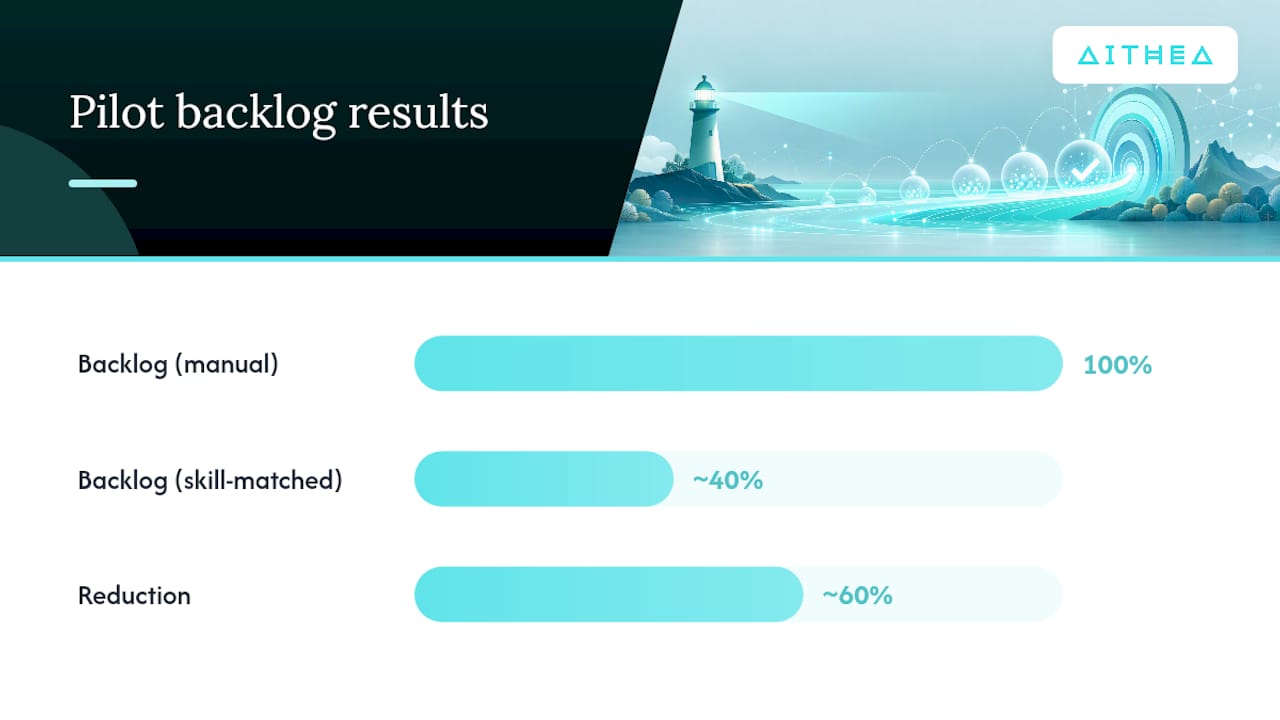
| Metric | Before | After |
|---|---|---|
| Backlog size | Baseline queue volume | Reduced by roughly 60% |
| Analyst assignment | Manual, queue-order | Skill-matched, clustered |
Running your own version requires a defined historical dataset, a sample size large enough for statistical confidence, a QA step before go-live, and an executive report summarising the before-and-after metrics for governance sign-off.
What compliance transformation leads keep learning the hard way
The resistance to backlog clearance rarely comes from the technology. It comes from analysts who have built their judgement around a queue that has always looked a certain way, and from leadership reluctant to sign off on automation without proof. The fix is training analysts on the new triage logic before go-live and pairing every technology change with visible governance, so adoption becomes a documented decision rather than a quiet workaround.
Sources
- Fraud alert backlogs: How to clear out the clutter - Huron Consulting Group
- Prioritising AML alerts: From backlog to risk‑based review - FinTech Global
- Anti‑Money Laundering Act of 2020 - FinCEN
- Alert backlog: What it is + the consequences on businesses - Unit21
If your team needs help scoping a clearance project or evaluating technology to sustain it, Aithea's compliance consulting services work directly with compliance officers on procurement, pilots and governance design. For teams still comparing vendors, Heliolus helps navigate the technology selection process, and you can get in touch to discuss a backlog assessment.
This article is general information, not a substitute for advice from a qualified financial advisor. Consult a qualified financial professional about your own circumstances before acting on anything here.
FAQ
What is alert management?
Alert management is the end-to-end process of generating, triaging, investigating and closing alerts flagged by monitoring systems, covering everything from initial risk scoring to final disposition and documentation.
How do you manage a backlog?
You manage a backlog by assessing its composition by age and risk, triaging clearly benign alerts for batch or automated closure, escalating high-exposure cases, and running the whole effort as a governed project with documented decisions rather than folding it into daily review.
What are alerting mechanisms?
Alerting mechanisms are the rules, thresholds and models within a monitoring system that flag transactions or behaviour for review, ranging from simple threshold rules to machine learning models that score risk and route alerts to investigators.
What does backlog mean in accounting?
In accounting and operations more broadly, a backlog refers to a volume of work, such as unprocessed transactions or unreviewed items, that has accumulated beyond the timeframe intended for completion; in compliance, this specifically means unreviewed AML or fraud alerts awaiting investigation.
How long does it typically take to clear an alert backlog?
Most defensible clearance projects run in phases across roughly eight weeks, from initial scoping and modelling through piloting and batch clearance, though the exact timeline depends on backlog size and available surge resourcing.