
Use a weighted, three-stage evaluation that tests vendors with your own data and prioritises data governance, integration, and total cost of ownership. That single discipline separates teams that select a vendor confidently from those still debating six months later.
Before you read further, eliminate any vendor that cannot satisfy these criteria on day one:
- Demonstrated UK GDPR compliance with a signed Data Processing Addendum (DPA) available before contract
- Documented data residency options for UK or EEA-based processing
- Explainable model outputs with at least one supported interpretability method (e.g. SHAP, LIME, or equivalent)
- Published SLAs covering uptime, incident response, and escalation paths
- Clear IP ownership clauses confirming your organisation retains rights to outputs and trained derivatives
- Reference customers in a comparable regulated sector willing to speak candidly
Next steps before vendor engagement: brief your legal, IT security, and compliance leads; prepare a requirements document with weighted criteria; and assemble a legal checklist covering IP, data use, and termination rights. Those three documents are your procurement foundation.
Key takeaways
A weighted, three-stage evaluation that tests vendors with your own data and prioritises data governance, integration, and total cost of ownership is the most reliable path to a defensible AI vendor selection decision.
| Point | Details |
|---|---|
| Three-stage evaluation | Screen with weighted RFI, run parallel POCs with your own data, then pilot before contract award. |
| Lock weights before demos | Set and document scoring weights before any vendor presents to eliminate post-demo bias. |
| Data governance is the top criterion | Assign at least 25% weight to data governance; eliminate any vendor that cannot produce a compliant DPA and DPIA. |
| Contract protections are non-negotiable | Secure IP ownership, data deletion on termination, audit rights, and model portability before signing. |
| Ai-thea supports the full cycle | Ai-thea provides matchmaking, RFP design, POC supervision, and governance frameworks for compliance technology procurement. |
Table of Contents
- What does an effective AI vendor selection framework look like?
- Does the vendor actually fit your organisation's goals?
- How do you assess integration and deployment readiness?
- What data governance and UK legal compliance checks are non-negotiable?
- How do you test a vendor's explainability and bias mitigation claims?
- Will the solution scale with your organisation's needs?
- What does total cost of ownership actually include?
- Which contract clauses must you secure before signing?
- How do you design an RFP and run a fair pilot?
- How do you convert scores into a final decision?
- How do you run a pilot and govern the vendor relationship afterwards?
- What UK regulatory requirements shape your vendor evaluation?
- What should you do in the next 30, 60, and 90 days?
- What procurement teams typically miss in AI vendor selection
- Ai-thea makes AI procurement faster and less risky for compliance teams
- Sources
- FAQ
What does an effective AI vendor selection framework look like?
APQC's structured checklist approach organises evaluation across six domains: business alignment, technical capabilities, security and ethics, partnership support, commercial viability, and adoption readiness. That structure maps cleanly to a three-stage process that keeps procurement moving without cutting corners.
The three stages are:
- Desk screen (weeks 1–2): Score vendors against your weighted criteria using RFI responses, published documentation, and reference calls. Reduce your longlist to three to five finalists. 137Foundry's evaluation framework recommends a disciplined shortlist and locked scoring weights to avoid decision paralysis.
- Technical due diligence and proof of concept (weeks 3–6): Run parallel POCs using representative samples of your own data. Pertama Partners' enterprise framework recommends this phase for technical fit assessment followed by a compliance and security audit.
- Pilot and contract negotiation (weeks 7–8+): Deploy in a controlled production-adjacent environment, verify SLAs under realistic load, and negotiate contract protections before full award.
Pro Tip: Lock your scoring weights before any vendor presents. Changing weights after a compelling demo is the single most common source of procurement bias, and it invalidates the objectivity of your scorecard.
Weighted scorecard template
The table below gives recommended starting weights for regulated UK organisations. Adjust them to reflect your sector's specific risk profile before evaluations begin.
| Evaluation domain | Recommended weight | What to assess |
|---|---|---|
| Data governance and privacy | 25% | GDPR compliance, DPA, data residency, retention controls |
| Technical capabilities and integration | 20% | API quality, deployment model, latency, connector availability |
| Compliance and regulatory readiness | 15% | ICO alignment, FCA model risk, audit-ready evidence |
| Total cost of ownership and ROI | 15% | Pricing model, hidden costs, realistic payback period |
| Vendor stability and support | 10% | Financial health, SLAs, post-go-live support quality |
| Explainability and ethics | 15% | Bias mitigation, fairness metrics, model transparency |
Score each vendor from 1 to 5 per domain, multiply by the weight, and sum to a weighted total out of 100. A vendor scoring below 60 overall, or below 3 out of 5 on data governance, should not progress to POC. Weighted scores for each domain are calculated according to the recommended weights above, and add up to 100.
Does the vendor actually fit your organisation's goals?
Business alignment is the criterion most teams assess last and regret skipping first. A technically excellent model that solves a problem you do not have is a liability, not an asset.
Define alignment using three lenses:
- Outcome fit: Can the vendor articulate the specific KPI your organisation will move, and by how much, within a defined timeframe? Vague claims about "improved efficiency" are not measurable commitments.
- Workflow impact: Map the vendor's solution against your current process. Identify where human review is replaced, augmented, or added. Change management cost is a real procurement line item.
- Strategic roadmap alignment: Ask whether the vendor's 12-month product roadmap matches your organisation's direction. A vendor building for large US banks may deprioritise the features a UK mid-market compliance team needs.
Partnership questions worth asking directly:
- What is your standard SLA for feature requests from clients of our size?
- How do you handle model retraining when regulatory requirements change?
- Can you provide three reference customers in UK financial services or trade compliance who went live recently?
Reference checks deserve more rigour than a 15-minute call. Ask referees specifically about post-go-live support quality, whether the vendor met its implementation timeline, and how the team handled the first significant incident. BDO's governance playbook recommends mapping board-level questions to vendor due diligence, including explicit validation of scalability claims and data protection evidence. That discipline applies equally to reference verification.
How do you assess integration and deployment readiness?
Integration effort is consistently underestimated in AI procurement. A vendor's API documentation tells you what is theoretically possible; a POC with your data tells you what is actually achievable in your environment.
Integration checklist:
- REST or GraphQL API availability, versioning policy, and deprecation notice periods
- Authentication standards supported (OAuth 2.0, SAML, API key management)
- Data format compatibility (JSON, XML, CSV ingestion; structured and unstructured data handling)
- Latency benchmarks under your expected transaction volumes
- Pre-built connectors for your existing systems (core banking, case management, sanctions screening platforms)
- Webhook support and event-driven architecture compatibility
Deployment model trade-offs matter significantly in regulated UK environments:
| Deployment model | Typical use case | Key trade-off |
|---|---|---|
| Cloud (vendor-hosted) | Fastest deployment, lowest internal IT overhead | Data leaves your perimeter; requires robust DPA and residency controls |
| On-premises | Maximum data control; meets strict data sovereignty requirements | Higher infrastructure cost; vendor support complexity increases |
| Hybrid | Sensitive data processed on-prem; analytics in cloud | Balances control and cost; integration complexity is higher |
For financial crime compliance specifically, where AI is becoming a core operational lever, the hybrid model is increasingly common. It allows transaction monitoring and KYC decisioning to remain within your perimeter while model training and analytics workloads use cloud elasticity.
Build an integration matrix that scores each finalist on deployment complexity (1 = plug-and-play, 5 = significant custom build), internal effort required (person-days), and estimated time to first production transaction. That matrix feeds directly into your TCO calculation.
What data governance and UK legal compliance checks are non-negotiable?
Data governance is where AI procurement intersects most directly with legal liability. UK GDPR, enforced by the Information Commissioner's Office (ICO), applies to any AI system processing personal data, and the obligations do not transfer to a vendor simply because they hold the data.
Data governance verification checklist:
- Data provenance documentation: where does training data originate, and was it lawfully obtained?
- Anonymisation and pseudonymisation standards applied to any data used for model training
- Retention schedules and deletion procedures, including post-contract data destruction certificates
- Access controls and role-based permissions for vendor staff accessing your data
- Audit logging of all data access and processing events
- Breach notification procedures and contractual commitment to notify within 72 hours per ICO requirements
Contract clause checklist for procurement to insist on:
- Data export rights: your organisation can extract all data in a machine-readable format at any time
- Deletion on termination: vendor commits to certified deletion of all your data within a defined period after contract end
- No use for training without explicit consent: vendor cannot use your data to improve their models without a separate, written agreement
- Audit rights: your organisation (or an appointed third party) can audit vendor data processing practices annually
- Data Processing Addendum: a compliant DPA must be executed before any personal data is shared
Pro Tip: Request the vendor's most recent Data Protection Impact Assessment (DPIA) for the specific product you are evaluating. A vendor that cannot produce a DPIA for a system processing personal data has a governance gap that no contractual clause can fully remedy.
For financial crime compliance use cases, the ICO's guidance on AI and data protection is directly relevant, as is the FCA's expectation that firms maintain oversight of third-party model risk. Linking your data governance checks to your existing model risk management framework is not optional; it is the operationally sound approach.
How do you test a vendor's explainability and bias mitigation claims?
Explainability and bias are the areas where vendor marketing most frequently outpaces operational reality. Asking the right questions during a compliance vendor demo separates genuine capability from polished slides.
Essential questions to ask:
- Which interpretability methods does your model support (SHAP, LIME, counterfactual explanations, attention maps)?
- How does your system explain an individual decision to a compliance officer or a customer subject to an adverse outcome?
- What fairness metrics do you monitor, and at what frequency?
- How do you detect and correct demographic parity failures or disparate impact across protected characteristics?
- What is your process when a bias issue is identified post-deployment?
Metrics you can request during a POC:
- Confusion matrices broken down by demographic subgroup
- Demographic parity difference scores across relevant protected characteristics
- False positive and false negative rates segmented by customer segment or geography
- Model drift indicators and the threshold at which retraining is triggered
Netguru's technical due diligence guidance recommends verifying model provenance, third-party licensing, and explainability measures during evaluation to reduce both legal and operational risk. For UK financial services, where the FCA expects firms to be able to explain automated decisions affecting customers, this is a regulatory requirement, not a preference.
The UK government's AI and data protection guidance from the ICO sets out the expectation that organisations using AI in decisions affecting individuals must be able to provide meaningful explanations. Procurement teams should treat this as a minimum bar, not a stretch goal.
Pro Tip: Require vendors to provide reproducible test artefacts from the POC: the exact dataset used, the model version, and the output files. Without reproducibility, you cannot verify claims made during evaluation, and you have no baseline for detecting model drift after go-live.
Will the solution scale with your organisation's needs?
Performance under controlled demo conditions tells you very little. What matters is behaviour under your peak load, with your data quality, and with your failure scenarios.
Performance metrics to measure during POC:
- Throughput: transactions or decisions processed per second at your expected peak volume
- Latency: end-to-end response time at the 95th and 99th percentile, not just the mean
- Concurrency: maximum simultaneous users or API calls before degradation begins
- Failover behaviour: what happens when a component fails, and how quickly does the system recover?
- Data quality tolerance: how does model accuracy change when input data quality degrades?
Capacity and scaling checklist:
- Does the platform support horizontal scaling (adding instances) or only vertical scaling (larger instances)?
- Is autoscaling automated, and what are the trigger thresholds?
- What monitoring and alerting does the vendor provide, and can it integrate with your existing observability stack (e.g. Datadog, Splunk, Azure Monitor)?
- What is the vendor's published uptime SLA, and what are the financial remedies for breach?
Assessing the vendor's roadmap for long-term viability requires asking direct questions: What percentage of revenue is reinvested in R&D? How many engineers work on the product you are buying? What is the deprecation policy for current API versions? A vendor with a compelling product today but a thin engineering team and no published roadmap is a concentration risk. For compliance teams tracking the trajectory of agentic AI in financial crime, the vendor's position on autonomous decision-making and human-in-the-loop controls is also a forward-looking indicator worth probing.
What does total cost of ownership actually include?
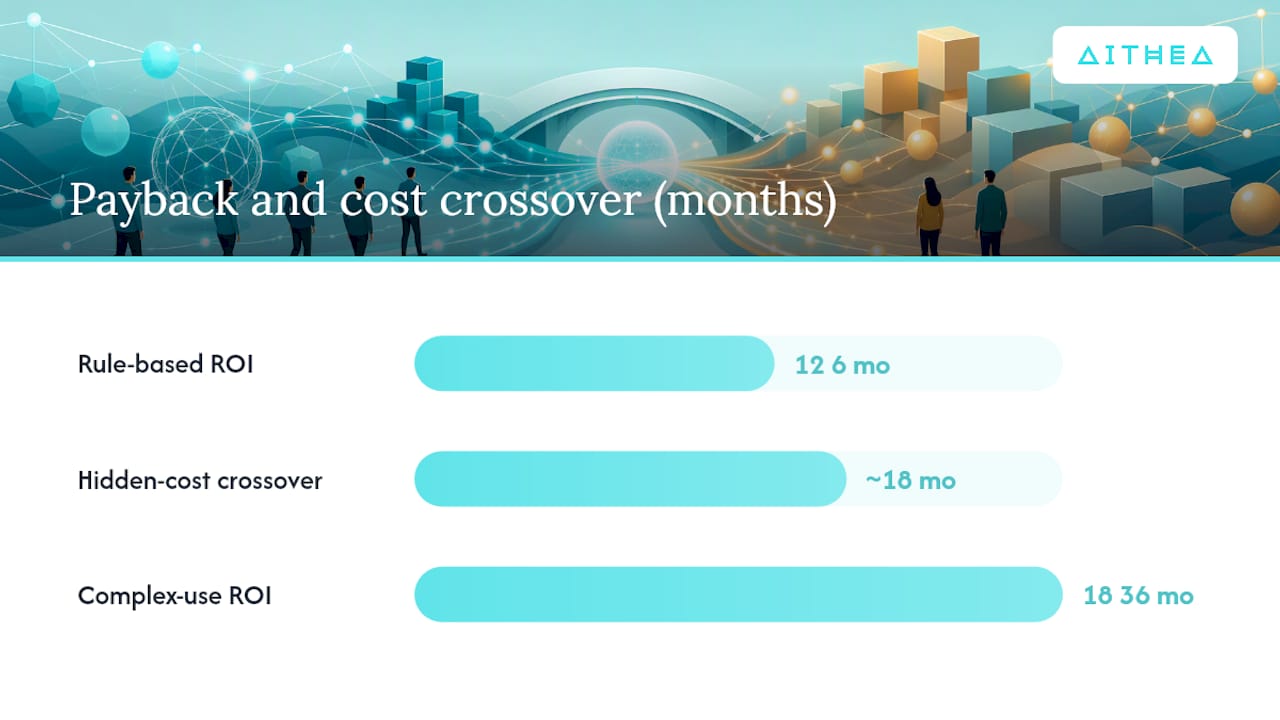
The licence fee is rarely the largest cost. For AI systems in regulated environments, the hidden costs frequently exceed the headline price within approximately 18 months of go-live.
Common pricing models and their scaling effects:
- Subscription (per seat or per module): predictable but can become expensive as user numbers grow; check whether the definition of "seat" includes read-only users and API integrations
- Per-prediction or per-transaction: aligns cost to usage but creates budget uncertainty at scale; model the cost at 2x and 5x your current volume before signing
- Infrastructure passthrough: vendor charges you for underlying cloud costs; these can spike unpredictably and are difficult to forecast
Hidden costs to include in your TCO model:
- Data preparation and cleansing before ingestion
- Integration development and testing (internal or third-party)
- Professional services for initial configuration and training
- Ongoing model retraining and maintenance
- Exit costs: data extraction, migration, and parallel running during transition
| TCO category | Typical cost driver | Questions to ask vendor |
|---|---|---|
| Licence / subscription | User count, module scope, volume tiers | What triggers a tier increase? |
| Implementation | Complexity of integration, data migration | Is professional services included or quoted separately? |
| Ongoing operations | Retraining frequency, monitoring overhead | Who owns retraining: vendor or client? |
| Exit and migration | Data portability, parallel running period | What is the standard exit notice period? |
For ROI, set a realistic payback horizon. In compliance and operational use cases, 12–18 months is achievable for high-volume, rule-based processes (transaction monitoring, sanctions screening). More complex use cases involving model-assisted investigation or document analysis typically require 18–36 months to demonstrate measurable ROI. Build your business case around conservative assumptions and document the baseline metrics before go-live.
Which contract clauses must you secure before signing?
Contract negotiation is where procurement teams most often concede ground they later regret. The clauses below are not negotiating positions; they are minimum protections for any AI engagement in a regulated UK environment.
Contract clause checklist:
- IP ownership: your organisation owns all outputs, derived models, and fine-tuned weights produced using your data
- Licence scope: the licence is explicitly limited to your named use case; any expansion requires a written amendment
- Data use for training: vendor is prohibited from using your data to improve their general models without separate written consent
- Audit rights: you retain the right to audit vendor systems, processes, and data handling at least annually, with reasonable notice
- Exit data portability: vendor must provide all your data, model configurations, and processing logs in a portable format within 30 days of contract termination
- SLA remedies: financial remedies for SLA breaches are specified, not left to "reasonable endeavours"
- Model drift obligations: vendor must notify you when model performance degrades beyond a defined threshold and provide a remediation timeline
Negotiation tips worth knowing: warranties on model accuracy are rare but not impossible to secure; frame them as performance thresholds in the SLA rather than as contractual guarantees. For model drift, specify the metric (e.g. F1 score, precision, recall) and the threshold that triggers a vendor obligation to retrain. Require audit reporting in a format compatible with your internal governance framework, not just a vendor-generated summary.
Pertama Partners' evaluation framework identifies contractual protections for IP, data use restrictions, and explicit termination and portability clauses as essential to avoiding downstream risk. That assessment holds for any UK regulated entity.
Pro Tip: Include a "model portability" clause that requires the vendor to provide model weights, architecture documentation, and training data lineage in a format your team or a successor vendor can use. Most vendors will resist this; the resistance itself tells you something about their confidence in your long-term dependency on them.
How do you design an RFP and run a fair pilot?
A well-structured RFI/RFP does two things: it forces vendors to respond on your terms rather than their marketing narrative, and it creates a documented audit trail for your procurement decision.
RFP/RFI checklist by section:
- Technical: architecture overview, API documentation, deployment options, data formats, performance benchmarks
- Security: penetration testing results (within 12 months), ISO 27001 or SOC 2 Type II certification, vulnerability disclosure policy
- Governance: GDPR compliance evidence, DPA template, DPIA availability, data residency options
- Roadmap: 12-month product roadmap, deprecation policy, R&D investment as a percentage of revenue
- Pricing: full TCO breakdown including professional services, infrastructure, and exit costs
- References: three named reference customers in comparable sectors, available for direct contact
Harbor Light's analysis makes the case plainly: vendor demos are unreliable as a primary selection tool. Structured evaluations and scenario-based testing using your data expose real operational fit in ways that a polished presentation never can.
Pilot acceptance criteria template:
- Define the representative dataset: minimum 90 days of production-equivalent data, including known edge cases and failure scenarios
- Set performance thresholds: minimum accuracy, precision, recall, and latency targets that must be met before acceptance
- Require rollback documentation: vendor must provide a tested rollback procedure before the pilot begins
- Monitor data flows: verify that data handling during the pilot matches the contractual DPA
- Score results using the same weighted criteria from your scorecard, not a fresh assessment
Run parallel POCs with the same dataset and evaluation metrics. Scoring diverges when teams use different datasets for different vendors; that divergence is noise, not signal.
How do you convert scores into a final decision?
Aggregating weighted scores removes subjectivity from the final decision, but only if the process has been followed consistently. A vendor comparison limited to three to five finalists, with pre-assigned weighted criteria, produces more data-driven decisions than relying on subjective impressions, as Netguru's evaluation guidance confirms.
Decision flow from scorecard to contract award:
- Aggregate weighted scores from all evaluators; use the mean, not the highest score, to reduce individual bias
- Apply a minimum threshold: any vendor below 60/100 overall, or below 3/5 on data governance, is eliminated regardless of other scores
- For tied finalists (within 5 points of each other), convene a structured panel discussion focused on the specific criteria where scores diverged
- Conduct final checks before award: security sign-off from your CISO or IT security lead, legal confirmation that all redlines are accepted, implementation plan reviewed and budget approved
- Issue a formal award letter and begin contract execution; do not share commercially sensitive evaluation scores with unsuccessful vendors
Final checks list:
- Security assessment signed off by CISO or equivalent
- Legal redlines accepted and DPA executed
- Implementation plan reviewed with realistic milestones
- Budget approval confirmed for full TCO, not just year-one licence costs
- Governance framework agreed, including reporting cadence and escalation paths
How do you run a pilot and govern the vendor relationship afterwards?
A successful POC does not automatically translate into a successful production deployment. The transition from pilot to live requires a structured onboarding plan and a governance model that persists for the life of the contract.
Pilot checklist:
- Monitoring dashboards configured and baseline metrics captured before go-live
- Rollback plan tested and documented, with a named owner responsible for execution
- SLA verification: confirm that production performance matches pilot benchmarks under real load
- Data flow audit: verify that production data handling matches the DPA and pilot configuration
- Incident response procedure agreed and tested with the vendor before go-live
Governance template for ongoing vendor management:
- Monthly operational review: performance metrics, incident log, open issues
- Quarterly strategic review: roadmap updates, regulatory changes, model performance trends
- Annual security review: updated penetration test results, certification renewals, access control audit
- Bias monitoring schedule: fairness metrics reviewed at least quarterly; retraining triggered by defined thresholds
- Escalation path: named contacts at both vendor and client for P1 incidents, with response time commitments
Post-award responsibilities should be split explicitly. The vendor owns model performance, retraining, and infrastructure reliability. Your organisation owns the use case definition, regulatory compliance, and the decision to act on model outputs. That boundary matters in a regulated environment where the FCA expects firms to maintain accountability for automated decisions, regardless of who built the model.
Pro Tip: Schedule a formal 90-day post-go-live review with the vendor. This is the point at which early integration issues surface, model performance against real data becomes visible, and the vendor's post-sale support quality becomes apparent. Contractually require this review as a condition of the first annual renewal.
What UK regulatory requirements shape your vendor evaluation?
UK organisations procuring AI for financial crime compliance, trade compliance, or customer-facing decisioning operate within a specific regulatory context that shapes every stage of vendor selection.
Key regulatory expectations:
- UK GDPR and ICO guidance: any AI system processing personal data must comply with UK GDPR. The ICO's guidance on AI and data protection sets out specific expectations for transparency, lawful basis, and the right to explanation for automated decisions. Request evidence of compliance during diligence, not assurances.
- FCA model risk expectations: the FCA expects firms to maintain a model risk management framework covering model development, validation, deployment, and ongoing monitoring. A vendor's AI model is a third-party model within your framework; your firm remains accountable for its performance and governance.
- FCA Consumer Duty: for customer-facing AI, Consumer Duty requires that firms can demonstrate good outcomes for customers. An AI model that produces unexplainable adverse decisions creates a direct Consumer Duty exposure.
- Financial crime compliance: for AML, KYC, and sanctions screening use cases, the intersection of AI and financial crime creates both opportunity and obligation. AI-driven transaction monitoring must be explainable to the National Crime Agency (NCA) and auditable by the FCA.
Sector-specific additional checks:
- Financial services: obtain the vendor's model validation documentation; confirm the model has been independently validated, not just internally tested
- Trade compliance: verify that sanctions list update frequency meets your obligations under OFSI and HMRC requirements; ask how the vendor handles list updates and how quickly changes propagate to live decisions
BDO's governance playbook emphasises a shift from point-in-time security audits to continuous, audit-ready compliance capabilities. For UK financial institutions, that means vendor selection must validate not just current compliance but the vendor's capacity to maintain it as regulations evolve.
Pro Tip: Link your regulatory evidence requests directly to your contract audit rights. If you require the vendor to maintain ISO 27001 certification, the contract should specify that lapse of certification is a material breach. Regulatory evidence gathered during diligence has no value unless it is backed by contractual obligations to maintain it.
What should you do in the next 30, 60, and 90 days?
The framework above is only useful if it translates into a concrete action plan. Here is a practical runbook.
Days 1–30: prepare and shortlist
- Finalise your requirements document with weighted scoring criteria (use the scorecard template above)
- Brief legal, IT security, compliance, and business leads; assign a named procurement owner
- Issue RFIs to three to five vendors; set a two-week response deadline
- Prepare governance documents: data governance policy, model risk framework, legal checklist
Days 31–60: evaluate and POC
- Score RFI responses against your weighted criteria; eliminate vendors below threshold
- Schedule POCs with your own representative data for the top two to three finalists
- Run parallel POCs using identical datasets and evaluation metrics
- Conduct reference calls with at least two named customers per finalist
Days 61–90: pilot, negotiate, and award
- Select the top-scoring vendor for a controlled pilot in a production-adjacent environment
- Begin contract negotiation; use the clause checklist from Section 9 as your baseline
- Obtain security sign-off, legal confirmation, and budget approval
- Award contract and schedule the 90-day post-go-live review
For organisations that need specialist support with RFP design, vendor matchmaking, or governance framework development, Ai-thea's Heliolus tool is built specifically for compliance technology procurement.
What procurement teams typically miss in AI vendor selection
The most common failure mode is not choosing the wrong vendor. It is choosing the right vendor for the wrong reasons, usually because a compelling demo displaced rigorous evaluation.
Procurement teams consistently underweight two things. First, the operational cost of a poor integration: a vendor whose API requires significant custom middleware adds months of internal engineering time that never appears in the headline price. Second, the governance gap between pilot and production: a model that performs well on clean, curated POC data can degrade significantly when exposed to the messy, incomplete data that characterises real compliance workflows.
The corrective action is straightforward but requires discipline: insist on POCs with your own production-representative data, and require the vendor to demonstrate performance on your worst-quality data, not just your best. That single requirement eliminates more unsuitable vendors than any other diligence step.
There is also a tendency to treat contract negotiation as a formality after the selection decision is made. The leverage to negotiate IP protections, model portability, and audit rights is highest before award, not after. Procurement teams that defer these conversations lose the ability to protect their organisation's interests at the moment they matter most.
Ai-thea makes AI procurement faster and less risky for compliance teams
Compliance technology procurement is genuinely complex. The vendor market is crowded, the regulatory stakes are high, and the gap between a vendor's demo and their production performance can be significant. Ai-thea exists precisely to close that gap for compliance officers, risk managers, and procurement leads who need to move quickly without cutting corners.
[IMAGE showing Ai-thea's AI procurement support services]

Ai-thea's services for AI vendor selection include compliance technology matchmaking (connecting your requirements to pre-vetted vendors), RFP design and scoring framework development, POC supervision and independent evaluation, and post-award governance framework design. The Heliolus selection navigator maps your compliance use case to the technology options most likely to meet your regulatory and operational requirements, reducing the time from requirements to shortlist significantly.
If you are at the start of a procurement process or need to rescue one that has stalled, get in touch with the Ai-thea team to discuss how we can support your evaluation from RFI to contract award.
Sources
- The Governance Playbook for AI Vendor Selection | BDO
- AI Vendor Selection Criteria | APQC
- AI vendor selection guide | Netguru
- AI Vendor Selection: Evaluation Framework for Enterprises
- Software Demos vs. Real Evaluations: Why Vendor Presentations Should Not Drive Platform Decisions — Harbor Light Strategies
- Software vendor evaluation: a framework that works | 137Foundry
FAQ
How do you select an AI vendor for a regulated UK organisation?
Use a three-stage process: desk screen with weighted RFI scoring, a proof of concept using your own representative data, and a controlled pilot before contract award. Prioritise data governance, UK GDPR compliance, and explainability as elimination criteria from the outset.
Why are vendor demos unreliable for AI supplier evaluation?
Demos are designed to show a product at its best, using curated data and controlled conditions. Scenario-based testing with your own production data exposes integration gaps, data quality sensitivity, and real latency that demos never reveal.
What contract clauses are most important in AI procurement?
IP ownership of outputs, prohibition on using your data for model training without consent, certified data deletion on termination, annual audit rights, and model portability in a usable format are the five clauses that protect your organisation most directly.
How can AI be used in vendor management after contract award?
AI tools can automate SLA monitoring, flag performance degradation against agreed thresholds, and track regulatory change that affects vendor obligations. For compliance use cases, AI-assisted vendor governance reduces the manual overhead of ongoing oversight significantly.
How long should an AI vendor evaluation take?
A well-structured evaluation takes approximately six to eight weeks: two weeks for desk screening and RFI scoring, four weeks for parallel POCs, and two weeks for compliance and security audit. Extending beyond eight weeks without a clear reason usually signals unclear requirements rather than vendor complexity.