
AI in compliance means deploying machine learning and natural language processing (NLP) systems to detect, prioritise, and help investigate regulatory risk — with every output treated as an input to human judgement, never a final decision. For UK compliance teams, the practical bottom line is this: the technology is mature enough to deploy now, the regulatory expectations are crystallising fast, and the governance burden falls squarely on the firm, not the vendor.
Moody's global study found that more than half of surveyed risk professionals were actively using or trialling AI for risk and compliance, with measurable reductions in false positives and faster alert triage. The EU AI Act introduces binding obligations for providers and deployers of high-risk AI systems, including many compliance tools. The FCA has signalled clearly that firms must maintain audit trails, document decision rationale, and treat AI outputs as inputs rather than conclusions. Three immediate implications follow for UK teams:
- AI outputs require human sign-off: every AI-flagged alert needs a documented human decision, not just a system closure.
- Explainability is a supervisory expectation: if you cannot explain why a model flagged a transaction, the FCA will ask you to.
- Governance must be built in from day one: retrofitting accountability structures after deployment is significantly harder than designing them upfront.
Key takeaways
AI in compliance delivers measurable efficiency and detection gains, but only when governance, explainability, and human oversight are built in from the start.
| Point | Details |
|---|---|
| Treat AI outputs as inputs | Every AI-flagged alert requires a documented human decision; the FCA expects a named accountable individual, not a model closure. |
| Build governance before deployment | Complete a DPIA, assign a model owner, and set monitoring thresholds before go-live, not after the first supervisory question. |
| Start with high-volume, structured use cases | Transaction monitoring triage and sanctions name matching offer the clearest data, the most measurable KPIs, and the fastest demonstrable return. |
| Explainability is a regulatory requirement | Models that cannot produce human-readable explanations at the individual alert level are not deployable in FCA-regulated environments. |
| Ai-thea supports the full procurement cycle | From use-case scoping and vendor evaluation via Heliolus to DPIA support and investigator training, Ai-thea helps teams adopt AI safely and at pace. |
Table of Contents
- How AI is already used in compliance programmes
- What the regulatory framework means for your AI deployment
- Benefits and risks: what you gain and what you must manage
- What operational controls does governing AI actually require?
- What the evidence and SupTech examples actually show
- A practical checklist for UK compliance teams starting or scaling AI
- When AI is not the right answer
- The governance gap is the real challenge
- Ai-thea helps compliance teams adopt AI with confidence
- Sources
- FAQ
How AI is already used in compliance programmes
The most mature AI applications in compliance are not experimental. They are running in production at banks, fintechs, and corporates across the UK right now, and the operational gains are measurable.
- Transaction monitoring and AML: Machine learning models process real-time, first-party behavioural signals and feedback loops to surface complex laundering patterns that static rule-based systems miss. ML-based AML systems can reduce false-positive alert volumes substantially, freeing investigators to focus on genuinely suspicious activity rather than clearing noise.
- Sanctions screening and name matching: AI-powered fuzzy matching and transliteration algorithms handle name variants, aliases, and script differences that trip up legacy exact-match systems. The operational gain is fewer missed hits and fewer manual reviews of obvious false positives. For a deeper look at how AI compares with traditional approaches, sanctions compliance and AI covers the technical trade-offs directly.
- KYC and adverse-media screening: NLP models scan unstructured news, court records, and regulatory databases to surface reputational risk signals at onboarding and during periodic review. A model acting like a junior analyst with initiative can triage hundreds of sources in seconds, flagging only the items that warrant human review.
- False-positive reduction and alert prioritisation: Risk scoring models rank alerts by probability of genuine suspicion, so investigators work the highest-risk queue first. This is where teams typically see the fastest return: triage time drops, and analyst capacity shifts toward complex cases.
- Regulatory change monitoring: NLP tools track legislative updates, FCA publications, and FATF guidance, tagging changes relevant to specific business lines and triggering workflow updates automatically.
- Automated evidence extraction: OCR and NLP extract structured data from contracts, corporate filings, and due-diligence documents, cutting the manual effort in onboarding and periodic review cycles.
Pro Tip: Hybrid models that combine rule-based logic with machine learning tend to outperform pure ML approaches in regulated environments. Rules preserve explainability and control for known typologies; ML handles novel patterns. Build the hybrid architecture from the start rather than bolting rules onto a black-box model later.
What the regulatory framework means for your AI deployment
The EU AI Act and its reach into UK firms
The EU AI Act classifies AI systems by risk level. Systems used in credit scoring, AML, and critical infrastructure monitoring fall into the high-risk category, triggering obligations around transparency, data governance, human oversight, and conformity assessments. UK firms with EU operations, EU-based customers, or EU-regulated entities within their group cannot treat the Act as someone else's problem. The EU impact assessment sets out the regulatory objectives and risk categories in detail. The practical implication: if your compliance AI touches EU data subjects or EU-regulated activity, your vendor and your firm both carry obligations.
The FCA's position and UK regulatory posture
The UK government's approach frames AI regulation as pro-innovation with proportionate oversight, prioritising safety and explainability without imposing a single prescriptive rulebook. The FCA has not yet published a dedicated AI rulebook, but its supervisory expectations are clear from published guidance and Dear CEO letters: firms must maintain audit trails, document why AI-flagged alerts were pursued or dismissed, and ensure that accountability for decisions sits with a named individual, not a model. Treating AI outputs as inputs to human decision-making is the governing principle, and it applies whether you built the model in-house or bought it from a vendor.
UK GDPR and data protection obligations
Using personal data to train or run compliance AI triggers UK GDPR obligations. Key considerations:
- Lawful basis: Legitimate interests or legal obligation are the most common bases for AML and KYC processing, but each must be documented and defensible.
- DPIAs: A Data Protection Impact Assessment is required before deploying any high-risk processing system. AI-driven transaction monitoring almost certainly qualifies.
- Data minimisation and retention: Models trained on more data than necessary create disproportionate risk. Define retention periods for training data and live inference data separately.
- Synthetic data: Generating synthetic datasets that preserve statistical properties without containing real personal data is a practical way to develop and test models while meeting data-protection obligations. The EBA's SupTech report identifies synthetic data generation as a good practice among EU competent authorities.
Operational responsibility: the firm deploying the AI is the data controller and the accountable party for supervisory purposes. Vendor contracts must clearly allocate data-processor responsibilities, but the FCA will look to the firm, not the vendor, if something goes wrong.
Benefits and risks: what you gain and what you must manage
AI in compliance delivers genuine, measurable advantages. It also creates new categories of governance risk that do not exist with manual processes. Both sides deserve equal attention.
Efficiency and detection gains are the headline benefits. AI systems process volumes of data that no human team can match, operating continuously without fatigue. False-positive rates in transaction monitoring can fall significantly when ML models replace or augment static rule sets. Research comparing ML models found that Decision Tree and Random Forest approaches produced markedly lower false-positive rates than traditional rule-based systems, though the same study noted explainability as a core challenge for regulatory acceptance.
The IACA research paper on AI and AML is direct on the risk side: AI is not a substitute for human judgement, and without governance controls, it can embed bias, produce opaque decisions, and create accountability gaps that regulators will penalise.
The key risks to manage:
- Bias: Training data that reflects historical enforcement patterns can encode demographic or geographic bias into model outputs. Regular bias audits using diverse test sets are not optional.
- Explainability: Deep learning models can detect complex laundering patterns that simpler models miss, but deep learning for AML faces real constraints from data privacy, availability, and the regulatory requirement to explain decisions. A model that cannot be explained cannot be defended to the FCA.
- Model drift: A model trained on last year's transaction patterns may underperform as criminal typologies evolve. Without ongoing monitoring, drift is invisible until a missed case surfaces.
- Human-in-the-loop erosion: Alert fatigue is real. If investigators routinely close AI-flagged alerts without genuine review, the human oversight layer becomes a rubber stamp. Process design must prevent this.
Statistic callout: Moody's survey of over 600 risk and compliance practitioners found that more than half were actively using or trialling AI, with users reporting measurable reductions in false positives in screening programmes.
What operational controls does governing AI actually require?
Getting AI into production is the easy part. Keeping it governed, auditable, and defensible over its full life cycle is where most compliance programmes underinvest.
Step-by-step control framework
- Define the use case and success metrics before procurement. What problem does this model solve? What does a false positive cost you versus a false negative? Set measurable thresholds before you sign a contract.
- Audit your data quality. ML models amplify data quality problems rather than hiding them. Map data lineage, identify gaps, and resolve labelling inconsistencies before training begins.
- Complete a DPIA. For any AI system processing personal data in a compliance context, a Data Protection Impact Assessment is a legal requirement under UK GDPR, not a best-practice suggestion.
- Validate the model independently. Internal model risk management teams or external validators should assess performance metrics, bias indicators, and explainability outputs before go-live.
- Set monitoring thresholds and review cadences. Define what constitutes a performance degradation event and who is responsible for triggering a model review. Monthly performance reporting is a minimum.
- Document governance sign-offs. Every material model change needs a documented approval chain. The FCA expects to see this trail.
- Train your investigators. A model is only as effective as the analysts interpreting its outputs. AML simulation and training tools can help teams build the skills to work confidently alongside AI systems.
Data governance checklist
- Data lineage documented from source to model input
- Access controls applied to training data and inference logs
- Retention periods defined for training data, live data, and model outputs separately
- Synthetic data used for development and testing where real personal data is not required
- Anonymisation or pseudonymisation applied where feasible without degrading model performance
Change management
Integrating AI into compliance workflows is a technology project and a people project in equal measure. Stakeholder mapping should identify who approves model changes, who reviews outputs, and who escalates anomalies. Training must cover not just how to use the tool but how to challenge it. Compliance leadership needs to embed AI review into existing sign-off processes, not create a parallel track that sits outside normal governance.

Pro Tip: Start model development with synthetic datasets. Practitioners report that synthetic data generation lets teams iterate rapidly on model design without exposing real personal data, satisfying both development speed and data-protection obligations simultaneously.
What the evidence and SupTech examples actually show
The evidence base for AI in compliance is growing, though it remains uneven. Most published studies use controlled or synthetic datasets rather than live production environments, which means real-world performance can differ from reported figures.
| Study / Source | Headline finding | Practitioner relevance |
|---|---|---|
| Moody's risk professional survey | Over half of 600+ practitioners actively using or trialling AI; false-positive reductions reported by users | Adoption is mainstream; governance expectations are rising in parallel |
| ACM conference paper (ML models vs rules) | Decision Tree and Random Forest models showed markedly lower false-positive rates than rule-based systems | Hybrid ML approaches can reduce alert volumes; explainability remains a deployment constraint |
| IACA research paper (AI and AML) | AI reduces false positives and frees investigators; governance and bias mitigation are essential | Human oversight and bias controls are not optional add-ons |
| EBA SupTech report (2025) | AI/NLP improves supervisory data analysis; data quality, resource limits, and explainability are adoption barriers | Good practices include synthetic data, sandboxes, and interoperable data extraction |
| Deep learning AML review | Deep learning detects complex patterns but faces data privacy and explainability constraints | Context-rich architectures needed; not a plug-and-play solution |
The EBA's 2025 report on AML/CFT SupTech tools is particularly instructive for firms watching how supervisors themselves are adopting AI. Competent authorities across the EU are using NLP for supervisory data analysis but report the same barriers firms face: data quality, resource constraints, and the need to explain model outputs to stakeholders. The report identifies synthetic data generation, co-development sandboxes, and interoperable data extraction as good practices that address these barriers.
Statistic callout: The EBA's SupTech report documents that data quality and explainability gaps are the primary practical barriers to AI adoption — not the technology itself.
A practical checklist for UK compliance teams starting or scaling AI
Getting started: numbered steps
- Identify one high-volume, well-defined use case. Transaction monitoring alert triage or sanctions name matching are the most common starting points because the data is structured and the success metrics are clear.
- Assess data readiness. Run a data quality audit before any vendor conversation. Poor data produces poor models regardless of vendor quality.
- Complete a DPIA and document lawful basis. Do this before procurement, not after. It will shape your vendor requirements.
- Run a structured vendor evaluation. Use a consistent framework across vendors. Ai-thea's Heliolus technology selection navigator is designed specifically to help compliance teams match use cases to vendor capabilities without the guesswork of unstructured RFP processes.
- Design a pilot with defined success metrics. Set false-positive rate targets, triage time benchmarks, and a minimum evaluation period before committing to full deployment.
- Obtain governance sign-offs. Model risk management, legal, data protection, and compliance leadership all need to sign off before go-live.
- Build ongoing monitoring into BAU. Assign a model owner, set review cadences, and define escalation triggers for performance degradation.
Vendor selection criteria
When evaluating AI vendors for compliance use cases, require the following:
- A model card documenting training data sources, performance metrics, known limitations, and bias testing results
- Explainability outputs at the individual alert level, not just aggregate model statistics
- Audit logs that capture every model input, output, and human decision in a format the FCA can review
- Data handling documentation covering storage location, retention, sub-processors, and breach notification procedures
- Independent validation evidence or willingness to submit to third-party model review
- SLAs covering model performance, not just system uptime
DPIA template headers to demand from vendors
A vendor DPIA should cover at minimum: processing purpose and legal basis; categories of personal data processed; data flows and sub-processors; retention and deletion schedules; security measures; risk assessment; and mitigation measures including human oversight design.
When AI is not the right answer
Not every compliance problem benefits from AI, and deploying it in the wrong context creates more risk than it resolves.
Situations where AI is inappropriate or premature:
- Low-volume, rare-event typologies: Models need sufficient labelled examples to learn from. If your firm processes fewer than a few hundred relevant events per year in a given category, there is not enough signal to train a reliable model.
- High legal-judgement tasks: Decisions requiring legal interpretation, prosecutorial discretion, or complex multi-jurisdictional analysis should remain with qualified humans. AI can support research, but the judgement call must be human.
- Poor data quality environments: Deploying ML on inconsistent, incomplete, or mislabelled data produces unreliable outputs that can be worse than a well-designed rule set.
- Contexts where explainability is non-negotiable: If a decision will be challenged in court or before a regulator and the model cannot produce a human-readable explanation, do not use it as the primary decision tool.
Regulatory grey areas that teams should track:
- Cross-border supervisory variation: The EU AI Act and the UK's pro-innovation approach are not aligned. Firms operating across both jurisdictions face overlapping and sometimes conflicting obligations. The complexity of cross-border compliance is a live operational challenge, not a future risk.
- Accountability gaps in third-party models: When a vendor's model produces a wrong output, the firm is still accountable to the FCA. Contracts must allocate liability clearly, but supervisory accountability cannot be contracted away.
- FATF guidance on AI and virtual assets: FATF has published guidance on virtual assets and emerging technologies, but its position on AI-specific AML controls continues to evolve. Teams should monitor FATF updates as a leading indicator of where national regulators will move next.
Where regulation is unsettled, the practical approach is to apply the highest common denominator: build to EU AI Act high-risk standards even for UK-only deployments, because the cost of retrofitting governance is higher than building it correctly from the start.
The governance gap is the real challenge
The compliance profession has spent decades building expertise in rules, judgement, and human accountability. AI does not replace that expertise. It amplifies it, for better or worse, depending on how well the governance layer is designed.
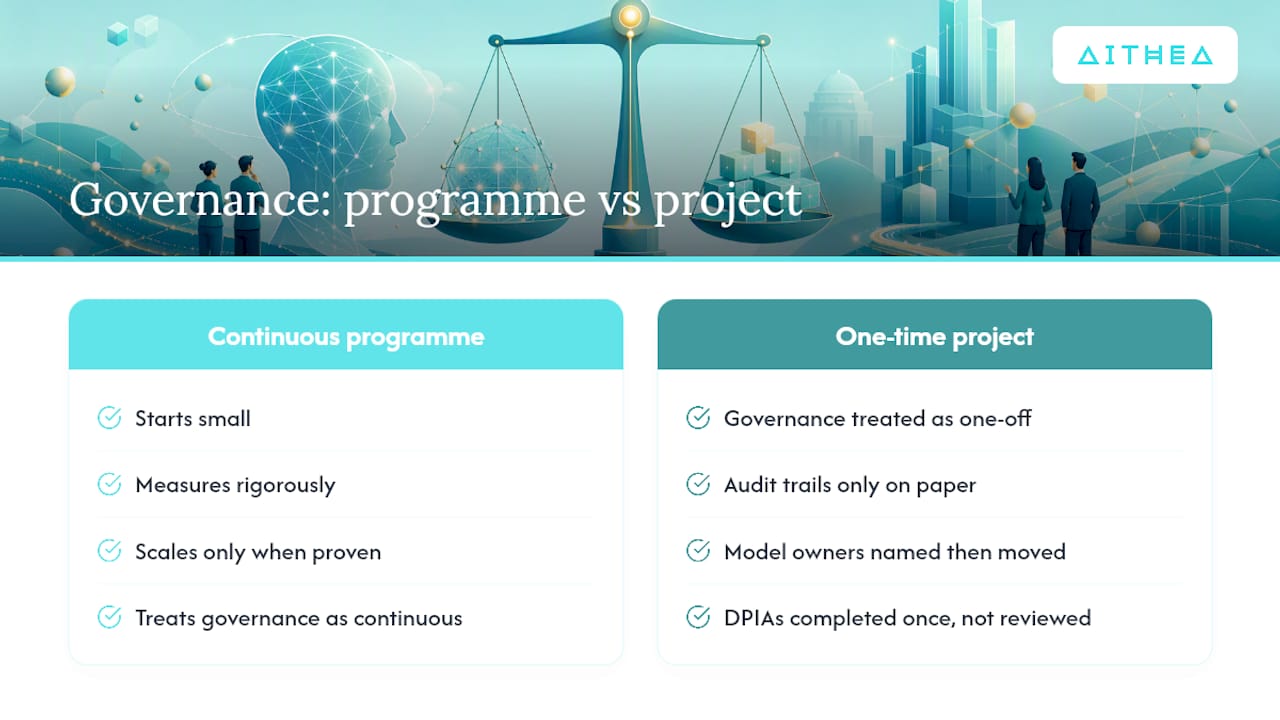
What concerns me most, looking at how firms are actually deploying AI right now, is not the technology. The models work. The concern is the governance gap between what firms think they have in place and what supervisors will find when they look closely. Audit trails that exist on paper but are not actually maintained. Model owners who were named at go-live and have since moved roles. DPIAs completed once and never reviewed as the model evolved. These are not technology failures. They are change management failures.
The firms getting this right share a common characteristic: compliance leadership treats AI governance as a continuous programme, not a one-time project. They start small, measure rigorously, and scale only when the governance infrastructure has proven it can keep pace. The future of compliance decision-making will involve increasingly autonomous AI agents, and the teams building strong governance habits now will be far better positioned to manage that transition safely.
The skills gap is real too. Compliance professionals who understand both the regulatory framework and the technical architecture of AI systems are rare. Investing in that capability, through training, simulation, and structured learning, is not a luxury. It is the foundation on which safe AI adoption is built.
Ai-thea helps compliance teams adopt AI with confidence
Compliance teams that know they need AI but are not sure where to start, or which vendor to trust, face a procurement problem as much as a technology problem. Ai-thea sits at the intersection of regulation, technology, and AI, and its services are built specifically for that gap.

The Heliolus technology selection navigator matches your specific compliance use cases to vendor capabilities using a structured evaluation framework, so your RFP process is grounded in requirements rather than marketing claims. Beyond vendor selection, Ai-thea supports DPIA preparation, model card review, pilot design, and SupTech integration, giving compliance teams the technical and regulatory context to make procurement decisions they can defend to the board and to supervisors. Microlearning and simulation tools help your investigators build the skills to work effectively alongside AI systems from day one. To discuss your team's specific needs, get in touch with Ai-thea and start the conversation.
Sources
The following sources are the primary references for regulation, evidence, and SupTech practice covered in this article. Where to start depends on your immediate need:
- AI in Compliance and Risk
- Report on the use of AML/CFT SupTech tools
- IACA research paper: AI and AML (selected findings)
- AI regulation: a pro‑innovation approach
FAQ
How is AI currently used in compliance programmes?
AI is deployed across transaction monitoring, sanctions screening, KYC, adverse-media analysis, and regulatory change monitoring. The primary operational gains are reduced false-positive volumes and faster alert triage, freeing investigators for complex cases.
Will AI replace compliance professionals?
No. AI automates high-volume, pattern-recognition tasks but cannot replace the legal judgement, contextual reasoning, and supervisory accountability that compliance roles require. Regulators including the FCA explicitly require human oversight of AI-driven decisions, and that requirement is structural, not temporary.
What does the EU AI Act mean for UK compliance teams?
High-risk AI systems, including many compliance tools, face binding obligations around transparency, data governance, and human oversight under the EU AI Act. UK firms with EU operations or EU-regulated group entities must assess whether their compliance AI falls within scope and plan accordingly.
What is the most important governance step before deploying AI?
Complete a Data Protection Impact Assessment and assign a named model owner before go-live. The FCA expects firms to document why AI-flagged alerts were pursued or dismissed, and that audit trail must be in place from the first day of operation, not retrofitted after a supervisory question.
Does AI in AML compliance actually reduce false positives?
Yes, with caveats. Machine learning models, particularly Random Forest and Decision Tree approaches, have shown markedly lower false-positive rates than rule-based systems in comparative studies. Real-world performance depends on data quality, model governance, and ongoing monitoring; gains are not automatic and require active management to sustain.