
TL;DR:
- Adverse media screening involves systematically searching open-source public information to detect negative reports indicating financial crime risk. Effective programs require managing false positives, ensuring multilingual coverage, and monitoring material events that often precede sanctions. Vendors must demonstrate strong data sources, explainability, and operational capabilities through thorough testing and documentation.
Adverse media screening is the systematic process of searching open-source information, including news, regulatory records, and public databases, to identify negative reporting about a customer, counterparty, or beneficial owner that may indicate financial crime risk. For AML/KYC and third-party due diligence programmes, it is not optional: UK supervisors and major AML frameworks treat it as an integral component of proportionate, risk-based customer due diligence.
Three things every compliance team should know before reading further:
- False positives are the norm, not the exception. Common names, transliteration variants, and syndicated content mean most automated hits require human review. Managing that volume is the central operational challenge.
- Multilingual coverage is a regulatory expectation, not a nice-to-have. Adverse reporting about a UK-facing customer may appear first in Mandarin, Arabic, or Portuguese. A programme that only searches English misses the signal entirely.
- Adverse media often precedes sanctions and enforcement. Negative reporting frequently surfaces before official designations, which means a well-tuned programme gives early warning that watchlist screening alone cannot provide.
The sections below explain each of these points in depth: what to screen, how to run the process, where data quality breaks down, and what to demand of vendors.
Table of Contents
- What does adverse media actually cover, and who must be screened?
- What sources should you monitor for adverse media?
- How does the adverse media screening process work, step by step?
- Why are false positives so high, and how do you reduce them?
- Which technology capabilities actually matter when evaluating vendors?
- What should your vendor RFP and procurement process look like?
- Key takeaways
- The gap between vendor claims and operational reality
- How Ai-thea helps compliance teams get adverse media right
- Useful sources and further reading
- FAQ
What does adverse media actually cover, and who must be screened?
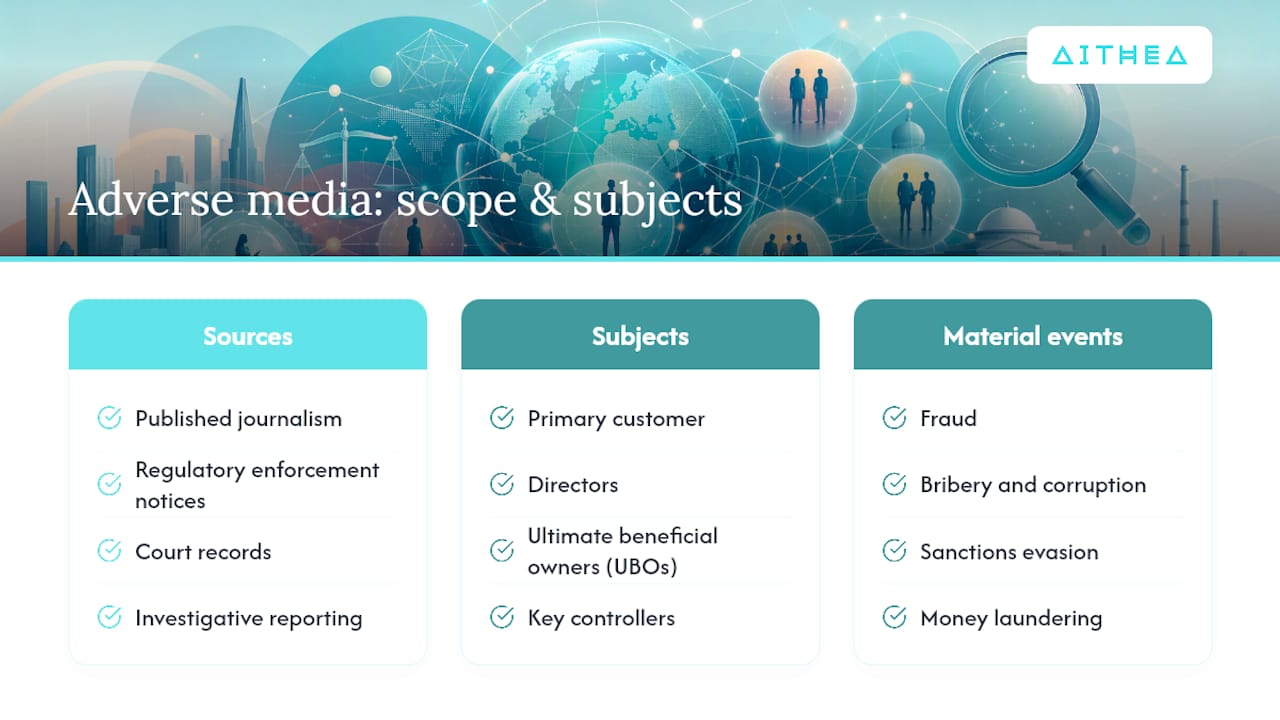
Adverse media, also referred to in practice as negative news screening or open-source adverse information, encompasses any publicly available content that suggests a subject is connected to financial crime, serious misconduct, or reputational risk. The term is broader than it sounds. It includes published journalism, regulatory enforcement notices, court records, and credible investigative reporting, but the scope of what counts as "material" is where most programmes go wrong.
The subjects in scope for a defensible programme extend well beyond the primary customer. Directors, ultimate beneficial owners (UBOs), key controllers, significant vendors, and related parties all carry risk that can flow back to the institution. A customer who appears clean in isolation may be controlled by a UBO with a documented history of bribery in a high-risk jurisdiction. Screening only the legal entity misses that entirely.
Wolfsberg Group guidance is clear on this point: a risk-based approach means aligning the extent, timing, and configuration of negative news screening to the firm's risk appetite and the customer's risk profile, rather than applying blanket searches to every name in the portfolio. Materiality, not volume, is the standard. Firms should evaluate source reliability when using vendor-supplied content, and configure their programmes to surface events that genuinely change a customer's risk assessment.
Event categories that are material for financial crime and reputational risk include fraud, bribery and corruption, sanctions evasion, money laundering, tax evasion, serious regulatory or enforcement actions, and credible reporting of involvement in organised crime. Not every negative article meets that threshold. A customer who received a parking fine or a minor employment tribunal ruling does not present the same risk as one named in a Serious Fraud Office investigation. Scope decisions must be anchored in the firm's risk appetite and customer segmentation, with higher-risk segments triggering broader and more frequent searches.
What sources should you monitor for adverse media?
Coverage decisions are where programmes either build genuine intelligence or generate noise. The instinct to cast the widest possible net is understandable, but without source quality controls it produces an unmanageable volume of low-value alerts.
- Negative news screening FAQs (Wolfsberg Group)
- Adverse Media Screening: The Definitive Guide for Financial Institutions │ smartKYC
- Adverse media screening: Process, tuning, and risks (didit.me)
- Adverse media screening: An overview (Thomson Reuters Legal)
- Adverse Media Screening (LexisNexis International)
- CPJ emergencies risk assessment template (Committee to Protect Journalists)
- Digital risk assessment template (SaferJourno)
- HM Revenue & Customs (GOV.UK)
Pro Tip: Build a tiered source taxonomy before configuring any vendor feed. Assign credibility weights to source categories and use those weights in your materiality rules. This prevents a single unverified social post from triggering the same alert priority as an FCA enforcement notice.
How does the adverse media screening process work, step by step?
A well-designed media screening process is not a single search event. It is a repeating workflow with defined decision points, documented rationale, and clear escalation paths. Here is how it maps in practice:
-
Identification and search string design. Define the subject's name variants, including transliterations, aliases, former names, and associated entities. For individuals, add date of birth, nationality, and known roles. For legal entities, include registration numbers, trading names, and key controllers. Poor search string design is the single largest driver of both false positives (too broad) and false negatives (too narrow).
-
Automated screening and matching. Run the search strings against your data sources, whether through a vendor platform or a combination of feeds. The system returns candidate matches, which must then be assessed for identity. Exact-match rules alone are insufficient: a subject named "Mohammed Al-Hassan" will appear in dozens of transliteration variants across Arabic-language sources. Fuzzy matching and phonetic algorithms are necessary, but they increase false positive volume.
-
False positive triage. This is where analyst time is consumed. Each candidate match must be assessed: is this the same person or entity as the subject? Disambiguation requires checking identity attributes (date of birth, nationality, known addresses, roles) against the article context. Adverse reporting frequently predates sanctions or enforcement actions, so dismissing a match too quickly carries real risk.
-
Relevance and materiality analysis. Once identity is confirmed, assess whether the event is material. What is the allegation? What stage has it reached? An allegation is not a conviction. LexisNexis guidance on adverse media is explicit on this: reviewers must record the event stage (allegation, investigation, charge, conviction, acquittal) and apply policy consequences proportionate to that stage. Conflating an allegation with a conviction in the audit record is a governance failure.
-
Decision and escalation. Outcomes fall into four categories: no change to the customer's risk profile; gather additional information before deciding; escalate for enhanced due diligence (EDD); or decline/exit the relationship. Each outcome must be approved at the appropriate level, with the approval authority defined in policy.
-
Documentation and audit trail. Record the search terms used, the sources queried, the date and time, the candidate matches reviewed, the identity assessment, the materiality conclusion, and the decision rationale. Preserve a snapshot of the source article. A documented assessment that connects the subject to the relevant event, preserves the source and stage, and explains materiality is what supervisors will look for.
-
Ongoing monitoring and rescreens. Onboarding screening is a point-in-time check. High-risk customers require continuous or scheduled delta monitoring, so that new adverse reporting triggers a fresh review rather than waiting for the next periodic review cycle. Event-driven rescreens (a new sanction designation, a public enforcement action) should be triggered automatically.
Why are false positives so high, and how do you reduce them?
False positives are not a vendor failure. They are a structural consequence of how names, languages, and news content interact, and any team that expects a vendor to eliminate them entirely is setting itself up for disappointment. Understanding the root causes is the first step to managing them.
Name ambiguity is the primary driver. Common surnames in Chinese, Arabic, Spanish, and many other languages mean that a single search string can return thousands of articles about hundreds of different individuals. "Wang Wei" is one of the most common names in China; "Mohammed Ahmed" appears across dozens of jurisdictions. Without strong identity attribute matching (date of birth, nationality, known roles), automated systems cannot distinguish your customer from the other 10,000 people with the same name.
Transliteration compounds the problem. A name written in Arabic script may be romanised in six different ways across different publications and databases. A vendor that only matches on one romanisation will miss relevant hits; one that matches on all of them will generate significant noise. The quality of a vendor's transliteration and cross-script matching engine is one of the most important, and least discussed, procurement criteria.
- Syndicated content creates the illusion of multiple independent sources. A single wire story republished across 200 outlets appears as 200 separate hits. Without deduplication logic, analysts spend time reviewing the same underlying event repeatedly.
- Stale content resurfaces as new alerts when archive pages are re-indexed or when a vendor refreshes its crawl. An article from 2019 can appear as a new alert in 2026 if the vendor's freshness logic is poorly designed.
- Source credibility variation means that a low-quality blog post and an FCA enforcement notice may receive equal weighting in an untuned system. Without source scoring, analysts cannot prioritise.
Practical mitigations that work:
- Establish a materiality taxonomy that defines which event types and source categories trigger which alert priority. Apply it as a filter before alerts reach the analyst queue.
- Use delta monitoring for ongoing customers rather than re-running full historic searches. Only surface content that is genuinely new since the last review date.
- Configure identity attribute thresholds: require a minimum number of matching attributes (name plus date of birth, or name plus nationality plus known role) before a candidate match is escalated to human review.
- Build and maintain a labelled evaluation set that includes true matches, confirmed false positives, transliteration variants, and multi-script examples. Re-run this set before and after any material change to your configuration to measure whether tuning has improved or degraded performance.
- Apply human-in-the-loop triage at the right point: automation handles volume, humans handle judgement. The goal is to reduce the analyst queue to genuinely ambiguous cases, not to automate the decision entirely.
Which technology capabilities actually matter when evaluating vendors?
Vendor marketing for adverse media solutions is dense with claims about coverage, accuracy, and AI capability. The table below maps the capabilities that matter operationally to the questions you should ask vendors to substantiate them.
| Capability | What it means in practice | How to test the claim |
|---|---|---|
| Source coverage | Number of sources, languages, and regional depth | Request a source list sample and coverage map by language and jurisdiction |
| Freshness | How quickly new content appears in the feed | Ask for mean time from publication to indexing; test with a recent known event |
| Entity resolution | Ability to match name variants, aliases, transliterations, and cross-script forms | Run a labelled test set including transliteration variants and common-name examples |
| NLP and relevance scoring | Contextual understanding of allegation framing, event stage, and subject role | Test with articles where the subject is mentioned peripherally versus centrally |
| Alert modes | Continuous, scheduled, delta, and historic look-back options | Confirm whether delta monitoring is available and how it handles re-indexed archive content |
| Explainability | Source snapshot preservation, decision rationale fields, reviewer notes | Request a sample audit trail export and check whether source snapshots are preserved |
| Integration | API availability, case-management connectors, AML system integration | Review API documentation; ask about existing connectors to your case-management platform |
| Vendor metrics | Precision, recall, false positive rate, mean time to triage | Ask for these figures from a labelled evaluation; do not accept marketing-deck numbers |
Two points deserve emphasis. First, native-language NLP is materially better than translate-then-search workflows. Translation introduces contextual errors that distort allegation framing, particularly for languages with complex morphology. A vendor that translates content into English before applying NLP is operating with a structural disadvantage. Second, AI and NLP genuinely transform negative media analysis from keyword hunting into evidence-linked, explainable risk signals, but only when the AI is benchmarked with labelled data and produces auditable outputs. A black-box score that cannot be explained to a supervisor is not a compliance tool. For a broader view of how AI is reshaping sanctions and watchlist screening, the same principles of explainability and benchmarking apply.
What should your vendor RFP and procurement process look like?
A defensible procurement process is not just good governance; it is the mechanism by which you discover whether a vendor's claims hold up under operational conditions. Ai-thea's experience supporting compliance teams through technology procurement consistently shows that the gap between vendor marketing and real-world performance is widest in three areas: false positive rates, multilingual coverage depth, and integration complexity.
Minimum data requests before shortlisting:
- A sample source list with language and jurisdiction breakdown
- Coverage maps for the specific regions and languages relevant to your customer portfolio
- Sample snapshots of how the system captured a recent, publicly known adverse event (test this yourself against a known case)
Performance tests to run during a proof of concept:
- Provide a labelled evaluation set of your own, including confirmed true matches, confirmed false positives, transliteration variants, and common-name examples. Do not use the vendor's own test data.
- Run a blind test: give the vendor a set of subject names without telling them which are true matches, and measure precision and recall against your labels.
- Measure analyst time-to-triage before and after the PoC. If the vendor's tool does not reduce triage time, the NLP and relevance scoring are not working as claimed.
Operational SLAs to pin down contractually:
- Update frequency and mean time from publication to indexing
- Support and escalation windows, particularly for urgent risk events
- Snapshot preservation: how long are source article snapshots retained, and in what format?
Commercial models and hidden costs:
| Model | Typical structure | Watch for |
|---|---|---|
| Per-search | Fee per query run | Costs escalate rapidly with large portfolios or frequent rescreens |
| Per-record | Fee per subject monitored | Pricing may exclude UBOs and related parties; clarify scope |
| Subscription | Flat fee for defined volume | Overage charges and re-indexing fees can be significant |
| Hybrid | Base subscription plus per-search | Most common; negotiate overage caps and rescreen pricing separately |
Hidden costs to ask about explicitly: re-indexing fees, charges for API calls beyond a threshold, costs for additional language packs, and fees for audit trail exports.
Governance and proof points:
- Request an audit trail export in a format compatible with your case-management system
- Ask how the vendor maps its categories to FATF and Wolfsberg materiality definitions
- Confirm reviewer role definitions: who in the vendor's team decides what counts as adverse?
The Heliolus AI RegTech directory provides a structured starting point for identifying and shortlisting adverse media vendors, with coverage of the UK compliance technology market and filtering by capability category.
Key takeaways
Effective adverse media screening requires materiality discipline, multilingual coverage, and vendor accountability: programmes that lack all three will generate high analyst burden with low supervisory defensibility.
| Point | Details |
|---|---|
| Establish a materiality taxonomy | Define which event types and source categories trigger which alert priority before configuring any vendor feed. |
| Measure false positive rate formally | Build a labelled evaluation set and re-run it after every material configuration change to track whether tuning is working. |
| Demand native-language NLP | Translate-then-search workflows miss contextual nuance; require vendors to demonstrate native-language processing for your key jurisdictions. |
| Run a blind PoC with your own data | Use your own labelled test set, not the vendor's, and measure analyst time-to-triage as the primary performance metric. |
| Ai-thea supports procurement and PoC design | Ai-thea's technology matchmaking and RFP support helps compliance teams structure vendor evaluations and identify solutions via the Heliolus AI directory. |
The gap between vendor claims and operational reality
There is a pattern Ai-thea observes repeatedly when working with compliance teams on adverse media procurement: the decision is made on coverage numbers and a polished demo, and the false positive rate is discovered only after go-live. By that point, the analyst team is overwhelmed, the programme is producing noise rather than intelligence, and the firm faces a difficult conversation about whether to retune, re-procure, or simply absorb the cost.
The underlying problem is that false positives are not a bug that vendors fix before release. They are a structural feature of the data environment, and the only way to know a vendor's real-world false positive rate for your specific portfolio is to test it with your own data. A vendor who refuses to run a blind PoC with a client-supplied labelled set is telling you something important about their confidence in their own product.
What teams consistently underestimate is the change management dimension. A new adverse media tool is not a drop-in replacement for a manual process. It changes the analyst's workflow, the escalation logic, the documentation standard, and the governance model. Without structured training, feedback loops between analysts and the configuration team, and clear ownership of the tuning process, even a technically strong tool will underperform. The AI should function as a capable junior analyst: surfacing candidates, scoring relevance, flagging event stages, and preserving evidence. The senior judgement, the materiality call, the escalation decision, must remain with a trained human who can explain it to a supervisor.
Governance is not a constraint on AI adoption in this space. It is the condition under which AI becomes genuinely useful.
How Ai-thea helps compliance teams get adverse media right
Compliance teams that have worked through this guide know what good adverse media screening looks like. Getting from current state to that standard, particularly when it involves procuring new technology, running a PoC, or restructuring an existing programme, is where the operational complexity concentrates.

Ai-thea works with compliance teams and financial institutions at exactly this point: structuring RFPs, designing PoC frameworks, evaluating vendor claims against real portfolio data, and mapping technology capabilities to regulatory requirements. The Heliolus AI RegTech directory gives teams a structured way to identify and compare adverse media vendors by capability, coverage, and integration profile, without starting from a blank page. For teams ready to move from evaluation to procurement, or who want support designing a labelled test set and blind PoC, get in touch with Ai-thea to discuss your specific programme requirements.
Useful sources and further reading
| Source | What it covers | Best used for |
|---|---|---|
| Wolfsberg Group: Negative News Screening FAQs | Risk-based approach, materiality, source evaluation | Policy design, programme scope decisions |
| Thomson Reuters: Adverse Media Screening Overview | Regulatory and supervisory expectations, audit requirements | Documentation standards, supervisor readiness |
| smartKYC: Adverse Media Screening Guide | Continuous monitoring, multilingual NLP, early warning signals | Technology evaluation, coverage decisions |
| didit.me: Process, Tuning, and Risks | Search string design, event staging, labelled evaluation sets | Operational tuning, PoC design |
| LexisNexis: Adverse Media Screening | Event-stage classification, policy consequences | Analyst training, decision documentation |
| CPJ: Emergencies Risk Assessment Template | Source reliability assessment for investigative reporting | Validating grey literature and investigative sources |
| SaferJourno: Digital Risk Assessment Template | Digital threat assessment, source integrity validation | Ethical handling of investigative and social sources |
| HMRC / GOV.UK | UK AML obligations, regulatory framework | Jurisdictional compliance anchoring |
A note on source preservation: whenever adverse media content informs a compliance decision, preserve a snapshot of the source at the time of review. Web content changes and is deleted. A URL alone is not evidence.
FAQ
What is adverse media screening?
Adverse media screening is the process of searching publicly available sources, including news, regulatory records, and court filings, to identify negative information about a customer, counterparty, or beneficial owner that may indicate financial crime risk. It is a required component of risk-based customer due diligence under UK AML regulations.
What are the guidelines for adverse media screening in the UK?
UK firms must follow a risk-based approach aligned with the Money Laundering Regulations 2017, FCA supervisory expectations, and Wolfsberg Group principles. The Wolfsberg FAQs on negative news screening specify that programmes should be proportionate to risk appetite, focused on material events, and supported by auditable documentation of every decision.
What does the adverse media check process involve?
The process runs from search string design and automated matching through false positive triage, materiality analysis, and a documented decision (no change, gather information, escalate, or exit). Each stage requires a recorded rationale, and source snapshots must be preserved at the time of review.
What triggers an AML check that includes adverse media?
Adverse media rescreens are triggered at onboarding, at periodic review intervals (with frequency set by risk segment), and by specific events such as a new sanction designation, a public enforcement action, or a material change in the customer's business or ownership structure. High-risk customers should be subject to continuous or delta monitoring between scheduled reviews.
How do you reduce false positives in adverse media screening?
The most effective mitigations are a defined materiality taxonomy, identity attribute thresholds that require multiple matching data points before escalating to human review, deduplication logic to suppress syndicated content, and delta monitoring to surface only genuinely new content. A labelled evaluation set, re-run after every configuration change, is the only reliable way to measure whether tuning is working.